
Beautiful Colors That Start With R (With Pictures & Names)

Anyone who has ever opened a design program and stared blankly at a color picker knows the problem. There are thousands of named shades out there, and finding the right one by letter can feel like searching for a single book in an unsorted library. This guide solves that problem for one letter specifically. It brings together every recognized, well-documented shade among the many colors that start with R, from the fiery brightness of Red to the quiet earthiness of Russet.
The list is organized in layers rather than as one giant wall of text. It opens with the most recognizable R colors, then moves into color families, common use cases, and finally a full alphabetical reference with hex and RGB codes for quick lookup. This structure means a graphic designer can jump straight to the hex/RGB crosswalk, while someone naming a paint color for a nursery can linger in the section on soft, nature-inspired shades instead.
People search for this kind of list for very different reasons. Designers need exact hex codes that will render consistently across browsers and print files. Painters and illustrators want descriptive names that spark ideas rather than technical values. Parents naming a pet, a boat, or even a child sometimes want a pretty word tied to a specific hue. Trivia lovers just enjoy discovering that a color like “Razzmatazz” is real and has an exact numeric identity. This guide tries to serve all of these readers at once.
Quick Answer: The Standout R Colors at a Glance
If there is only time to remember a handful of names, these are the colors that start with R worth knowing first. Red (#FF0000) tops the list simply because it is one of the three primary colors in both the RGB and RYB color models, making it foundational rather than optional. Royal Blue (#4169E1) earns its spot for being one of the most requested “blue” shades in web and fashion design, prized for looking rich without turning as dark as navy. Rust (#B7410E) and Russet (#80461B) matter because they anchor the autumn and industrial-design color palettes that show up constantly in branding and home décor.
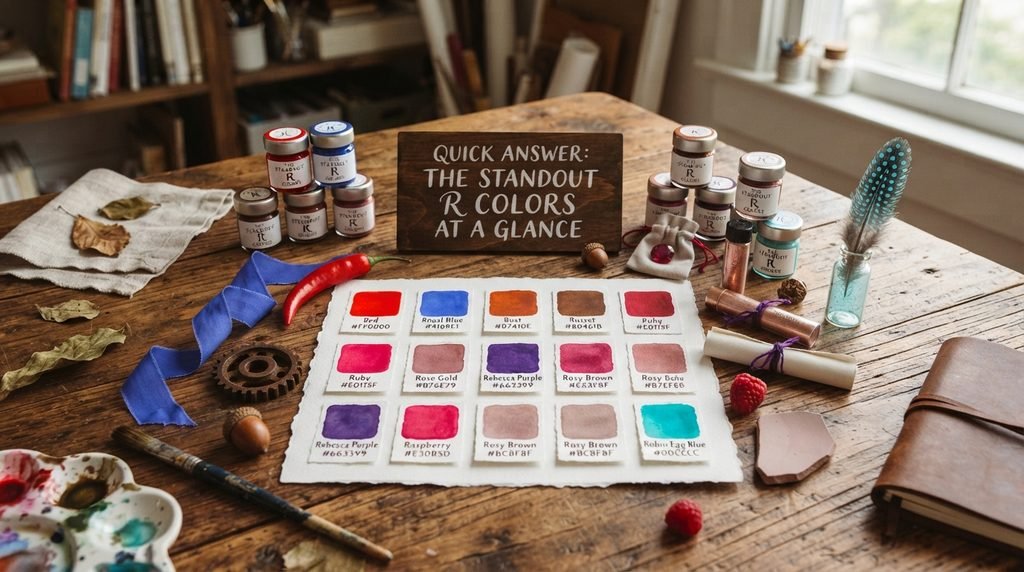
Ruby (#E0115F) and Rose Gold (#B76E79) are the two most searched-for R colors in jewelry and beauty, each carrying strong emotional associations tied to gemstones and metals. Rebecca Purple (#663399) deserves a mention purely for its story, since it is the only CSS color named after a real person. Rounding out the list, Raspberry (#E30B5D), Rosy Brown (#BC8F8F), and Robin Egg Blue (#00CCCC) each represent a distinct family, pink-red, muted neutral, and blue-green, showing just how wide the letter R actually stretches across the color wheel.
What R Colors Tend to Symbolize
Color names starting with R lean heavily toward warmth, energy, and richness, though the letter also produces some surprisingly calm, muted shades. Red-based names dominate the list, and red itself carries some of the strongest psychological weight of any color, tied to passion, urgency, and even physical arousal in controlled studies of human response. That emotional intensity carries over into red’s many R-named relatives, so a shade like Rufous or Rosso Corsa still reads as bold and energetic even in a slightly muted or darkened form.
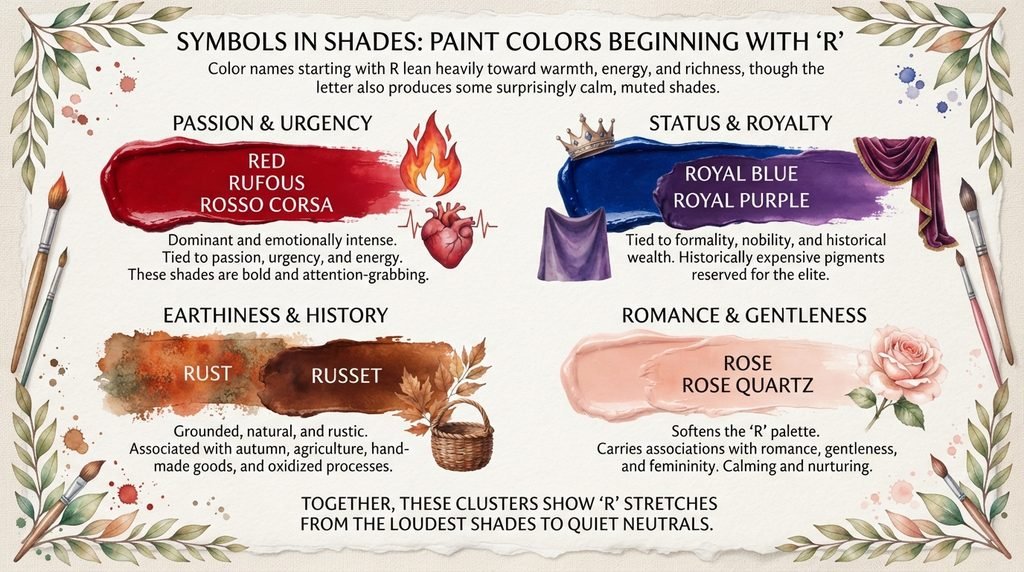
Rust and Russet occupy a different emotional register entirely. Both shades come from natural processes, oxidized iron for rust and a coarse woven fabric for russet, and both carry a grounded, earthy feeling associated with autumn, agriculture, and handmade goods. Royal Blue and Royal Purple lean into a completely different symbolic tradition, one tied to status and formality, since both trace back to pigments and dyes that were historically expensive and reserved for nobility. Rose-based names, by contrast, soften the letter R considerably, pulling in associations with romance, gentleness, and femininity that balance out red’s more aggressive cousins. Together, these clusters show that R is not a one-note letter; it stretches from the loudest, most attention-grabbing shade on the color wheel to some of its quietest neutrals.
R Colors Grouped by Family
Splitting these names into families makes the list far easier to use, since a person hunting for a warm accent wall color and a person hunting for a calming bedroom shade are looking in completely different directions.
The reds and pinks form the single largest cluster among R colors, and for good reason: red is the root of the letter’s most famous entry. This family includes Red itself, Raspberry, Rose, Rose Red, Ruby, Rosewood, Rufous, Roman, and Razzmatazz. Most of these shades sit somewhere between true red and true pink, differing mainly in how much blue or orange undertone gets mixed in, which is why Ruby leans purple-pink while Rufous leans brown-red.
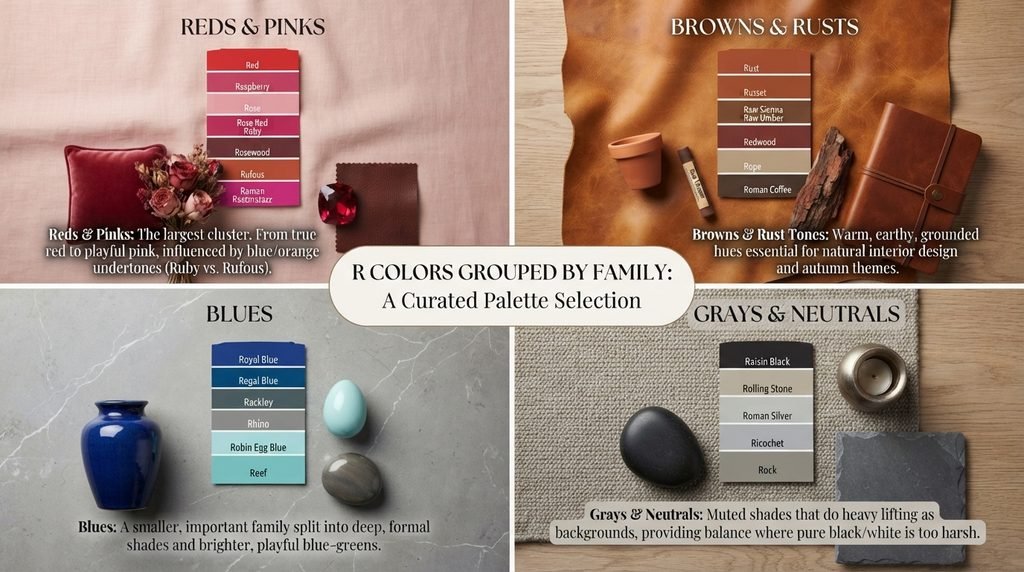
The browns and rust tones form the second-largest group, built around Rust, Russet, Raw Sienna, Raw Umber, Redwood, Rope, and Roman Coffee. These shades share a warm, earthy base and show up constantly in interior design, leather goods, and autumn-themed branding, since they read as natural and grounded rather than synthetic.
The blues are a smaller but important family, anchored by Royal Blue, Regal Blue, Rackley, Rhino, and Robin Egg Blue. This group splits into two moods: the deep, formal blues like Royal Blue and Regal Blue, and the brighter, playful blue-greens like Robin Egg Blue and Reef.
The grays and neutrals, including Raisin Black, Rolling Stone, Roman Silver, Ricochet, and Rock, round out the list. These muted shades rarely stand out on their own, but they do heavy lifting as backgrounds and text colors in design work where a pure black or white would feel too harsh.
R Colors in Design and Branding
Certain R colors show up again and again in logos, web design, and product packaging, and it is worth understanding why. Royal Blue remains one of the most requested “trustworthy but not boring” blues in corporate branding, since it carries more energy than navy while still reading as professional. Rebecca Purple has a smaller but devoted following among web developers specifically, largely because of its origin story: it was added to the CSS color specification in memory of Eric Meyer’s daughter Rebecca, who passed away from brain cancer at age six, making it one of the few named colors with a documented human tribute behind it rather than a marketing team.
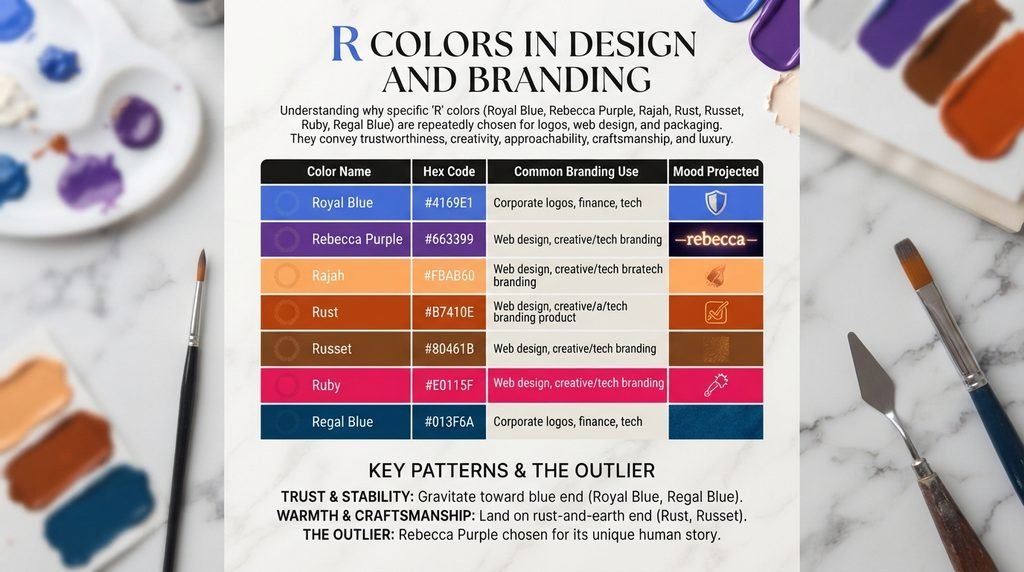
Rust and Russet have found a strong second life in modern branding trends tied to sustainability and craftsmanship, since both shades signal “natural” and “handmade” far more convincingly than a bright synthetic orange ever could. This table gathers the R colors most frequently chosen for design and branding work, alongside the general reason each one gets picked and the mood it tends to project once applied to a logo or interface.
| Color Name | Hex Code | Common Branding Use |
| Royal Blue | #4169E1 | Corporate logos, finance, tech |
| Rebecca Purple | #663399 | Web design, creative/tech branding |
| Rajah | #FBAB60 | Friendly, approachable consumer brands |
| Rust | #B7410E | Sustainable, artisanal, autumn-themed brands |
| Russet | #80461B | Leather goods, outdoor and heritage brands |
| Ruby | #E0115F | Beauty, jewelry, luxury branding |
| Regal Blue | #013F6A | Premium or exclusive-feeling brands |
Looking at this table, a clear pattern emerges: brands chasing trust and stability gravitate toward the blue end (Royal Blue, Regal Blue), while brands chasing warmth or craftsmanship land on the rust-and-earth end (Rust, Russet). Rebecca Purple stands out as the outlier here, chosen less for its visual properties and more for the story it lets a brand tell.
R Colors in Fashion and Beauty
Fashion and beauty brands reach for R colors constantly, particularly from the pink-red and metallic-adjacent families. Rose Gold became a cultural phenomenon after Apple used it for the iPhone 6s in 2015, but the shade itself dates back much further, tracing its roots to the Fabergé eggs of the 19th century, long before it became a smartphone finish. Ruby continues to dominate gemstone-inspired lipstick and nail polish naming, trading on the gemstone’s association with deep, confident red rather than the brighter, more playful tone of pure Red. Rose itself sits in an interesting middle ground: technically closer to red than pink on a color wheel, it still reads as romantic and soft in most fashion contexts because of its strong floral association.
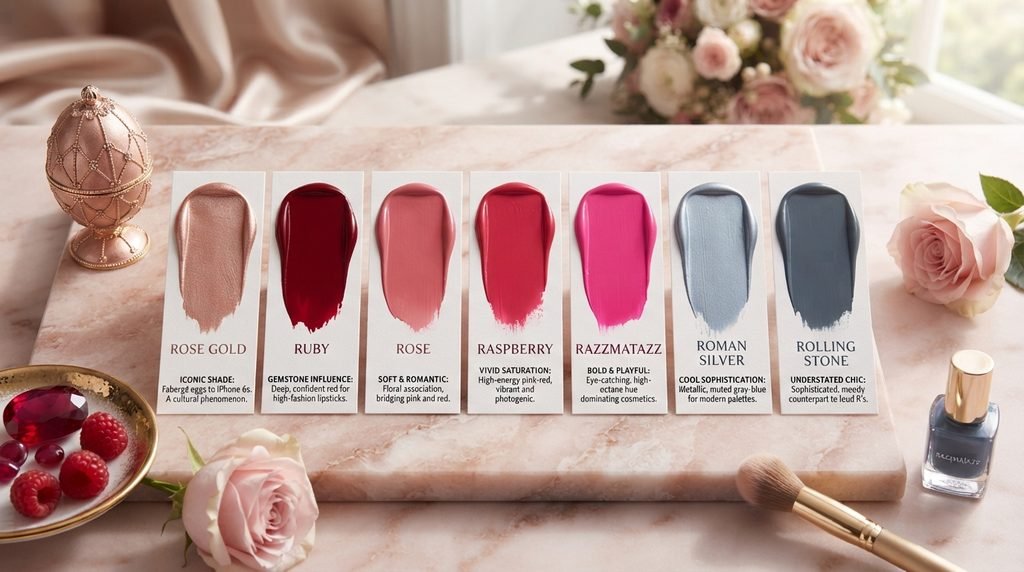
Raspberry and Razzmatazz round out the beauty-industry favorites, both leaning into vivid, high-saturation pink-reds that photograph well and stand out on a shelf. Roman Silver and Rolling Stone occasionally appear in metallic or “cool girl” makeup palettes, offering a muted, sophisticated gray-blue alternative to the louder shades dominating the rest of the R family.
Rare and Unusual R Color Names
Some R color names read less like standard vocabulary and more like tiny stories, and a few deserve a closer look before landing in any table. Rangitoto is a deep, green-black named directly after Rangitoto Island, a volcanic island near Auckland, New Zealand, chosen specifically because the shade echoes the dark volcanic rock covering the island’s surface. Ronchi, one of the odd entries in the entire alphabet, borrows its name from an Italian neighborhood and lands as a warm, golden yellow with no obvious visual connection to its geographic namesake, which is part of what makes it feel so obscure.
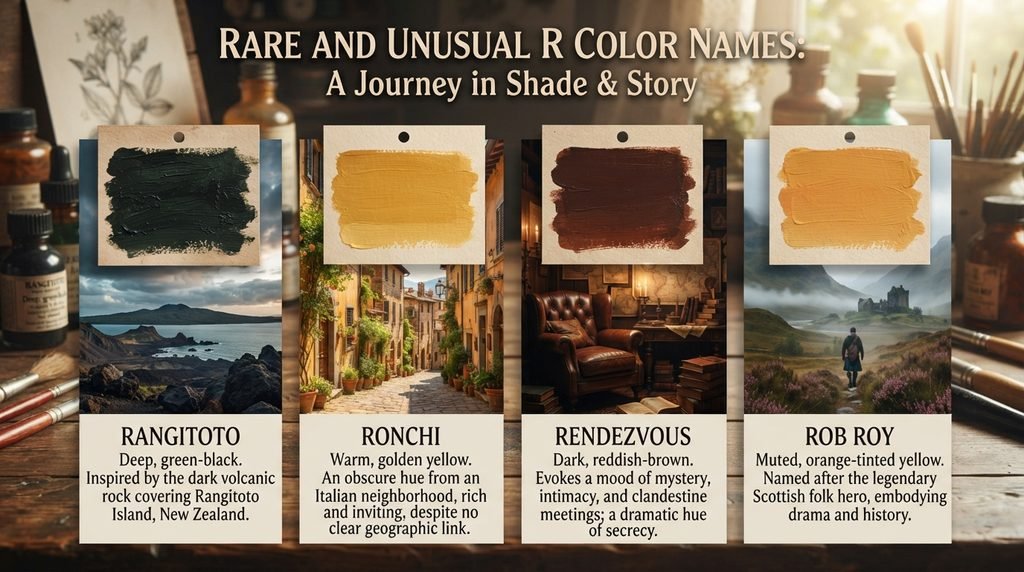
Rendezvous takes its name from the French phrase for an appointment or meeting, and it shows up as a dark, reddish-brown, an association that likely stems more from a general sense of mystery and intimacy than from any literal connection to meetings. Rob Roy, a muted, orange-tinted yellow, borrows its name from the famous Scottish folk hero, following a naming convention where a color gets tied to a legendary or historical figure to lend it a sense of drama. These names rarely show up in everyday design work, but they matter for exactly that reason: they demonstrate how deep and specific color-naming traditions can get once you move past the fifty or so shades most people already know.
Colors That Are Easy to Confuse With Each Other
A handful of R colors sit close enough together on the color wheel that mixing them up is genuinely easy, especially when working from a small screen or a printed swatch book. Rust (#B7410E) and Russet (#80461B) are the most commonly confused pair, since both are brownish-orange earth tones; the key difference is that Rust leans more orange and saturated, evoking oxidized metal, while Russet sits darker and more muted, closer to a dry autumn leaf. Royal Blue (#4169E1) and Regal Blue (#013F6A) create a similar problem, both reading as “rich blue” at a glance, though Royal Blue is noticeably brighter and lighter, while Regal Blue drops into a much darker, almost navy-adjacent register.
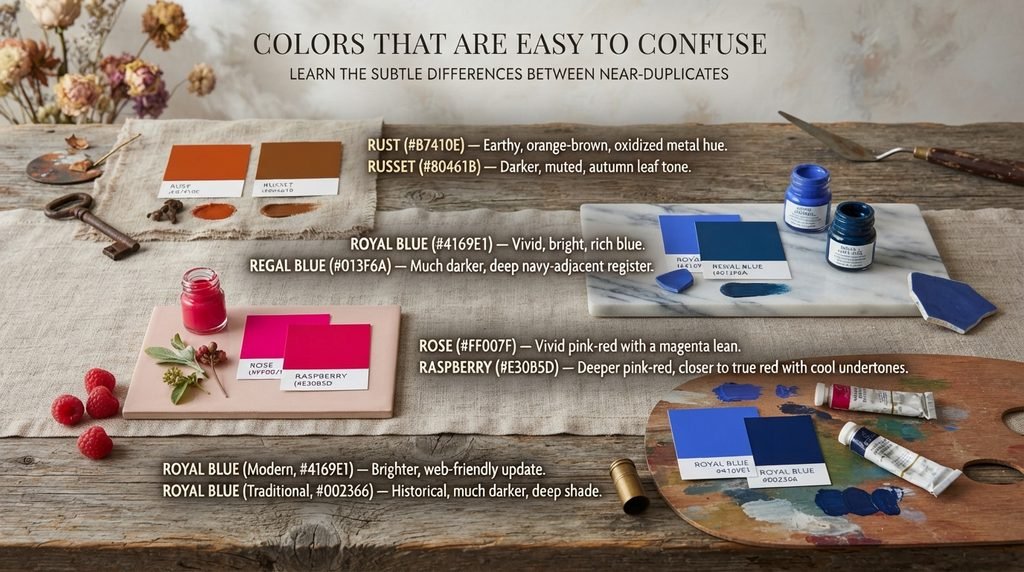
Rose (#FF007F) and Raspberry (#E30B5D) also blur together for many people, since both are vivid pink-reds; Rose carries a slightly more magenta lean, while Raspberry pulls closer to true red with a cooler pink undertone layered on top. Finally, Royal Blue (Modern, #4169E1) and Royal Blue (Original/Traditional, #002366) technically share a name but represent two genuinely different eras of the color, the modern version being a brighter, web-friendly update of a much darker historical shade. Anyone picking colors for a project where consistency matters should always confirm the exact hex code rather than relying on the name alone, precisely because these near-duplicates exist.
Master Alphabetical List of R Colors
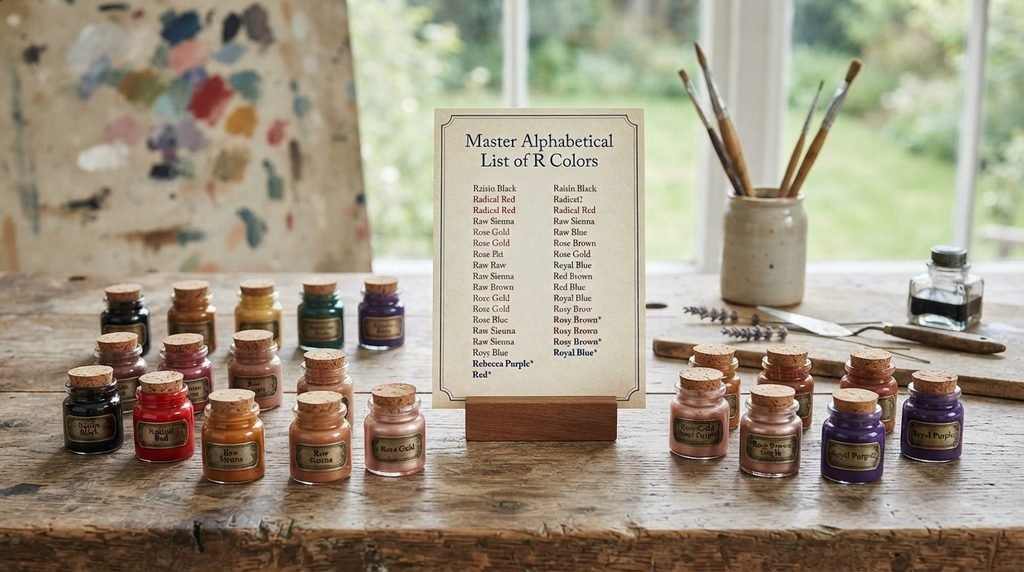
This list gathers the colors covered throughout the guide into one alphabetical reference, mixing standardized CSS/X11 web colors with widely documented traditional and commercial names. Standard web colors, meaning names built into the official CSS specification, are marked accordingly, while the rest are established names drawn from long-standing color-reference sources rather than official coding standards. Both types are useful, but it is worth knowing which is which before locking a brand’s entire palette around a name that a browser will not actually recognize.
- Rackley (traditional)
- Radical Red (traditional)
- Rajah (traditional)
- Raisin Black (traditional)
- Raspberry (traditional)
- Raw Sienna (traditional pigment name)
- Raw Umber (traditional pigment name)
- Rebecca Purple (CSS standard)
- Red (CSS/X11 standard)
- Redwood (traditional)
- Reef (traditional)
- Regal Blue (traditional)
- Rifle Green (traditional)
- Robin Egg Blue (traditional)
- Roman Silver (traditional)
- Rose (traditional)
- Rose Gold (traditional)
- Rosewood (traditional)
- Rosso Corsa (traditional/motorsport)
- Rosy Brown (CSS/X11 standard)
- Rouge (traditional)
- Royal Blue (CSS/X11 standard)
- Royal Blue Traditional (historical reference shade)
- Royal Purple (traditional)
- Rufous (traditional)
- Russet (traditional)
- Rust (traditional)
This mix shows something important about how color naming actually works online. Only a small handful of R names — Red, Rosy Brown, Royal Blue, and Rebecca Purple — are guaranteed to render correctly if typed directly into CSS code.
Hex and RGB Crosswalk: Why Exact Codes Matter
A color name alone is not enough for serious design work, because names are interpreted differently depending on the source, the software, and even the printer being used. A hex code, by contrast, points to one exact, unambiguous value that will render identically on any modern screen, which is why professional designers treat the hex or RGB value as the real identity of a color and the name as more of a friendly label. This matters even more for R colors specifically, since names like “Rose” and “Red” can shift slightly depending on which database or crayon company originally coined them.
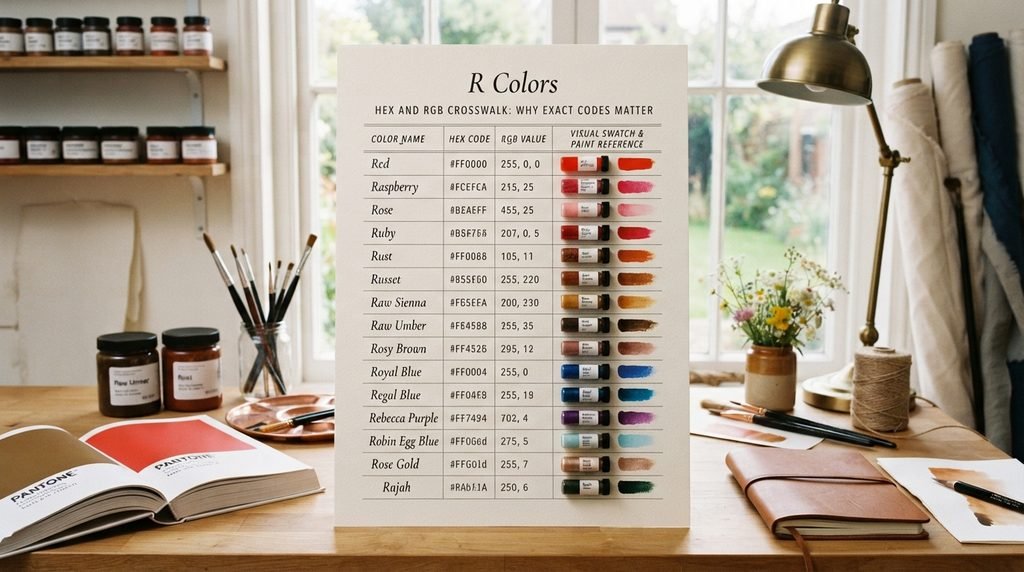
| Color Name | Hex Code | RGB Value |
| Red | #FF0000 | 255, 0, 0 |
| Raspberry | #E30B5D | 227, 11, 93 |
| Rose | #FF007F | 255, 0, 127 |
| Ruby | #E0115F | 224, 17, 95 |
| Rust | #B7410E | 183, 65, 14 |
| Russet | #80461B | 128, 70, 27 |
| Raw Sienna | #D27D46 | 210, 125, 70 |
| Raw Umber | #826644 | 130, 102, 68 |
| Rosy Brown | #BC8F8F | 188, 143, 143 |
| Royal Blue | #4169E1 | 65, 105, 225 |
| Regal Blue | #013F6A | 1, 63, 106 |
| Rebecca Purple | #663399 | 102, 51, 153 |
| Robin Egg Blue | #00CCCC | 0, 204, 204 |
| Rose Gold | #B76E79 | 183, 110, 121 |
| Rajah | #FBAB60 | 251, 171, 96 |
Notice how the RGB values confirm what the eye already suspects: Red sits at a pure, maximum-saturation point with zero green or blue, while a shade like Raw Umber shows all three RGB channels sitting closer together, which is exactly why it reads as a muted, brownish neutral rather than a vivid color. This kind of cross-check is a quick way to sanity-test whether a “new” color name actually behaves the way its description claims.
Full Comparison Table of R Colors
This expanded table brings together every color discussed throughout the guide, organized by name, hex code, RGB value, general color family, and the setting where each shade tends to get used most often. The “family” column groups each entry into red, pink, brown, blue, orange, purple, or neutral, making it easier to scan for a specific mood rather than reading through hex codes one at a time.
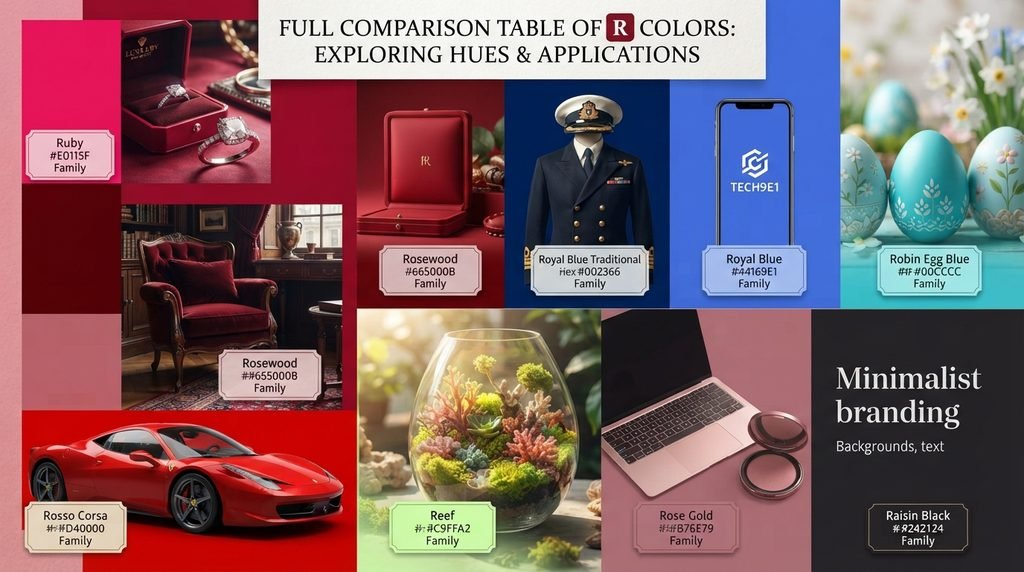
| Color Name | Hex | RGB | Family | Common Use |
| Red | #FF0000 | 255,0,0 | Red | Branding, alerts, primary design |
| Raspberry | #E30B5D | 227,11,93 | Pink-Red | Beauty, packaging |
| Radical Red | #FF355E | 255,53,94 | Red | Sportswear, energetic branding |
| Rose | #FF007F | 255,0,127 | Pink-Red | Fashion, romance-themed design |
| Rose Red | #C21E56 | 194,30,86 | Pink-Red | Floral and gift branding |
| Ruby | #E0115F | 224,17,95 | Pink-Red | Jewelry, luxury beauty |
| Rufous | #A81C07 | 168,28,7 | Red-Brown | Nature and wildlife design |
| Rosso Corsa | #D40000 | 212,0,0 | Red | Motorsport, automotive branding |
| Rouge | #A23B6C | 162,59,108 | Pink-Purple | Cosmetics |
| Rust | #B7410E | 183,65,14 | Orange-Brown | Autumn palettes, industrial design |
| Russet | #80461B | 128,70,27 | Brown | Leather goods, heritage branding |
| Raw Sienna | #D27D46 | 210,125,70 | Brown | Art, pigment-based work |
| Raw Umber | #826644 | 130,102,68 | Brown | Art, neutral interiors |
| Redwood | #A45A52 | 164,90,82 | Brown | Wood tones, cabin décor |
| Rosewood | #65000B | 101,0,11 | Dark Brown-Red | Furniture, formal branding |
| Rosy Brown | #BC8F8F | 188,143,143 | Muted Pink-Brown | Vintage design, soft interiors |
| Rajah | #FBAB60 | 251,171,96 | Orange | Friendly consumer branding |
| Royal Blue | #4169E1 | 65,105,225 | Blue | Corporate branding, tech |
| Royal Blue Traditional | #002366 | 0,35,102 | Dark Blue | Formalwear, uniforms |
| Regal Blue | #013F6A | 1,63,106 | Dark Blue | Premium branding |
| Rackley | #5D8AA8 | 93,138,168 | Blue-Gray | Corporate, calm interiors |
| Robin Egg Blue | #00CCCC | 0,204,204 | Blue-Green | Playful branding, spring themes |
| Reef | #C9FFA2 | 201,255,162 | Green | Nature, eco branding |
| Rifle Green | #414833 | 65,72,51 | Green | Military, outdoor gear |
| Royal Purple | #7851A9 | 120,81,169 | Purple | Luxury, royalty-themed branding |
| Rebecca Purple | #663399 | 102,51,153 | Purple | Web/tech branding |
| Rose Gold | #B76E79 | 183,110,121 | Metallic Pink | Beauty, tech products |
| Raisin Black | #242124 | 36,33,36 | Neutral/Black | Backgrounds, text |
| Roman Silver | #838996 | 131,137,150 | Gray | Metallic and industrial design |
| Rolling Stone | #747D83 | 116,125,131 | Gray | Minimalist branding |
A few rows stand out from this table immediately. Rosewood, at #65000B, is one of the darkest entries here, sitting so close to black that it functions almost like a warm alternative to true black in furniture and formal design work. Royal Blue Traditional at #002366 makes a useful reminder that the same color name can shift meaningfully over time, since its modern counterpart is dramatically brighter. Reef, at #C9FFA2, is the clear outlier for anyone expecting every R color to lean red or brown, proving the letter covers far more of the color wheel than its most famous entries suggest.
Decision Table: Picking the Right R Color for the Job
Choosing a color name from a list is only half the job; matching that color to an actual purpose is where most of the real decision-making happens. The table below organizes a handful of dependable R colors by the type of project they suit best, whether that is a logo, a wall color, or a wedding palette, so a reader can jump straight to their use case instead of scrolling back through every section above.
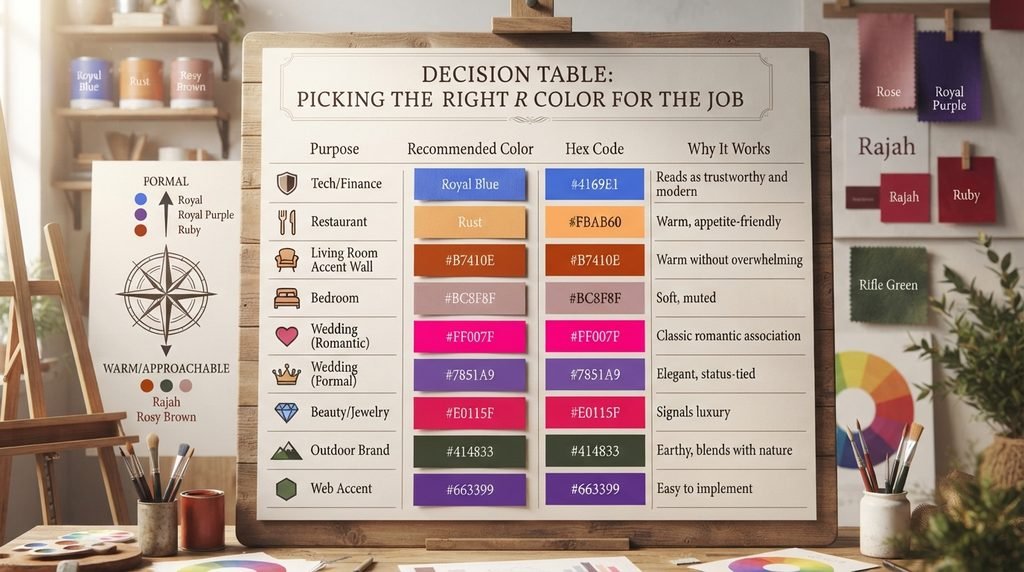
| Purpose | Recommended Color | Hex Code | Why It Works |
| Tech or finance logo | Royal Blue | #4169E1 | Reads as trustworthy and modern |
| Restaurant or food branding | Rajah | #FBAB60 | Warm, appetite-friendly, approachable |
| Accent wall in a living room | Rust | #B7410E | Warm without overwhelming a room |
| Bedroom wall paint | Rosy Brown | #BC8F8F | Soft, muted, easy to live with |
| Wedding color theme (romantic) | Rose | #FF007F | Classic romantic association |
| Wedding color theme (formal) | Royal Purple | #7851A9 | Elegant, historically tied to status |
| Beauty or jewelry branding | Ruby | #E0115F | Signals luxury and richness |
| Outdoor/nature brand | Rifle Green | #414833 | Earthy, blends with natural themes |
| Web development accent color | Rebecca Purple | #663399 | Built into CSS, easy to implement |
The clearest pattern in this table is that warmth and formality pull in opposite directions. Anything meant to feel cozy or approachable — a restaurant, a living room, a casual brand — leans toward Rust, Rajah, or Rosy Brown, while anything meant to feel formal or prestigious —a wedding, a finance logo, jewelry — gravitates toward Royal Blue, Royal Purple, or Ruby. Knowing which side of that line a project falls on makes picking the right R color far faster.
Conclusion
The letter R turns out to hold one of the richest, most varied groups of named colors in the entire alphabet, stretching from the pure intensity of Red all the way to the quiet earthiness of Russet and the soft romance of Rose. Whether the goal is finding an exact hex code for a logo, a descriptive name for a paint chip, or just satisfying curiosity about how many colors that start with R actually exist, this list covers the full range, backed by verified hex and RGB data rather than guesswork. Anyone building a palette around this letter has genuine variety to work with, not just a handful of red variations repeated under different names.
Frequently Asked Questions
How many colors start with the letter R?
There are well over 150 documented colors that start with R once traditional, commercial, and CSS/X11 standard names are combined, ranging from common shades like Red and Rust to rarer names like Ronchi and Rangitoto.
What is the most popular color that starts with R?
Red is by far the most recognized and widely used color starting with R, largely because it functions as a primary color in both the RGB and RYB color models.
Is “Rosy Brown” an official web color?
Yes, Rosy Brown is part of the official CSS/X11 color specification, with the standardized hex code #BC8F8F, meaning it will render correctly in any browser or CSS file without needing a manual hex value.
What color is Rebecca Purple, and why is it named that?
Rebecca Purple is a deep, blue-tinted purple with the hex code #663399, added to the CSS specification in memory of Rebecca Meyer, the daughter of web designer Eric Meyer, making it one of the only officially standardized colors named after a specific real person.
What is the difference between Rust and Russet?
Rust (#B7410E) is a brighter, more orange-leaning brown inspired by oxidized iron, while Russet (#80461B) is darker and more muted, originally named after a coarse woven fabric rather than a natural chemical process.
What color is Royal Blue, and does it have more than one version?
Royal Blue commonly refers to the modern, brighter shade at #4169E1, but there is also a darker, historical “Royal Blue Traditional” at #002366, and confusing the two can noticeably change the tone of a finished design.