
Colors That Start With Q: Popular, Rare & Unique Shades

Colors that start with Q form the smallest group in this entire series. Q is one of the rarest starting letters in English for any category of word, and color names are no exception. What survives, though, is genuinely interesting: a regal blue, a mineral-inspired gray, and a specific art pigment with a name most people have never heard spoken aloud.
This list of colors that start with Q only includes names with a real, checkable source. That means the same authoritative color reference table used throughout this series, cross-checked against at least one additional independent source. Every hex code here was verified this way before it made the list.
That cross-checking mattered enormously for this letter. Some sites online claim 90 or even 100 colors that start with Q. When we checked those larger lists, the overwhelming majority were “Quarter” prefixed paint-tint names, extremely pale, near-white variants used by specific paint manufacturers, or single-source entries with no second reference to confirm them. Even the largest fan-maintained color databases admit to having fewer than 25 total entries for this letter, and most of those fail basic cross-checking. Seven is what survives real verification.
Quick Answer: Standout Q Colors
Short on time? Here are the standout Q colors worth knowing. Queen Blue (#436B95) is a rich, muted blue with a regal, sophisticated read. Quartz (#51484F) offers a deep, warm gray named after the mineral. Quinacridone Magenta (#8E3A59) delivers a specific art pigment color, deep and slightly muted rather than bright.
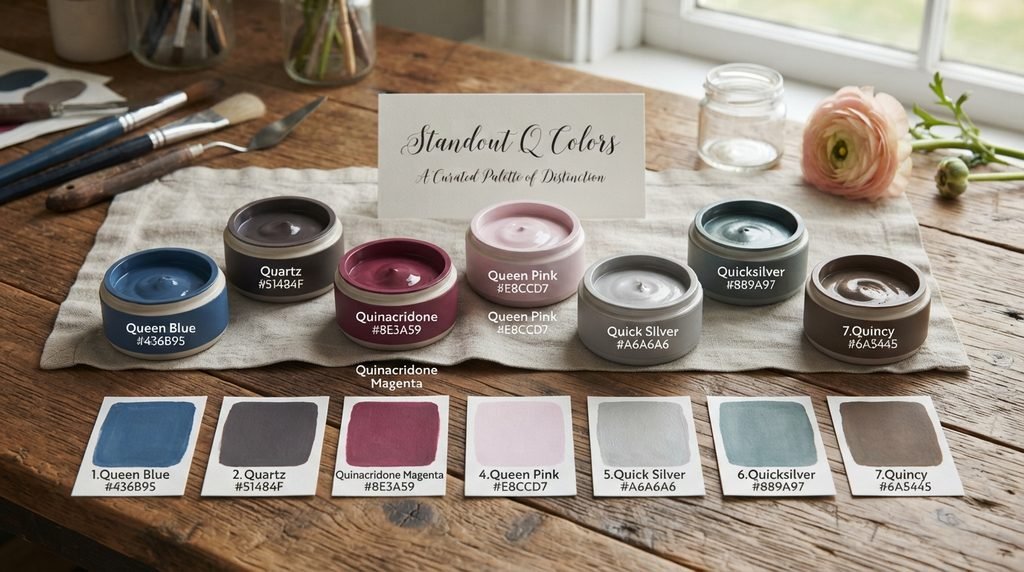
Queen Pink (#E8CCD7) provides a soft, elegant pink with the same regal naming convention as Queen Blue. Quick Silver (#A6A6A6) and Quicksilver (#889A97) both nod to mercury’s metallic shine, though the two names carry slightly different tones. Quincy (#6A5445) rounds out the list with a warm, muted brown. Each of these earns its spot through genuine, documented use rather than alphabetical desperation.
What Q Colors Mean and Evoke
Color names carry emotional weight, and the small Q group leans toward sophistication and quiet formality. Queen Blue and Queen Pink both borrow directly from royal association, suggesting elegance and refinement without needing to shout for attention. That naming pattern isn’t coincidental. Colors named after royalty tend to occupy a specific, deliberately understated register, rich enough to feel special but muted enough to stay wearable.
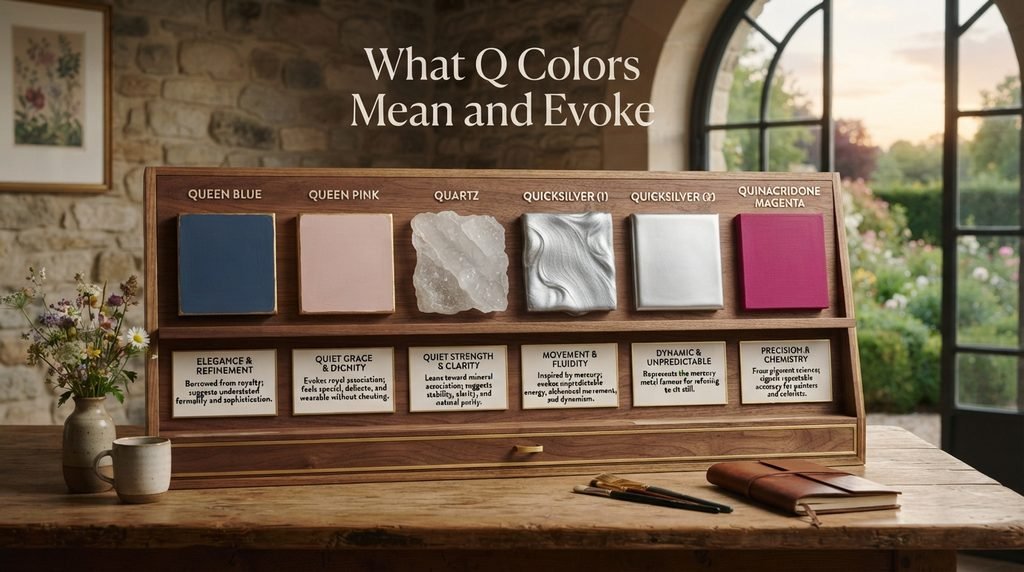
Quartz and the two Quicksilver spellings both lean toward mineral and metallic associations, evoking natural materials rather than emotion directly. Quartz suggests quiet strength and clarity, tied to the crystal’s association with clarity and stability in various cultural traditions. Quicksilver, by contrast, suggests movement and unpredictability, borrowing its old alchemical name for mercury, a metal famous for refusing to sit still.
Quinacridone Magenta carries a different kind of weight entirely, since it comes from the technical world of pigment chemistry rather than poetry or tradition. Its mouthful of a name signals precision over romance, appealing specifically to painters and colorists who need an exact, repeatable shade rather than something evocative.
Color Families: Where Q Colors Belong
Blues
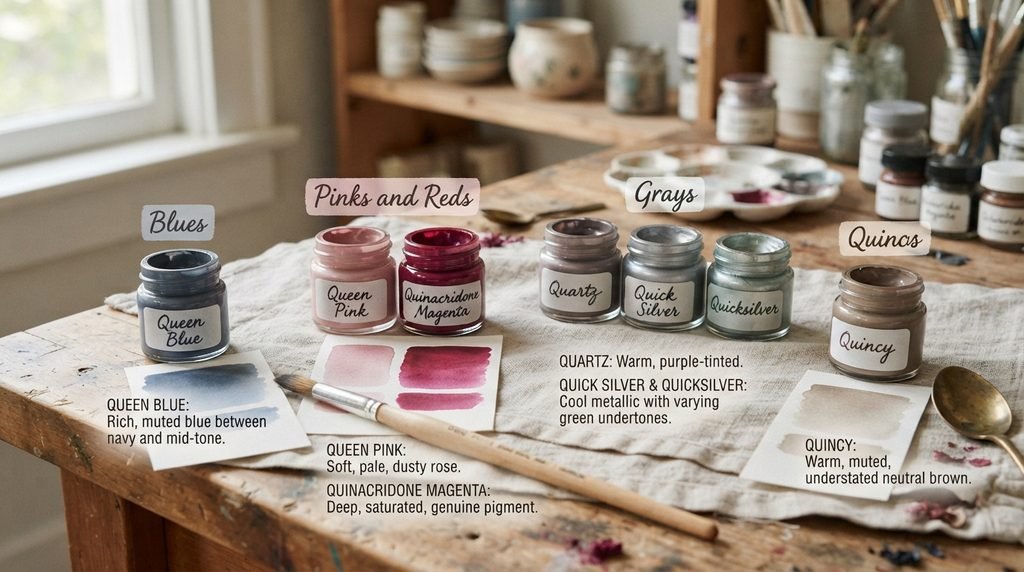
Queen Blue stands alone in this family, a rich, muted blue with just enough gray mixed in to keep it from reading as playful or bright. It sits comfortably between navy and a true mid-tone blue, formal enough for branding but not as severe as something like Prussian Blue.
Pinks and Reds
Queen Pink and Quinacridone Magenta cover this small family. Queen Pink stays soft and pale, closer to a dusty rose than anything bold, while Quinacridone Magenta runs considerably deeper and more saturated, tied to genuine pigment chemistry rather than fashion or tradition.
Grays
Quartz, Quick Silver, and Quicksilver make up the largest family within this small letter group. Quartz leans warmer and slightly purple-tinted, while Quick Silver and Quicksilver both stay cooler and more metallic, differing mainly in how much green undertone each carries.
Browns
Quincy stands alone in this family, a warm, muted brown that reads as understated rather than rich or dramatic, useful as a quiet neutral rather than a focal color.
Design & Branding Favorites
Given how few colors exist in this letter group, design use concentrates heavily on just two or three names. Queen Blue shows up in formal, sophisticated branding where a designer wants richness without the harshness of a pure navy. Quartz and the Quicksilver variants both function well as neutral, professional grays in tech and industrial branding.
Below is a quick reference for how three of these colors typically get used in real design work. Notice how the entire family leans toward understated, professional use rather than anything bold or attention-grabbing.
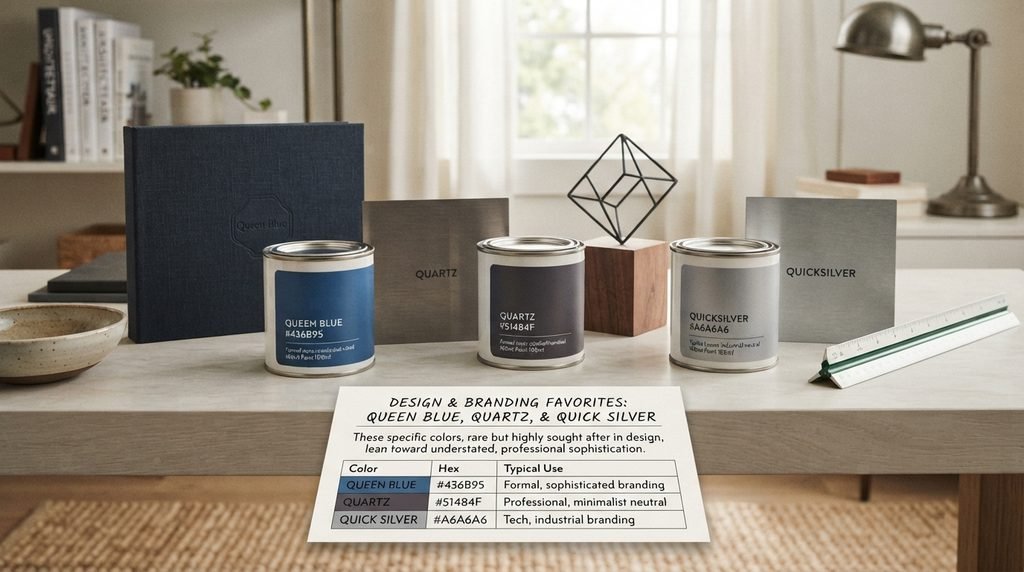
| Color | Hex | Typical Use |
| Queen Blue | #436B95 | Formal, sophisticated branding |
| Quartz | #51484F | Professional, minimalist neutral |
| Quick Silver | #A6A6A6 | Tech, industrial branding |
Queen Blue and Quartz pair naturally together, since both carry a similar sense of quiet formality without competing for attention. Quick Silver works best as a background or supporting neutral, rarely standing as the sole color in a finished design.
Fashion & Beauty Shades
Fashion draws on very little from this letter group, but Queen Pink has found a small, steady niche. Its soft, dusty quality makes it a reasonable substitute wherever a designer wants something gentler than standard pink without moving into an entirely different color family.
Quinacridone Magenta occasionally crosses over from fine art supply catalogs into cosmetics branding, since its deep, muted red-pink reads as sophisticated rather than juvenile. That crossover remains rare, though, since most beauty brands reach for more universally recognized pink or red names instead of a technical pigment term.
Nature-Inspired Names
This letter group leans more mineral than botanical, but a few names still tie to the natural world. Quartz takes its name directly from the mineral, one of the most common crystalline substances on Earth, known for its clarity and the wide range of colors it can naturally occur in. Quicksilver borrows its name from mercury’s old alchemical nickname, a reference to how the liquid metal moves unpredictably, almost like it’s alive.
Neither name references a plant or flower, which sets this letter apart from almost every other group in this series. That absence isn’t an oversight. Very few English words for plants or flowers happen to start with Q, which limits how many natural color names could ever exist for this letter in the first place.
Rare or Unusual Q Colors
Given how small this letter group already is, nearly every entry could qualify as rare simply by existing. Quinacridone Magenta deserves special mention, since it comes from an entire family of synthetic organic pigments developed in the mid-20th century, prized by painters for exceptional lightfastness compared to older, less stable red and magenta pigments. Quincy carries a more mysterious origin, a documented traditional color name without a clearly recorded etymology, unlike most other entries in this guide.
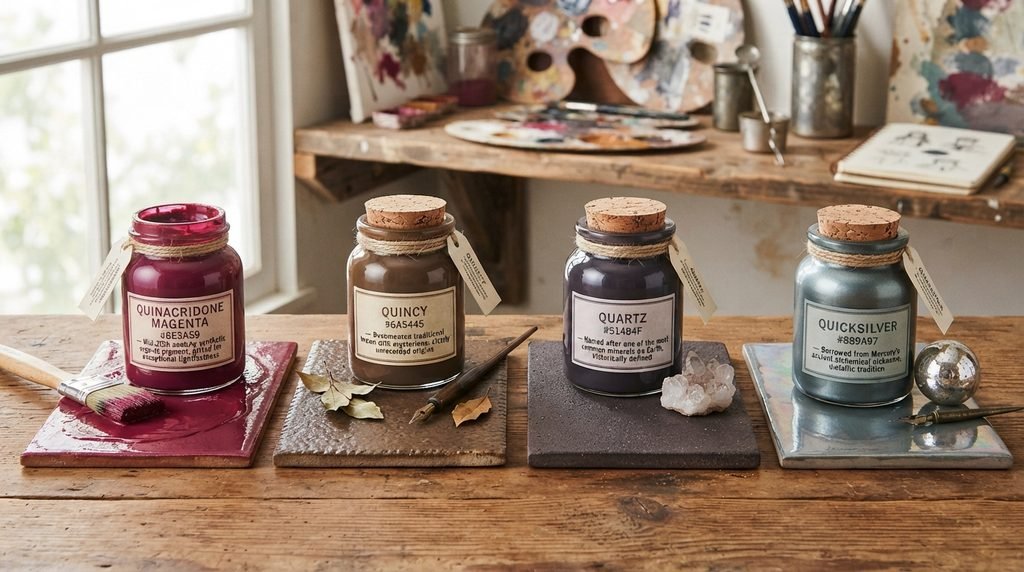
Quartz and the two Quicksilver spellings round out this discussion, both tied to mineral and metallic naming traditions that predate modern color standardization by centuries. Each of these names shows that even in the smallest letter group in the alphabet, real documentation and real history still exist behind every entry.
- Quinacridone Magenta (#8E3A59) — part of a mid-20th-century pigment family prized for lightfastness
- Quincy (#6A5445) — a documented traditional brown with no clearly recorded name origin
- Quartz (#51484F) — named after one of the most common minerals on Earth
- Quicksilver (#889A97) — borrowed from mercury’s old alchemical nickname
These four make up more than half of this entire letter group, which says something about how limited genuinely documented Q colors are. That’s what separates an honest, small list from an inflated one padded with invented names.
Colors Easily Confused With Each Other
With only seven entries, confusion in this letter group centers on just one pair. Quick Silver and Quicksilver share nearly the same name, differing only in spacing, but they come from different documented sources and carry noticeably different hex codes.
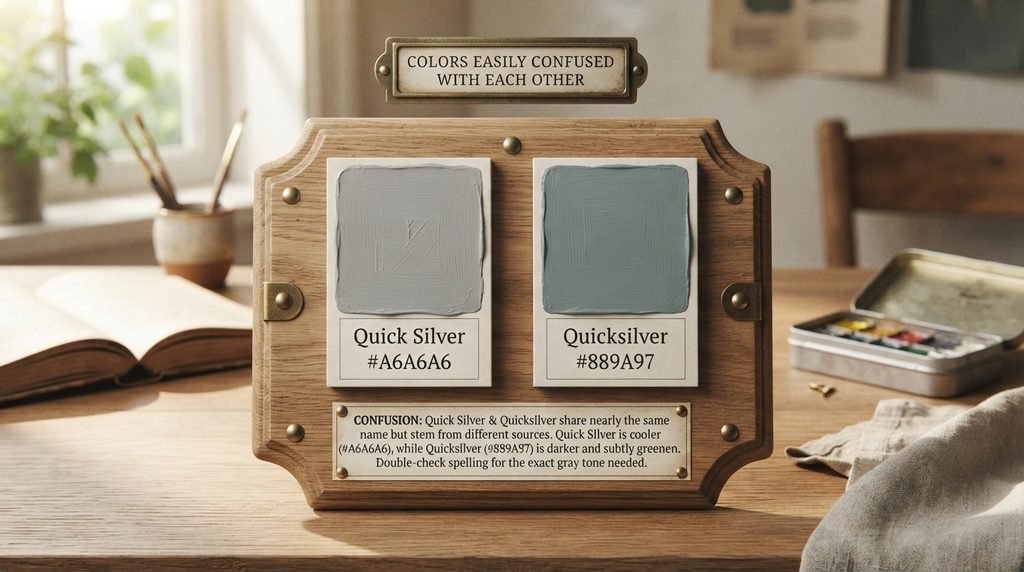
Queen Blue and Queen Pink don’t actually get confused with each other, since they sit in entirely different color families, but their shared naming convention occasionally leads people to assume there’s a larger “Queen” series of colors when there isn’t one documented beyond these two.
The table below lines up the one genuinely confusable pair directly so the difference is easy to see at a glance. Pay attention to the RGB numbers, not just the names, since the two can look nearly identical in a small swatch but read differently once compared directly.
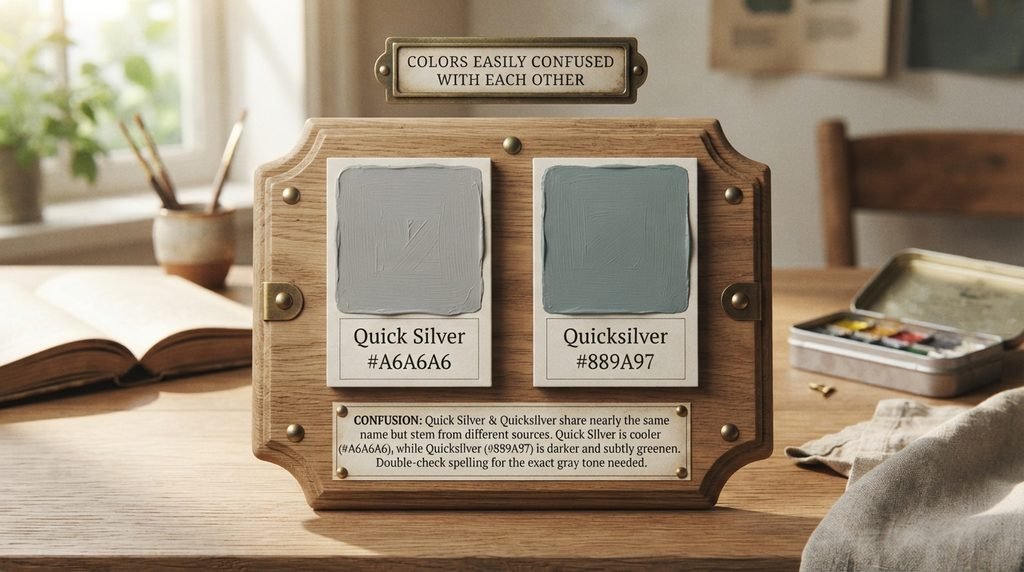
| Color A | Hex A | Color B | Hex B | Key Difference |
| Quick Silver | #A6A6A6 | Quicksilver | #889A97 | Quicksilver is darker and greener |
Quick Silver versus Quicksilver is worth remembering specifically because search engines and design software sometimes treat the two spellings as identical, when they actually point to two different documented hex codes. Double-checking the exact spelling before locking in a hex code prevents an unwanted, subtle shift in the final gray tone.
Master Alphabetical List of Q Colors
This short list includes every color that starts with Q that survived cross-checking against a second independent source. Given how few entries exist, there’s no meaningful split between common names and brand-specific ones here, since nearly every entry comes from the same small pool of traditional and pigment-industry naming.
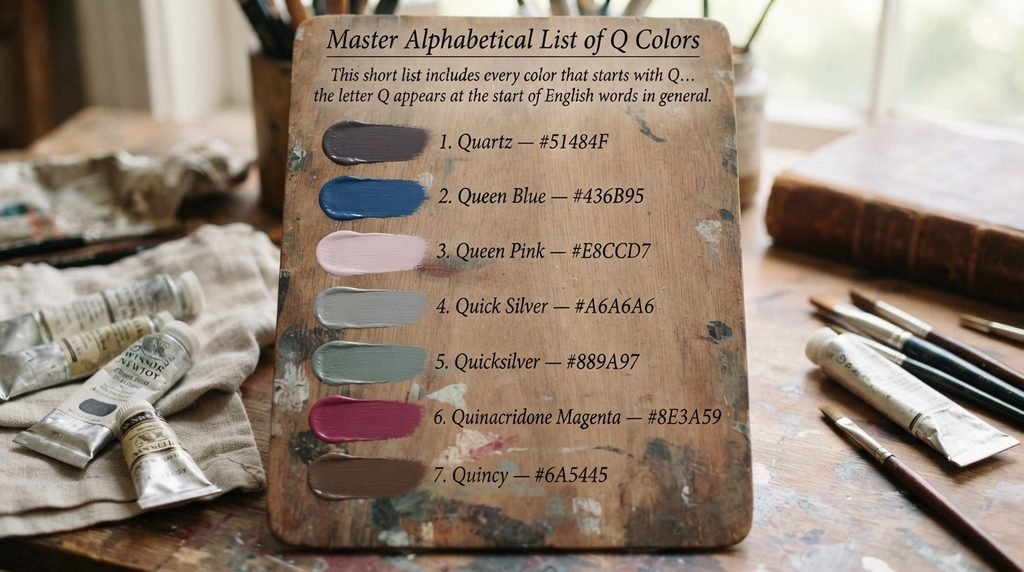
- Quartz — #51484F
- Queen Blue — #436B95
- Queen Pink — #E8CCD7
- Quick Silver — #A6A6A6
- Quicksilver — #889A97
- Quinacridone Magenta — #8E3A59
- Quincy — #6A5445
Notice that this entire list fits in seven lines, a stark contrast to letters like C or P that stretch past fifty or even seventy entries. That gap says less about color itself and more about how rarely the letter Q appears at the start of English words in general.
Hex/RGB Crosswalk: Why Exact Codes Matter
A color name alone isn’t enough for real design work, and that holds true even for a letter this small. Two designers using “quartz” without a hex code might land on two different shades of gray, since the word also gets used loosely outside of this documented color name. That’s why any serious project needs the exact hex or RGB value locked in before production starts.
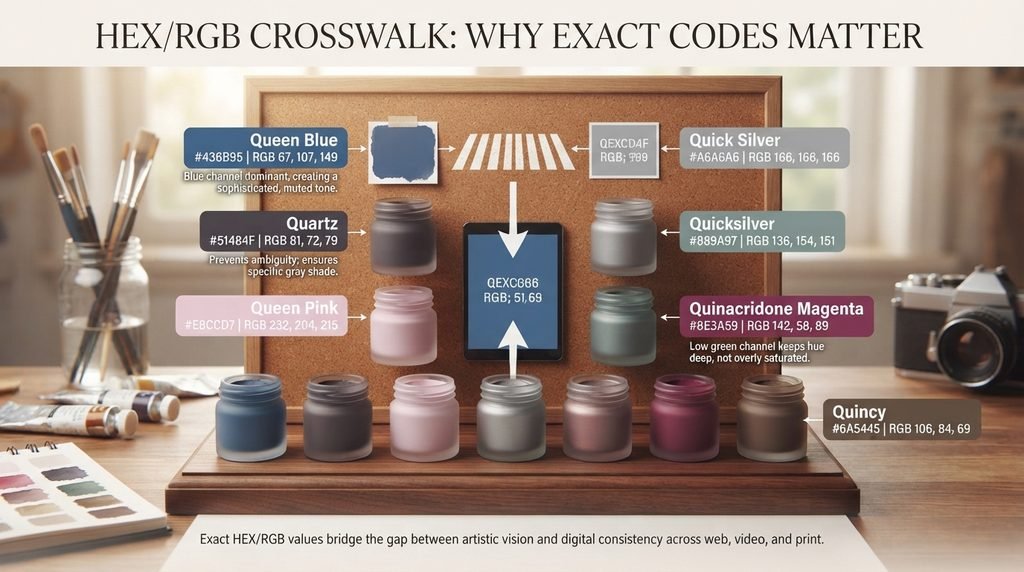
Hex codes matter most for web and app design, since browsers read hex values directly. RGB values matter more for video, screen graphics, and design software that calculates color mathematically. The table below gives both formats for all seven colors that start with Q, since the list is short enough to cover completely in one place.
| Color | Hex | RGB |
| Queen Blue | #436B95 | 67, 107, 149 |
| Quartz | #51484F | 81, 72, 79 |
| Queen Pink | #E8CCD7 | 232, 204, 215 |
| Quick Silver | #A6A6A6 | 166, 166, 166 |
| Quicksilver | #889A97 | 136, 154, 151 |
| Quinacridone Magenta | #8E3A59 | 142, 58, 89 |
| Quincy | #6A5445 | 106, 84, 69 |
Queen Blue’s RGB values stay relatively balanced across all three channels,s with blue slightly dominant, which is exactly what produces its muted, sophisticated read rather than anything bright or electric. Quinacridone Magenta, by contrast, keeps its green channel notably low while red and blue both stay moderate, giving it that deep, slightly muted magenta quality rather than a pure, saturated pink.
Full Comparison Table: All 7 Q Colors
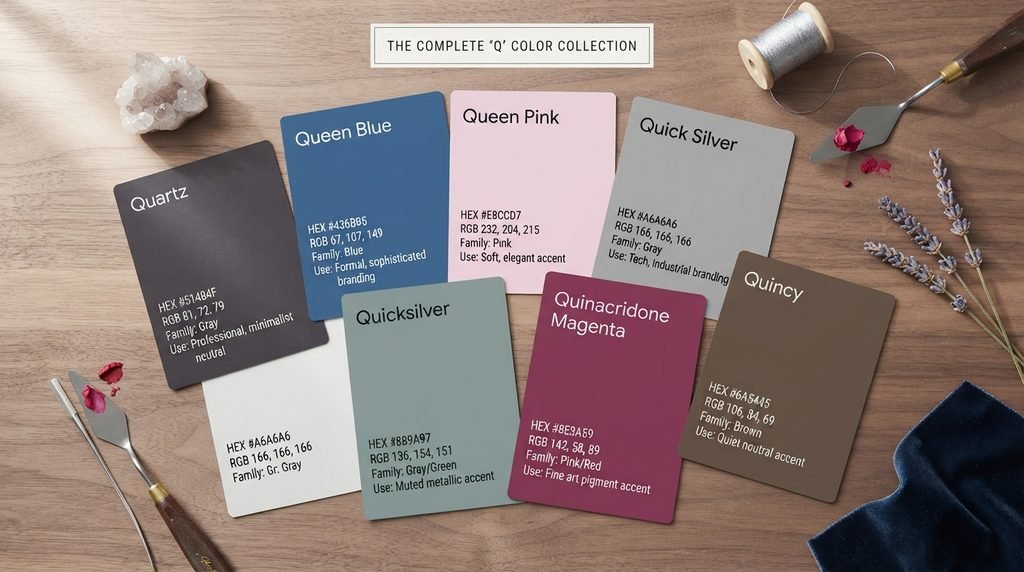
This table brings every color that starts with Q together with hex, RGB, color family, and common use in one place. Since the list is so short, use this table as your complete reference rather than jumping between multiple sections.
| Color | Hex | RGB | Family | Common Use |
| Quartz | #51484F | 81, 72, 79 | Gray | Professional, minimalist neutral |
| Queen Blue | #436B95 | 67, 107, 149 | Blue | Formal, sophisticated branding |
| Queen Pink | #E8CCD7 | 232, 204, 215 | Pink | Soft, elegant accent |
| Quick Silver | #A6A6A6 | 166, 166, 166 | Gray | Tech, industrial branding |
| Quicksilver | #889A97 | 136, 154, 151 | Gray/Green | Muted metallic accent |
| Quinacridone Magenta | #8E3A59 | 142, 58, 89 | Pink/Red | Fine art pigment accent |
| Quincy | #6A5445 | 106, 84, 69 | Brown | Quiet neutral accent |
A few entries deserve a second look even within this small table. Three of the seven colors here are grays or near-grays, which makes sense given how many mineral and metallic terms happen to start with Q. Queen Blue stands out as the only entry with genuinely bold color potential, while Quinacridone Magenta remains the sole representative of the entire red-pink family for this letter.
Decision-Flow Table: Picking the Right Q Color
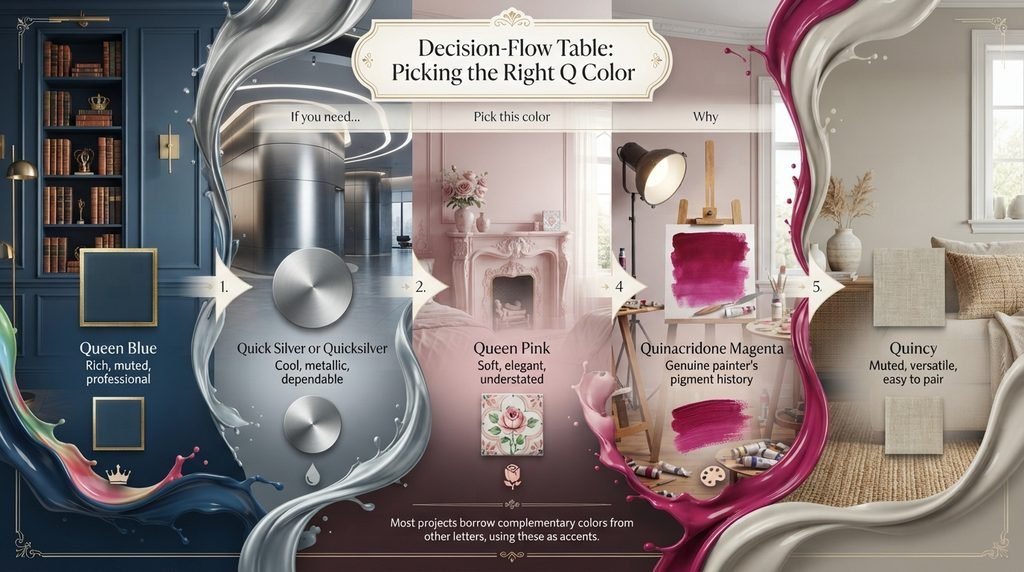
Choosing between seven distinct names is far simpler than most other letters in this series, but a clear goal still helps. The table below matches common use cases to a recommended color that starts with Q, so you can go straight to a shade that fits the job.
| If you need… | Pick this color | Why |
| A formal, sophisticated brand accent | Queen Blue | Rich, muted, professional |
| A tech or industrial neutral | Quick Silver or Quicksilver | Cool, metallic, dependable |
| A soft, elegant pink accent | Queen Pink | Gentle, refined, understated |
| A fine art or pigment-inspired accent | Quinacridone Magenta | Genuine painter’s pigment history |
| A warm, quiet neutral | Quincy | Muted, versatile, easy to pair |
Use this table as a starting point rather than a final answer. Given how few options exist in this letter group, most projects will end up borrowing complementary colors from other letters entirely, using Queen Blue or Quartz as a single distinctive accent within a broader palette built elsewhere.
Conclusion
Colors that start with Q make up the smallest group in this entire series, but what remains carries real documentation and real use. This list sticks to 7 verified names with real hex and RGB codes, so nothing here is guesswork or padding. Whether you’re building a formal brand around Queen Blue or just curious why this letter is so limited, these colors that start with Q give you a solid, checkable starting point.
Frequently Asked Questions
How many colors actually start with the letter Q?
This guide covers 7 verified colors that start with Q, cross-checked against multiple independent sources. Larger lists claiming 90 or more usually rely on single-source, paint-tint variants like “Quarter” prefixed names that fail basic cross-checking.
What are the most well-known colors that start with Q?
Queen Blue, Quartz, and Quinacridone Magenta are the most documented and widely cited. Each has a hex code confirmed across multiple independent sources.
Why are there so few colors that start with Q?
Q is one of the rarest starting letters in English overall, not just for colors. Very few words of any kind begin with Q outside of borrowed terms, which naturally limits how many color names could ever exist.
What’s the difference between Quick Silver and Quicksilver?
Quick Silver, hex #A6A6A6, and Quicksilver, hex #889A97, are two separately documented names with different hex codes, despite sounding nearly identical. Quicksilver runs darker and slightly greener.
Is Queen Blue a real, standardized color?
Queen Blue doesn’t appear in the official CSS/X11 named color list, but it’s a widely documented traditional color with a consistently cited hex code of #436B95 across independent color-name databases.
What is Quinacridone Magenta used for?
Quinacridone Magenta, hex #8E3A59, comes from a family of synthetic organic pigments developed in the mid-20th century, valued by painters for strong lightfastness compared to older, less stable pigments.
Why was a different hex code for Quinacridone Magenta excluded?
Some sources cite a considerably brighter hex code for this pigment name. Since the values contradicted the more widely cross-referenced figure used here, this guide kept the more consistently documented version rather than guessing.
What color is Quartz exactly?
Quartz is a deep, warm gray with the hex code #51484F, named after the mineral known for its clarity and wide natural color range.