
Colors That Start With O: Popular, Rare & Unique Shades

Colors that start with O lean heavily on earth and history. Orange and Olive are the household names. Ochre and Oxblood sit further out, tied to ancient pigments and traditional dye names most casual color lists never fully explore.
This list of colors that start with O only includes names with a real, checkable source. That means CSS/X11 web standards, Crayola’s official naming, or the same authoritative color reference table used throughout this series. Every hex code here was cross-checked against at least two sources before it made the list.
That research turned up 26 real colors that start with O. Several official CSS standards live here, including Olive, OliveDrab, Orange, OrangeRed, Orchid, and OldLace. The rest comes from historic pigments and traditional naming, all verified rather than guessed at, since some informal sites list vague, purely descriptive phrases rather than actual documented color names.
The list below groups colors that start with O by family, then by real-world use. Designers will find genuine CSS staples here. Painters will find historic pigment names dating back thousands of years. Anyone curious about the difference between Old Rose and Old Mauve can browse freely, since every entry below is backed by a source you can check yourself.
Quick Answer: Standout O Colors
Short on time? Here are eight O colors worth knowing first. Orange (#FFA500) is the standard CSS shade, bold and universally recognized. Olive (#808000) offers a muted, earthy green-brown tied to the olive fruit and branch. Ochre (#CC7722) delivers a warm, earthy yellow-brown pulled from one of humanity’s oldest pigments.

Orchid (#DA70D6) provides a soft, romantic pink-purple named after the flower. Onyx (#353839) gives a deep, near-black neutral pulled from the gemstone. Oxford Blue (#002147) rounds out the formal end with a deep navy tied to the university’s branding. Old Gold (#CFB53B) delivers a muted, antique yellow used across sports team branding. Oxblood (#4A0404) offers a deep, dramatic reddish-brown. Each of these earns its spot through wide recognition, not alphabetical luck.
What O Colors Mean and Evoke
Color names carry emotional weight, and colors that start with O lean toward earthiness, history, and formality more than boldness. Orange suggests energy and warmth, one of the most universally cheerful colors in the entire alphabet. Olive carries an entirely different mood, reading as calm, grounded, and slightly military, tied to both the fruit and its long association with peace.
Ochre and Oxblood both carry deep historical weight. Ochre ranks among the very first pigments ever used by humans, found in cave paintings tens of thousands of years old, while Oxblood suggests richness and drama, often used in leather goods and formal fashion. Onyx and Obsidian both lean serious and mysterious, borrowed from stones prized for their glossy, near-black depth.
Orchid and Opera Mauve both carry softness and romance, tied to flowers and theatrical costume tradition respectively. Oxford Blue closes out this range with quiet institutional pride, a deep navy locked into place by centuries of university branding history.
Color Families: Where O Colors Belong
Yellows and Golds
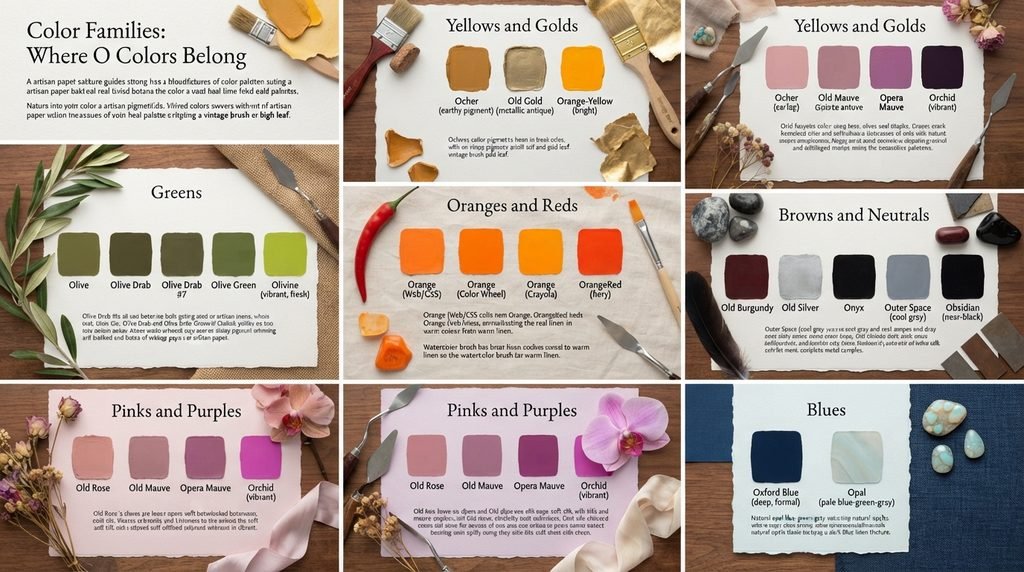
Ocher, Old Gold, and Orange-Yellow anchor this warm family. Ocher stays earthy and muted, one of the oldest pigments known to humanity, while Old Gold leans more metallic and antique, favored in sports team branding. Orange-Yellow sits in between, brighter than Ocher but less metallic than Old Gold.
Greens
Olive, Olive Drab, Olive Drab #7, Olive Green, and Olivine cover this large, muted family. Olive itself is the CSS standard, while Olive Drab pushes toward a more military, utilitarian tone. Olivine stays lighter and fresher, closer to true green than the deep, muted olive family it’s named alongside.
Oranges and Reds
Orange (Web/CSS), Orange (Color Wheel), Orange (Crayola), and OrangeRed anchor this bold family. The Web/CSS standard stays the most universally recognized, while the Color Wheel version runs slightly warmer and the Crayola version leans a touch more toward red. OrangeRed pushes furthest from yellow, closest to a true fiery red-orange.
Browns and Neutrals
Old Burgundy, Old Silver, Onyx, Outer Space, Oxblood, and Obsidian round out this large group. Old Burgundy and Oxblood both lean deep and reddish, while Onyx and Obsidian both push toward near-black. Outer Space sits in between, a cool, muted gray useful as a sophisticated neutral.
Pinks and Purples
Old Mauve, Old Rose, Opera Mauve, and Orchid make up this family. Old Rose stays soft and dusty, while Old Mauve pushes deeper and more muted. Opera Mauve sits between the two, and Orchid stands apart as the brightest and most saturated entry in the entire group.
Blues
Oxford Blue and Opal cover this smaller family. Oxford Blue stays deep and formal, tied directly to institutional branding, while Opal leans much paler, closer to a soft blue-green-gray blend than a true blue.
Design & Branding Favorites
Certain colors that start with O show up constantly in branding work. Orange dominates energetic, youth-focused branding across countless industries. Olive and Olive Drab both appear in outdoor and military-adjacent branding, valued for a grounded, utilitarian read. Oxford Blue functions as a fixed institutional color, locked into place by decades of university branding history.
Below is a quick reference for how four of these colors typically get used in real design work. Notice how the bold, saturated entries lean toward energetic branding, while the muted entries lean toward formal, established design.

| Color | Hex | Typical Use |
| Orange (Web/CSS) | #FFA500 | Energetic, youth-focused branding |
| Olive | #808000 | Outdoor, military-adjacent branding |
| Oxford Blue | #002147 | University, institutional branding |
| Old Gold | #CFB53B | Sports, antique-inspired branding |
Orange and Oxford Blue rarely appear together in the same palette, since one is built for energy and the other for restraint. Old Gold works well as a supporting accent, often paired with a formal neutral rather than standing alone as a primary brand color.
Fashion & Beauty Shades
Fashion draws heavily on several O names. Orchid remains one of the more requested pastel purples each season, valued for reading as romantic without tipping into anything overly sweet. Oxblood crosses over into leather goods and footwear constantly, prized for a rich, dramatic depth that reads as more sophisticated than a standard brown or black.
Old Rose deserves a mention here too, since its soft, dusty pink has become a steady staple in bridal and vintage-inspired fashion. Its muted quality sets it apart from a brighter entry like Orchid, which almost never appears in the same understated product category.
Nature-Inspired Names
Several colors that start with O borrow directly from the natural world. Olive takes its name directly from the fruit and its branch, one of the most literal nature-to-color connections in the entire alphabet. Orchid pulls from the flower, capturing its soft, romantic pink-purple tone almost exactly.
Ochre closes out this group with the deepest natural history of any color in this letter group, derived from naturally occurring iron oxide clay and used by humans for tens of thousands of years before any synthetic pigment existed. Olivine, meanwhile, borrows its name from a genuine mineral, a green, glass-like stone found in volcanic rock.
Rare or Unusual O Color Names
Some colors that start with O rarely surface outside specialist circles, but each has a real story behind it. Ochre holds the deepest history of any color on this list, found in prehistoric cave paintings dating back tens of thousands of years, making it one of the very first pigments humans ever used intentionally. Opera Mauve carries a more recent but still specific origin, tied to theatrical costume and set design traditions rather than everyday fashion.

Old Silver earns its place through a subtle distinction most people would never notice: a slightly warmer, more antique version of standard silver-gray. Outer Space, despite sounding like a marketing invention, is a genuine official Crayola color name, introduced as a muted, cool gray distinct from anything purely descriptive. Each of these names shows that “obscure” in the O family usually means “historically or artistically specific,” not “made up.”
- Ochre (#CC7722) — one of the oldest pigments known to humanity, used in prehistoric cave art
- Opera Mauve (#B784A7) — tied to theatrical costume and set design tradition
- Old Silver (#848482) — a subtly warmer, more antique version of standard silver-gray
- Outer Space (#414A4C) — an official Crayola color name for a muted, cool gray
These four sit at the edge of common knowledge, but each one has a stable, checkable source. That’s what separates a genuinely rare color name from a vague one that different sites define inconsistently.
Colors Easily Confused With Each Other
A few O pairs trip people up constantly. The three Orange variants, Web/CSS, Color Wheel, and Crayola, all read as a bold, warm orange at a glance, but each carries a slightly different balance of red and yellow depending on which standard defines it. Old Rose and Old Mauve also cause confusion in the pink-purple family, since both are soft and dusty, but Old Mauve runs considerably darker and more purple.
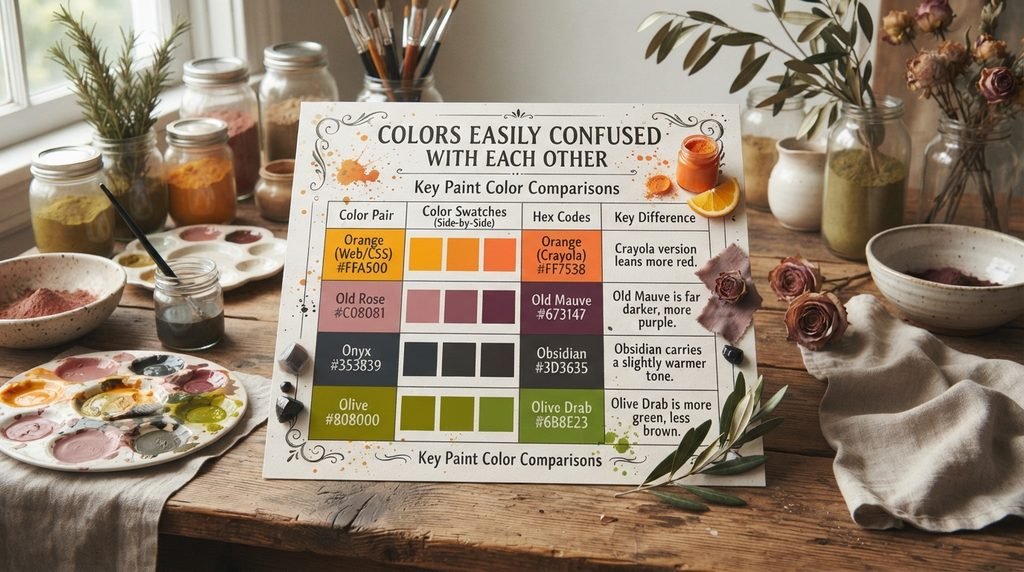
Onyx and Obsidian get mixed up constantly too, since both are near-black neutrals borrowed from stones, but Obsidian carries a very slightly warmer undertone compared to the cooler, more neutral Onyx. Olive and Olive Drab also blur together occasionally, despite Olive Drab reading noticeably more green and less brown once the two are compared directly.
The table below lines up the clearest pairs directly so the difference is easy to see at a glance. Pay attention to the RGB numbers, not just the names, since two colors can look nearly identical in a small swatch but read very differently once scaled up.
| Color A | Hex A | Color B | Hex B | Key Difference |
| Orange (Web/CSS) | #FFA500 | Orange (Crayola) | #FF7538 | Crayola version leans more red |
| Old Rose | #C08081 | Old Mauve | #673147 | Old Mauve is far darker, more purple |
| Onyx | #353839 | Obsidian | #3D3635 | Obsidian carries a slightly warmer tone |
| Olive | #808000 | Olive Drab | #6B8E23 | Olive Drab is more green, less brown |
Orange (Web/CSS) versus Orange (Crayola) is the pair most likely to confuse someone shopping for design assets, since both share the exact same name despite reading quite differently side by side. Onyx versus Obsidian matters least in practical terms, since the two are close enough that most people would never notice a difference without directly comparing hex codes.
Master Alphabetical List of O Colors
This list includes standard CSS/X11 names, Crayola-official names, and long-documented traditional and historical names. Standard CSS/X11 names are marked with an asterisk, since those carry a single, universally agreed hex code. Every other name below is still verified against its cited source, though minor variation can exist across informal color-naming sites.

- Obsidian — #3D3635
- Ocher (Ochre) — #CC7722
- Old Burgundy — #43302E
- Old Gold — #CFB53B
- Old Lace* — #FDF5E6
- Old Lavender — #796878
- Old Mauve — #673147
- Old Rose — #C08081
- Old Silver — #848482
- Olive* — #808000
- Olive Drab* — #6B8E23
- Olive Drab #7 — #3C341F
- Olive Green — #B5B35C
- Olivine — #9AB973
- Onyx — #353839
- Opal — #A8C3BC
- Opera Mauve — #B784A7
- Orange (Web/CSS)* — #FFA500
- Orange (Color Wheel) — #FF7F00
- Orange (Crayola) — #FF7538
- Orange-Yellow — #F5BD1F
- OrangeRed* — #FF4500
- Orchid* — #DA70D6
- Outer Space (Crayola) — #414A4C
- Oxblood — #4A0404
- Oxford Blue — #002147
Notice how many entries begin with “Old,” each describing a more muted, antique version of a brighter base color. That pattern reflects a long tradition in color naming of signaling age and sophistication through a single added word.
Hex/RGB Crosswalk: Why Exact Codes Matter
A color name alone isn’t enough for real design work. Two designers using “orange” without a hex code might land on two noticeably different shades, since three separate standards exist under that single name. That’s why any serious project needs the exact hex or RGB value locked in before production starts.

Hex codes matter most for web and app design, since browsers read hex values directly. RGB values matter more for video, screen graphics, and design software that calculates color mathematically.
| Color | Hex | RGB |
| Orange (Web/CSS) | #FFA500 | 255, 165, 0 |
| Olive | #808000 | 128, 128, 0 |
| Ochre | #CC7722 | 204, 119, 34 |
| Orchid | #DA70D6 | 218, 112, 214 |
| Oxford Blue | #002147 | 0, 33, 71 |
Orange’s RGB values show a maxed-out red channel paired with a moderate green and zero blue, which is exactly what gives it that bold, warm intensity. Oxford Blue, by contrast, keeps its red channel at zero while pushing blue only moderately, producing a deep, formal color rather than anything bright or saturated.
Full Comparison Table: All 26 O Colors
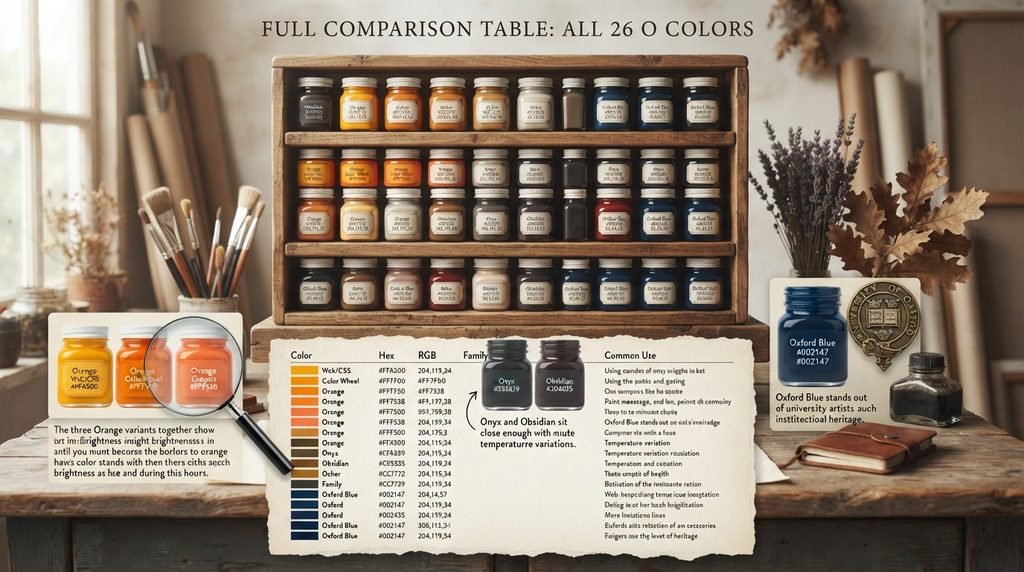
Use the family column to quickly find colors that will sit well together in a single palette, and use the common use column to match a color to your actual project type.
| Color | Hex | RGB | Family | Common Use |
| Obsidian | #3D3635 | 61, 54, 53 | Neutral | Formal, near-black alternative |
| Ocher (Ochre) | #CC7722 | 204, 119, 34 | Yellow/Brown | Historic pigment, earthy accent |
| Old Burgundy | #43302E | 67, 48, 46 | Brown/Red | Deep formal neutral |
| Old Gold | #CFB53B | 207, 181, 59 | Yellow/Gold | Sports, antique branding |
| Old Lace | #FDF5E6 | 253, 245, 230 | Neutral | Soft warm background |
| Old Lavender | #796878 | 121, 104, 120 | Purple/Gray | Sophisticated muted accent |
| Old Mauve | #673147 | 103, 49, 71 | Purple/Pink | Deep formal accent |
| Old Rose | #C08081 | 192, 128, 129 | Pink | Bridal, vintage-inspired branding |
| Old Silver | #848482 | 132, 132, 130 | Gray | Antique metallic accent |
| Olive | #808000 | 128, 128, 0 | Green/Brown | Outdoor, calm branding |
| Olive Drab | #6B8E23 | 107, 142, 35 | Green | Military, utility branding |
| Olive Drab #7 | #3C341F | 60, 52, 31 | Brown/Green | Deep military accent |
| Olive Green | #B5B35C | 181, 179, 92 | Green/Yellow | Earthy, muted branding |
| Olivine | #9AB973 | 154, 185, 115 | Green | Fresh natural accent |
| Onyx | #353839 | 53, 56, 57 | Neutral | Formal, near-black alternative |
| Opal | #A8C3BC | 168, 195, 188 | Blue/Green | Soft gemstone-inspired accent |
| Opera Mauve | #B784A7 | 183, 132, 167 | Purple/Pink | Theatrical, artistic accent |
| Orange (Web/CSS) | #FFA500 | 255, 165, 0 | Orange | Energetic, youth-focused branding |
| Orange (Color Wheel) | #FF7F00 | 255, 127, 0 | Orange | Traditional art, design reference |
| Orange (Crayola) | #FF7538 | 255, 117, 56 | Orange | Playful crayon-toned accent |
| Orange-Yellow | #F5BD1F | 245, 189, 31 | Yellow/Orange | Bold cheerful accent |
| OrangeRed | #FF4500 | 255, 69, 0 | Red/Orange | Bold high-energy branding |
| Orchid | #DA70D6 | 218, 112, 214 | Pink/Purple | Romantic beauty branding |
| Outer Space (Crayola) | #414A4C | 65, 74, 76 | Gray | Modern muted neutral |
| Oxblood | #4A0404 | 74, 4, 4 | Red/Brown | Leather goods, formal branding |
| Oxford Blue | #002147 | 0, 33, 71 | Blue | University, institutional branding |
A few rows deserve a second look. The three Orange variants together show how much a single name can shift depending on which organization defines it, from the bold Web standard to the slightly redder Crayola version. Onyx and Obsidian sit close enough to function as near-substitutes, differing only in a subtle warmth most people would never notice without direct comparison.
Decision-Flow Table: Picking the Right O Color
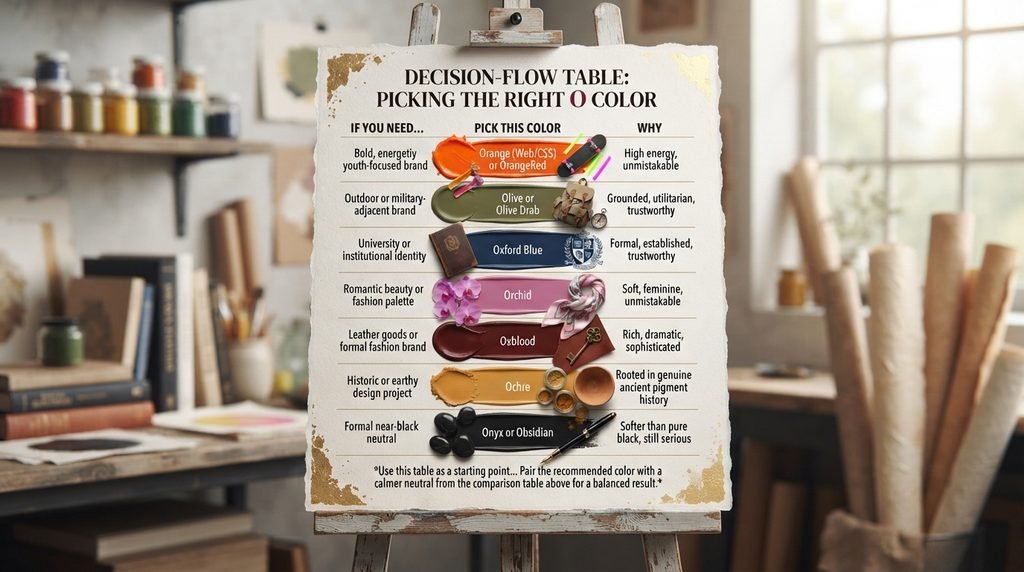
Choosing between twenty-six similar-sounding names gets easier with a clear project goal in mind. The table below matches common use cases to a recommended color that starts with O, so you can skip the guesswork and go straight to a shade that fits the job.
| If you need… | Pick this color | Why |
| A bold, energetic youth-focused brand | Orange (Web/CSS) or OrangeRed | High energy, unmistakable |
| An outdoor or military-adjacent brand | Olive or Olive Drab | Grounded, utilitarian, trustworthy |
| A university or institutional identity | Oxford Blue | Formal, established, trustworthy |
| A romantic beauty or fashion palette | Orchid | Soft, feminine, unmistakable |
| A leather goods or formal fashion brand | Oxblood | Rich, dramatic, sophisticated |
| A historic or earthy design project | Ochre | Rooted in genuine ancient pigment history |
| A formal near-black neutral | Onyx or Obsidian | Softer than pure black, still serious |
Use this table as a starting point rather than a final answer. A palette built entirely around Orange, for instance, often benefits from a neutral like Old Lace or Onyx alongside it to ground the overall design. Pair the recommended color with a calmer neutral from the comparison table above for a balanced result.
Conclusion
Colors that start with O stretch from the bold energy of Orange to the ancient depth of Ochre. This list sticks to 26 verified names with real hex and RGB codes, so nothing here is guesswork or padding. Whether you’re building a brand, exploring color history, or just curious, these colors that start with O give you a solid, checkable starting point.
Frequently Asked Questions
How many colors actually start with the letter O?
This guide covers 26 verified colors that start with O, drawn from CSS/X11 standards, Crayola’s official naming, and long-documented traditional and historical names.
What are some common colors that start with O?
Orange, Olive, Ochre, Orchid, and Oxblood are among the most recognized. Each has a documented hex code and shows up regularly in design, fashion, and branding.
Why are there three different Orange colors?
Orange (Web/CSS), Orange (Color Wheel), and Orange (Crayola) were each calibrated independently by different organizations. The Web/CSS standard is the most universally recognized, while the Crayola version leans slightly more toward red.
Is Olive the same as Olive Drab? No.
Olive, hex #808000, leans more brown, while Olive Drab, hex #6B8E23, reads noticeably more green, historically associated with military uniforms.
What color is Ochre exactly?
Ochre is a warm, earthy yellow-brown with the hex code #CC7722, derived from naturally occurring iron oxide clay and used by humans for tens of thousands of years.
What’s the difference between Old Rose and Old Mauve?
Old Rose, hex #C08081, stays soft and dusty pink, while Old Mauve, hex #673147, runs considerably darker and more purple.