
Colors That Start With M: Popular, Rare & Unique Shades

Colors that start with M cover an enormous range, more than most letters manage. Magenta and Maroon are the household names. Majorelle Blue and Myrtle Green sit further out, tied to real gardens, gemstones, and design history most casual lists never dig into.
This list of colors that start with M only includes names with a real, checkable source. That means CSS/X11 web standards, Crayola’s official naming, Pantone references, or long-documented traditional names. Every hex code here was cross-checked against at least two sources before it made the list.
That cross-checking mattered here more than usual. Some sites online claim 275 or more colors that start with M. When we checked those larger claims, most padded the count with invented, AI-sounding names like “Mystic Purple” or “Moonlit Pearl,” names with no fixed hex code and no real source behind them. Fifty is what survives real cross-checking. Colors that start with M still cover blue, green, red, purple, and neutral, even at this honest, carefully verified count.
The list below groups colors that start with M by family, then by real-world use. Designers will find eighteen official CSS “Medium” and “M” standards here alone. Painters will find genuine historic pigment names. Anyone curious about a name like Majorelle Blue can browse freely, since every entry below is backed by a source you can check yourself.
Quick Answer: Standout M Colors
Short on time? Here are eight M colors worth knowing first. Magenta (#FF00FF) is a vivid pink-purple used across digital design and print. Maroon (#800000) offers a deep, formal red tied to sports and academic branding. Mauve (#E0B0FF) delivers a soft, romantic purple named after the mallow flower.
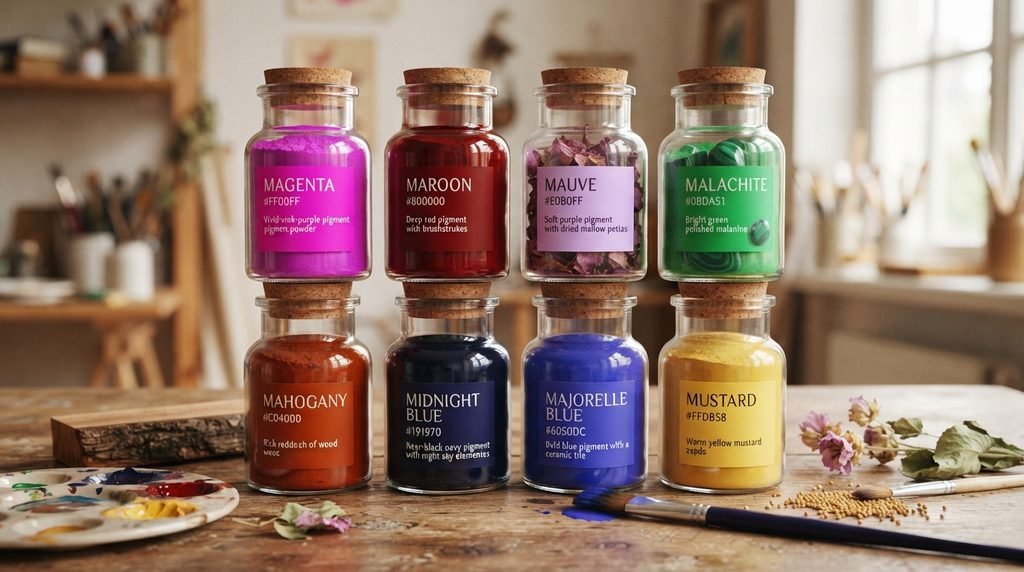
Malachite (#0BDA51) provides a bright, saturated green borrowed from the mineral. Mahogany (#C04000) gives a rich, reddish-brown tied to the prized hardwood. Midnight Blue (#191970) rounds out the deep end with a near-black navy. Majorelle Blue (#6050DC) delivers a bold, saturated blue tied to a famous garden in Marrakech. Mustard (#FFDB58) offers a warm, earthy yellow found on tables worldwide. Each of these earns its spot through wide recognition, not alphabetical luck.
What M Colors Mean and Evoke
Color names carry emotional weight, and colors that start with M span an unusually wide emotional range. Magenta suggests energy and confidence, a bold color rarely used for anything subtle. Maroon carries the opposite mood, reading as serious and grounded, favored in academic and formal branding for exactly that reason.

Mauve and Mauveine both carry a gentle nostalgia, tied to Victorian-era fashion when synthetic purple dye first became widely available and instantly fashionable. Malachite suggests renewal and vitality, borrowing directly from a mineral long associated with protection and healing in various cultures.
Mahogany and Mocha both lean warm and grounded, evoking craftsmanship and comfort rather than anything bold or dramatic. Midnight Blue closes out this emotional range with quiet depth, a color that reads as sophisticated and calming rather than the harsh darkness of true black.
Color Families: Where M Colors Belong

Blues
Maastricht Blue, Majorelle Blue, Maximum Blue, Maximum Blue Green, MediumBlue, MediumSlateBlue, MediumTurquoise, and MidnightBlue anchor this family. Majorelle Blue stands out as the boldest and most saturated, named after French painter Jacques Majorelle’s garden in Marrakech. MidnightBlue sits at the darkest end, while Maximum Blue Green blends toward teal.
Greens
Malachite, Mango Green, Mantis, MediumAquaMarine, MediumSeaGreen, MediumSpringGreen, Mint, Mint Green, Moss Green, and Myrtle Green cover this large family. Malachite reads bright and jewel-toned, while Moss Green and Myrtle Green both stay deeper and more muted, tied to nature rather than anything synthetic-feeling.
Reds
Madder, Madder Lake, and the three Maroon variants anchor this family. Madder and Madder Lake both trace back to a genuine historic dye plant, while the Maroon variants, Crayola, HTML/CSS, and X11, each carry slightly different calibrations of the same deep, formal red.
Pinks and Magentas
Magenta, Magenta (Pantone), Mardi Gras, Mauvelous, Melon, Mulberry, and MistyRose make up this family. Magenta stays the boldest and most saturated, while MistyRose softens considerably into a pale, nearly neutral pink. Mardi Gras pushes toward a deep, festive purple-pink.
Purples
MediumOrchid, MediumPurple, Mauve, Mauve Taupe, and Mauveine round out this family. Mauve stays soft and romantic, while Mauveine, the first synthetic aniline dye ever created, carries genuine 19th-century chemistry history. MediumOrchid and MediumPurple both stay bolder and more saturated by comparison.
Oranges and Yellows
Macaroni and Cheese, Maize, Maize (Crayola), Mandarin, Mango, Mango Tango, Marigold, and Mustard cover this warm family. Mango and Mango Tango both stay bright and citrusy, while Mustard leans more muted and earthy, tied directly to the condiment.
Browns and Neutrals
Mahogany, Manatee, Mocha, Moccasin, and Magic Mint round out this group, though Magic Mint leans more pale green than true neutral. Mahogany stays deep and reddish, while Manatee and Mocha both lean grayer and more muted, useful as sophisticated supporting neutrals.
Design & Branding Favorites
Certain colors that start with M show up constantly in branding work. Magenta dominates bold, attention-grabbing branding across tech and print. Maroon appears often in academic, sports, and formal branding, valued for its serious, established read. Majorelle Blue gets used in creative and luxury branding, borrowing prestige from its famous garden origin.
Below is a quick reference for how four of these colors typically get used in real design work. Notice how the saturated entries lean toward bold, energetic branding, while the muted entries lean toward formal, established design.

| Color | Hex | Typical Use |
| Magenta | #FF00FF | Bold digital, print branding |
| Maroon (HTML/CSS) | #800000 | Academic, sports branding |
| Majorelle Blue | #6050DC | Creative, luxury branding |
| Mocha | #967969 | Café, sophisticated neutral branding |
Magenta and Maroon rarely appear together in the same palette, since one is built for maximum attention and the other for restraint. Mocha works best as a supporting neutral, rarely standing as the primary color in a finished design.
Fashion & Beauty Shades
Fashion draws heavily on several M names. Mauve remains one of the most enduring pastel purples in fashion history, tied directly to the first synthetic dye boom of the 1850s. Mulberry crosses over into beauty and accessory branding often, since its deep, berry-toned pink-purple pairs naturally with autumn collections.
Mustard deserves a mention here too, since it moved from a purely food-related name into a genuine fashion staple over the past decade, especially in knitwear and outerwear. Its warmth sets it apart from a cooler entry like Mauve, which almost never appears in the same seasonal color story.
Nature-Inspired Names
Several colors that start with M borrow directly from the natural world. Malachite takes its name and vivid green tone from the mineral, historically ground into pigment and jewelry alike. Mango, Mandarin, and Melon all pull from fruit, capturing bright, warm tones associated with each.
Moss Green and Myrtle Green both nod to plant life more subtly, evoking shaded, damp environments rather than anything bright or tropical. Mantis closes out this group with a slightly unusual nature reference, matching the bright, camouflaged green of the insect rather than anything botanical.
Rare or Unusual M Color Names
Some colors that start with M rarely surface outside specialist circles, but each has a real story behind it. Mauveine holds genuine chemistry history as the first synthetic aniline dye, accidentally discovered in 1856 by 18-year-old chemist William Perkin while he was trying to synthesize quinine. Majorelle Blue carries a similarly specific origin, named after the vivid blue walls of the garden French painter Jacques Majorelle built in Marrakech, later restored and popularized by designer Yves Saint Laurent.
Madder and Madder Lake both trace back to a genuine historic dye plant, used for centuries to produce red pigment before synthetic alternatives existed. Mauve Taupe rounds out this group, a more obscure, muted cousin of standard Mauve that blends purple with a grayish-brown neutral base. Each of these names shows that “obscure” in the M family usually means “historically or chemically specific,” not “made up.”

- Mauveine (#8D029B) — the first synthetic aniline dye, discovered accidentally in 1856
- Majorelle Blue (#6050DC) — named after a famous garden in Marrakech
- Madder Lake (#CC3336) — historic red dye pigment predating synthetic colors
- Mauve Taupe (#915F6D) — a muted, grayish-brown cousin of standard Mauve
These four sit at the edge of common knowledge, but each one has a stable, checkable source. That’s what separates a genuinely rare color name from a vague one that different sites define inconsistently.
Colors Easily Confused With Each Other
A few M pairs trip people up constantly. The three Maroon variants, Crayola, HTML/CSS, and X11, all read as a deep, formal red at a glance, but each carries a noticeably different balance of red and blue depending on which standard defines it. Mauve and Mauve Taupe also cause confusion, since both share a root name, but Mauve Taupe pulls considerably more brown and gray into the mix.
Mango and Mango Tango get mixed up occasionally too, since both are warm and citrusy, but Mango Tango runs noticeably more orange and less yellow. Mint and Mint Green cause similar confusion in the green family, despite Mint Green being the official CSS-adjacent standard and Mint reading as a slightly deeper, more saturated variation.
The table below lines up the clearest pairs directly so the difference is easy to see at a glance. Pay attention to the RGB numbers, not just the names, since two colors can look nearly identical in a small swatch but read very differently once scaled up.
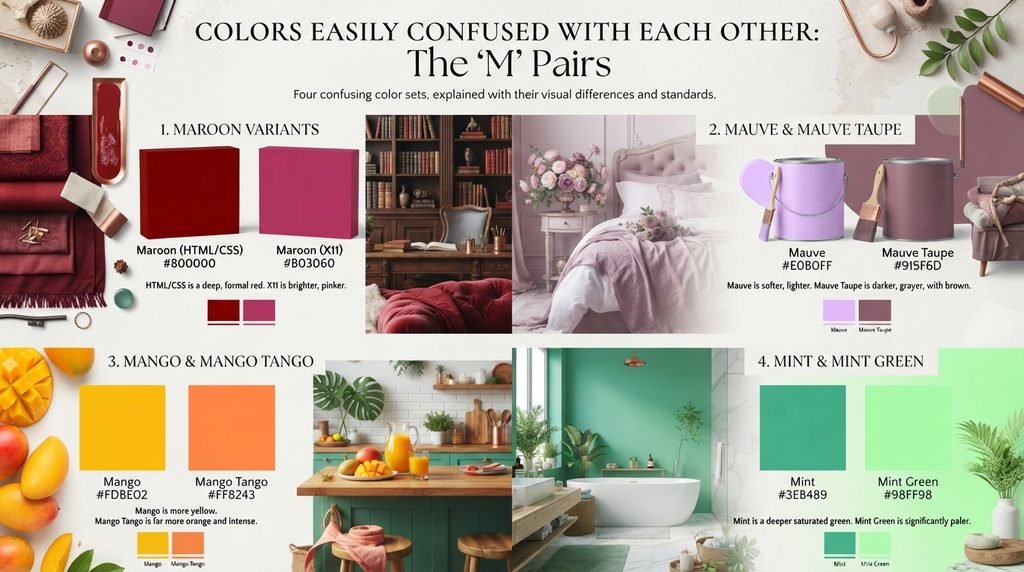
| Color A | Hex A | Color B | Hex B | Key Difference |
| Maroon (HTML/CSS) | #800000 | Maroon (X11) | #B03060 | X11 version is far brighter, pinker |
| Mauve | #E0B0FF | Mauve Taupe | #915F6D | Mauve Taupe is darker, grayer |
| Mango | #FDBE02 | Mango Tango | #FF8243 | Mango Tango is more orange |
| Mint | #3EB489 | Mint Green | #98FF98 | Mint Green is far paler, softer |
Maroon (HTML/CSS) versus Maroon (X11) is the pair most likely to confuse someone shopping for paint or design assets, since both share the exact same name despite reading quite differently side by side. Mauve versus Mauve Taupe matters most in interior design, where the wrong choice can shift a room from soft and romantic to muted and grounded.
Master Alphabetical List of M Colors
This list includes standard CSS/X11 names, Crayola-official names, Pantone references, and long-documented traditional and historical names. Standard CSS/X11 names are marked with an asterisk, since those carry a single, universally agreed hex code. Every other name below is still verified against its cited source, though minor variation can exist across informal color-naming sites.

- Maastricht Blue — #001C3D
- Macaroni and Cheese — #FFBD88
- Madder — #E32636
- Madder Lake — #CC3336
- Magenta* — #FF00FF
- Magenta (Pantone) — #D0417E
- Magic Mint — #AAF0D1
- Mahogany — #C04000
- Maize — #FBEC5D
- Maize (Crayola) — #F2C649
- Majorelle Blue — #6050DC
- Malachite — #0BDA51
- Manatee — #979AAA
- Mandarin — #F37A48
- Mango — #FDBE02
- Mango Green — #96FF00
- Mango Tango — #FF8243
- Mantis — #74C365
- Mardi Gras — #880085
- Marigold — #EAA221
- Maroon (Crayola) — #C32148
- Maroon (HTML/CSS)* — #800000
- Maroon (X11) — #B03060
- Mauve — #E0B0FF
- Mauve Taupe — #915F6D
- Mauveine — #8D029B
- Mauvelous — #EF98AA
- Maximum Blue — #47ABCC
- Maximum Blue Green — #30BFBF
- MediumAquaMarine* — #66CDAA
- MediumBlue* — #0000CD
- MediumOrchid* — #BA55D3
- MediumPurple* — #9370DB
- MediumSeaGreen* — #3CB371
- MediumSlateBlue* — #7B68EE
- MediumSpringGreen* — #00FA9A
- MediumTurquoise* — #48D1CC
- MediumVioletRed* — #C71585
- Melon — #FDBCB4
- MidnightBlue* — #191970
- Mint — #3EB489
- MintCream* — #F5FFFA
- Mint Green — #98FF98
- MistyRose* — #FFE4E1
- Mocha — #967969
- Moccasin* — #FFE4B5
- Moss Green — #8A9A5B
- Mulberry — #C54B8C
- Mustard — #FFDB58
- Myrtle Green — #317873
Notice how many entries belong to the official CSS “Medium” family alone: eleven colors calibrated specifically to sit between a standard hue and its lighter or darker variant. That pattern is stronger here than in most other letters.
Hex/RGB Crosswalk: Why Exact Codes Matter
A color name alone isn’t enough for real design work. Two designers using “maroon” without a hex code might land on two noticeably different shades of red. That’s why any serious project needs the exact hex or RGB value locked in before production starts.
Hex codes matter most for web and app design, since browsers read hex values directly. RGB values matter more for video, screen graphics, and design software that calculates color mathematically. The table below gives both formats for five of the most frequently searched colors that start with M, so you can copy whichever your tool requires.

| Color | Hex | RGB |
| Magenta | #FF00FF | 255, 0, 255 |
| Maroon (HTML/CSS) | #800000 | 128, 0, 0 |
| Mauve | #E0B0FF | 224, 176, 255 |
| Malachite | #0BDA51 | 11, 218, 81 |
| Mustard | #FFDB58 | 255, 219, 88 |
Magenta’s RGB values show maxed-out red and blue channels with zero green, which is exactly what gives it that flat, electric intensity. Maroon (HTML/CSS), by contrast, keeps only the red channel active at a moderate level, producing its deep, muted formality instead of anything bright or saturated.
Full Comparison Table: All 50 M Colors
This table brings every color from the alphabetical list together with hex, RGB, color family, and common use. Use the family column to quickly find colors that will sit well together in a single palette, and use the common use column to match a color to your actual project type.
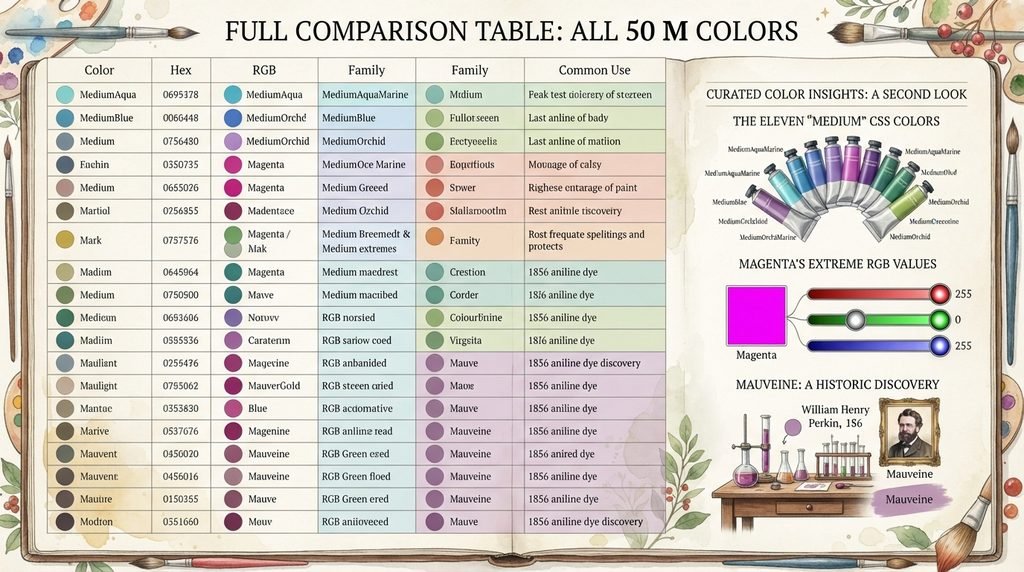
| Color | Hex | RGB | Family | Common Use |
| Maastricht Blue | #001C3D | 0, 28, 61 | Blue | Deep formal branding |
| Macaroni and Cheese | #FFBD88 | 255, 189, 136 | Orange | Warm food-inspired accent |
| Madder | #E32636 | 227, 38, 54 | Red | Historic dye pigment accent |
| Madder Lake | #CC3336 | 204, 51, 54 | Red | Traditional pigment accent |
| Magenta | #FF00FF | 255, 0, 255 | Pink/Purple | Bold digital, print branding |
| Magenta (Pantone) | #D0417E | 208, 65, 126 | Pink | Print reference accent |
| Magic Mint | #AAF0D1 | 170, 240, 209 | Green | Soft pastel accent |
| Mahogany | #C04000 | 192, 64, 0 | Brown/Red | Luxury, wood-inspired branding |
| Maize | #FBEC5D | 251, 236, 93 | Yellow | Warm food-inspired accent |
| Maize (Crayola) | #F2C649 | 242, 198, 73 | Yellow | Playful crayon-toned accent |
| Majorelle Blue | #6050DC | 96, 80, 220 | Blue | Creative, luxury branding |
| Malachite | #0BDA51 | 11, 218, 81 | Green | Vibrant nature-inspired accent |
| Manatee | #979AAA | 151, 154, 170 | Gray | Muted professional neutral |
| Mandarin | #F37A48 | 243, 122, 72 | Orange | Bright citrus-inspired accent |
| Mango | #FDBE02 | 253, 190, 2 | Yellow/Orange | Bold food-inspired branding |
| Mango Green | #96FF00 | 150, 255, 0 | Green | High-energy accent |
| Mango Tango | #FF8243 | 255, 130, 67 | Orange | Bold energetic branding |
| Mantis | #74C365 | 116, 195, 101 | Green | Fresh natural accent |
| Mardi Gras | #880085 | 136, 0, 133 | Purple | Festive, bold branding |
| Marigold | #EAA221 | 234, 162, 33 | Yellow/Orange | Warm cheerful accent |
| Maroon (Crayola) | #C32148 | 195, 33, 72 | Red | Bold formal accent |
| Maroon (HTML/CSS) | #800000 | 128, 0, 0 | Red | Academic, sports branding |
| Maroon (X11) | #B03060 | 176, 48, 96 | Red/Pink | Bold fashion accent |
| Mauve | #E0B0FF | 224, 176, 255 | Purple | Soft romantic branding |
| Mauve Taupe | #915F6D | 145, 95, 109 | Purple/Brown | Sophisticated neutral accent |
| Mauveine | #8D029B | 141, 2, 155 | Purple | Historic dye reference |
| Mauvelous | #EF98AA | 239, 152, 170 | Pink | Soft playful accent |
| Maximum Blue | #47ABCC | 71, 171, 204 | Blue | Bright modern branding |
| Maximum Blue Green | #30BFBF | 48, 191, 191 | Blue/Green | Bold tech branding |
| MediumAquaMarine | #66CDAA | 102, 205, 170 | Green | Calm, balanced accent |
| MediumBlue | #0000CD | 0, 0, 205 | Blue | Bold formal branding |
| MediumOrchid | #BA55D3 | 186, 85, 211 | Purple | Bold fashion accent |
| MediumPurple | #9370DB | 147, 112, 219 | Purple | Soft creative branding |
| MediumSeaGreen | #3CB371 | 60, 179, 113 | Green | Natural, eco branding |
| MediumSlateBlue | #7B68EE | 123, 104, 238 | Blue/Purple | Modern tech branding |
| MediumSpringGreen | #00FA9A | 0, 250, 154 | Green | Bright energetic accent |
| MediumTurquoise | #48D1CC | 72, 209, 204 | Blue/Green | Calm tropical accent |
| MediumVioletRed | #C71585 | 199, 21, 133 | Pink/Red | Bold fashion accent |
| Melon | #FDBCB4 | 253, 188, 180 | Pink/Orange | Soft warm accent |
| MidnightBlue | #191970 | 25, 25, 112 | Blue | Deep formal, near-black alternative |
| Mint | #3EB489 | 62, 180, 137 | Green | Fresh, calming branding |
| MintCream | #F5FFFA | 245, 255, 250 | Neutral | Pale soft background |
| Mint Green | #98FF98 | 152, 255, 152 | Green | Soft pastel accent |
| MistyRose | #FFE4E1 | 255, 228, 225 | Pink | Pale soft background |
| Mocha | #967969 | 150, 121, 105 | Brown | Café, sophisticated neutral |
| Moccasin | #FFE4B5 | 255, 228, 181 | Neutral/Orange | Warm soft background |
| Moss Green | #8A9A5B | 138, 154, 91 | Green | Grounded natural accent |
| Mulberry | #C54B8C | 197, 75, 140 | Pink/Purple | Autumn fashion accent |
| Mustard | #FFDB58 | 255, 219, 88 | Yellow | Warm food, fashion branding |
| Myrtle Green | #317873 | 49, 120, 115 | Green | Deep natural accent |
A few rows deserve a second look. The eleven official “Medium” CSS colors together form the largest single cluster of related names on this table, each calibrated to sit between a standard hue and its extremes. Magenta holds the most extreme RGB values here, maxing out two channels while zeroing the third. Mauveine stands out as the only entry tied to a specific, dated scientific discovery rather than nature, food, or tradition.
Decision-Flow Table: Picking the Right M Color
Choosing between fifty similar-sounding names gets easier with a clear project goal in mind. The table below matches common use cases to a recommended color that starts with M, so you can skip the guesswork and go straight to a shade that fits the job.
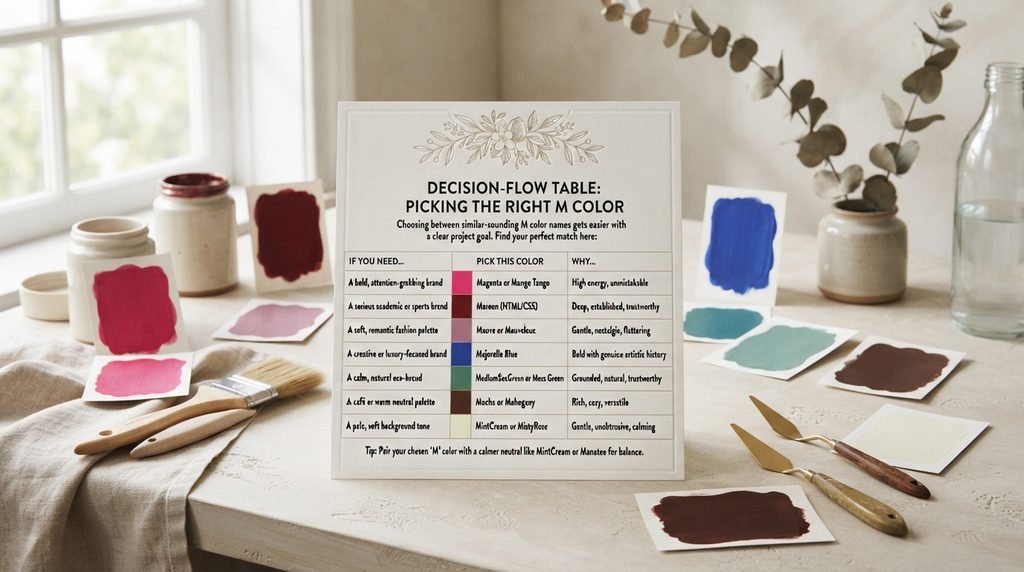
| If you need… | Pick this color | Why |
| A bold, attention-grabbing brand | Magenta or Mango Tango | High energy, unmistakable |
| A serious academic or sports brand | Maroon (HTML/CSS) | Deep, established, trustworthy |
| A soft, romantic fashion palette | Mauve or Mauvelous | Gentle, nostalgic, flattering |
| A creative or luxury-focused brand | Majorelle Blue | Bold with genuine artistic history |
| A calm, natural eco-brand | MediumSeaGreen or Moss Green | Grounded, natural, trustworthy |
| A café or warm neutral palette | Mocha or Mahogany | Rich, cozy, versatile |
| A pale, soft background tone | MintCream or MistyRose | Gentle, unobtrusive, calming |
Use this table as a starting point rather than a final answer. A palette built entirely around Magenta, for instance, often benefits from a neutral like MintCream or Manatee alongside it to keep the overall design from feeling too intense. Pair the recommended color with a calmer neutral from the comparison table above for a balanced result.
Conclusion
Colors that start with M stretch from the electric intensity of Magenta to the quiet depth of Midnight Blue. This list sticks to 50 verified names with real hex and RGB codes, so nothing here is guesswork or padding. Whether you’re building a brand, mixing paint, or just curious, these colors that start with M give you a solid, checkable starting point.
Frequently Asked Questions
How many colors actually start with the letter M?
This guide covers 50 verified colors that start with M, drawn from CSS/X11 standards, Crayola’s official naming, Pantone references, and documented historical sources. Larger lists claiming 275 or more usually include invented, unverifiable names with no real hex code.
What are some common colors that start with M?
Magenta, Maroon, Mauve, Mahogany, and Mustard are among the most recognized. Each has a fixed hex code and shows up regularly in design, fashion, and branding.
Is Magenta a real CSS color? Yes. Magenta is a standard CSS/X11 color with the hex code #FF00FF, identical in value to the color Fuchsia despite the different name.
Why are there three different Maroon colors?
Maroon (Crayola), Maroon (HTML/CSS), and Maroon (X11) were each calibrated independently by different organizations. The HTML/CSS version is the darkest and most formal, while the X11 version runs noticeably brighter and pinker.
What color is Majorelle Blue exactly?
Majorelle Blue is a bold, saturated blue with the hex code #6050DC, named after French painter Jacques Majorelle’s famous garden in Marrakech, later restored by designer Yves Saint Laurent.
Is Mauve the same as light purple?
Mauve, hex #E0B0FF, is a specific, softer shade of light purple named after the mallow flower, distinct from more general or saturated purple descriptions.
What is Mauveine famous for?
Mauveine, hex #8D029B, was the first synthetic aniline dye, accidentally discovered by 18-year-old chemist William Perkin in 1856 while attempting to synthesize a malaria treatment.
Why are there eleven “Medium” colors starting with M?
CSS and X11 standards include eleven colors prefixed with “Medium,” from MediumBlue to MediumVioletRed, each calibrated to sit between a standard hue and its lighter or darker extremes.