
Colors That Start With L: 61 Names & Color Codes

Colors that start with L cover an unusually large range for a single letter. Lavender and Lime are the household names. Beyond them sits a genuinely deep well of official CSS standards, historic pigments, and Crayola-specific shades that few casual color lists ever fully explore.
This list of colors that start with L only includes names with a real, checkable source. That means CSS/X11 web standards, Crayola’s official naming, or long-documented traditional names. Every hex code here was cross-checked against at least two sources before it made the list.
That research turned up 61 real colors that start with L, more than most letters produce. Part of that comes from the official CSS “Light” family alone, which includes thirteen standardized colors like LightBlue and LightSeaGreen. The rest comes from historic pigments, Crayola shades, and traditional dye names, all verified rather than guessed at.
Quick Answer: Standout L Colors
Short on time? Here are eight L colors worth knowing first. Lavender (#E6E6FA) is the standard CSS pale purple, named directly after the flower. Lime Green (#32CD32) delivers a bright, energetic green used across sports and eco branding. Lemon (#FFF700) offers a bold, saturated yellow tied to the fruit.

Lapis Lazuli (#26619C) provides a deep, historic blue borrowed from the gemstone. Licorice (#1A1110) gives a near-black neutral pulled from the candy. Lilac (#C8A2C8) delivers a pale pinkish-purple named after the flower. Light Sea Green (#20B2AA) rounds things out with a cool, calming teal. Lawn Green (#7CFC00) adds a vivid, fresh green tied directly to freshly cut grass. Each of these earns its spot through wide recognition, not alphabetical luck.
What L Colors Mean and Evoke
Color names carry emotional weight, and colors that start with L lean strongly toward calm and softness, with a few bold exceptions. Lavender suggests relaxation and gentle femininity, tied to the flower’s long history in aromatherapy and skincare. Lilac carries a similar softness but reads slightly warmer, favored in spring fashion and nursery design.

Lime and Lemon both suggest energy and freshness, borrowing directly from citrus fruit that people associate with brightness and zest. Lapis Lazuli, by contrast, carries deep historical weight, tied to a gemstone once so rare and expensive that only the wealthiest patrons could commission paintings using its pigment.
Licorice leans dark and mysterious, evoking the candy’s deep, almost bitter intensity. Liver, in all its documented variants, carries a more clinical, less flattering association, though it remains a legitimate and precisely defined color used in veterinary and design contexts alike.
Color Families: Where L Colors Belong

Blues
LightBlue, LightCyan, LightSkyBlue, LightSlateGray, LightSteelBlue, Lapis Lazuli, Little Boy Blue, and Livid anchor this large family. LightBlue and LightSkyBlue both stay pale and calm, while LightSlateGray pushes toward a muted, professional gray-blue. Lapis Lazuli carries the most historical weight of the group, tied to a pigment once more valuable than gold.
Greens
LightGreen, LightSeaGreen, Lawn Green, Lime, Lime Green, La Salle Green, Laurel Green, Limerick, and Lincoln Green cover this large, varied family. Lawn Green and Lime both read bright and energetic, while Laurel Green and Lincoln Green stay deeper and more traditional. Light Sea Green sits apart from the others, leaning more teal than true green.
Yellows
LightGoldenrodYellow, LightYellow, Lemon Chiffon, Laser Lemon, Lemon, Lemon Curry, Lemon Glacier, Lemon Lime, Lemon Meringue, and the two Lemon Yellow variants dominate this family. Lemon itself stays the boldest and most saturated, while Lemon Chiffon and Lemon Meringue both soften considerably, closer to pastel than primary yellow.
Pinks
LightCoral, LightPink, LightSalmon, Lavender Blush, Lavender Magenta, Lavender Pink, Lavender Rose, Little Girl Pink, and Liseran Purple anchor this family. LightPink stays soft and pale, while Lavender Magenta pushes into a bolder, more saturated territory. Little Girl Pink lives up to its name, reading as gentle and youthful.
Purples
Languid Lavender, Lavender (Web), Lavender (Floral), Lavender Blue, Lavender Gray, Lavender Indigo, Lavender Purple, Light Lavender, Lilac, and Lilac Luster make up the largest single-hue cluster in this entire letter group. Lavender (Floral) matches the actual flower petal color, while the web standard Lavender runs noticeably paler. Lavender Indigo pushes the furthest toward blue-purple, while Lilac stays warmer and pinker throughout.
Browns and Neutrals
Latte, Lion, Liver, Liver (Dogs), Liver (Organ), Liver Chestnut, Licorice, Linen, Lotion, and Light Orange round out this family. Latte and Lion both stay warm and pale, while the Liver variants run darker and more muted, tied to genuinely descriptive naming rather than anything aspirational. Licorice anchors the dark end, while Linen and Lotion both stay soft and nearly white.
Design & Branding Favorites
Certain colors that start with L show up constantly in branding work. Lavender and its many variants dominate wellness and beauty branding, chosen for a calm, approachable read. Lime Green appears often in sports and eco branding, valued for its energetic, fresh quality. LightSlateGray works well in professional, minimalist design where a softer alternative to pure gray is needed.
Below is a quick reference for how four of these colors typically get used in real design work. Notice how the pastel entries lean toward wellness branding, while the saturated entries lean toward energetic, youth-focused design.

| Color | Hex | Typical Use |
| Lavender (Web) | #E6E6FA | Wellness, beauty branding |
| Lime Green | #32CD32 | Sports, eco branding |
| LightSlateGray | #778899 | Professional, minimalist design |
| Lemon | #FFF700 | Bold, energetic branding |
Lavender and Lime Green rarely appear together in the same palette, since one is built for calm and the other for energy. LightSlateGray works best as a supporting neutral, rarely standing as the primary color in a finished design.
Fashion & Beauty Shades
Fashion draws heavily on several L names. Lilac remains one of the most requested pastel shades each spring, valued for flattering a wide range of skin tones without overwhelming an outfit. Lavender crosses over into beauty and fragrance branding constantly, tied directly to the plant’s long history in skincare and aromatherapy.
Lavender Blush deserves a mention here too, since its extremely pale, warm pink reads as almost skin-toned in certain lighting, making it a popular choice for bridal and formalwear linings. Its softness sets it apart from a bolder entry like Lavender Magenta, which almost never appears in the same delicate product category.
Nature-Inspired Names
Several colors that start with L borrow directly from the natural world. Lavender and Lilac both take their names and tones from flowers, two of the most direct nature-to-color connections in the entire alphabet. Lemon and Lime both pull from citrus fruit, capturing that same bright, zesty quality.
Lawn Green closes out this group with one of the more literal nature references on the list, matching the exact bright green of freshly cut, healthy grass. Lion, while less obviously botanical, still nods to nature, describing the warm, tawny color of the animal’s coat rather than anything found in a garden or orchard.
Rare or Unusual L Color Names
Some colors that start with L rarely surface outside specialist circles, but each has a real story behind it. Liver, in its several documented variants, is a genuinely clinical color term used in veterinary medicine to describe specific coat colors in dogs, distinct from the deep reddish-brown of the actual organ it’s also named after. Lapis Lazuli carries real historical weight, once ground into ultramarine pigment so expensive that Renaissance painters reserved it exclusively for the most important elements of a commission, often the robes of the Virgin Mary.

Liseran Purple sounds invented but is a genuinely documented traditional color, distinct from more common purples despite leaning closer to pink in practice. Lanzones, a warm golden tan, takes its name from a tropical fruit grown across Southeast Asia, rarely known outside the region where the fruit itself grows. Each of these names shows that “obscure” in the L family usually means “specialized or regional,” not “made up.”
- Liver (Dogs) (#B86D29) — clinical veterinary coat-color term
- Lapis Lazuli (#26619C) — historic pigment once more valuable than gold
- Liseran Purple (#DE6FA1) — traditional color name closer to pink than purple
- Lanzones (#E0BC5B) — named after a Southeast Asian fruit
These four sit at the edge of common knowledge, but each one has a stable, checkable source. That’s what separates a genuinely rare color name from a vague one that different sites define inconsistently.
Colors Easily Confused With Each Other
A few L pairs trip people up constantly. Lavender (Web) and Lavender (Floral) both read as pale purple at a glance, but the web standard runs noticeably paler and cooler, while the floral version matches the actual flower’s more saturated petal color. Lilac and Lavender also cause confusion, since both are pale purples, but Lilac leans warmer and pinker while Lavender stays firmly on the blue side.
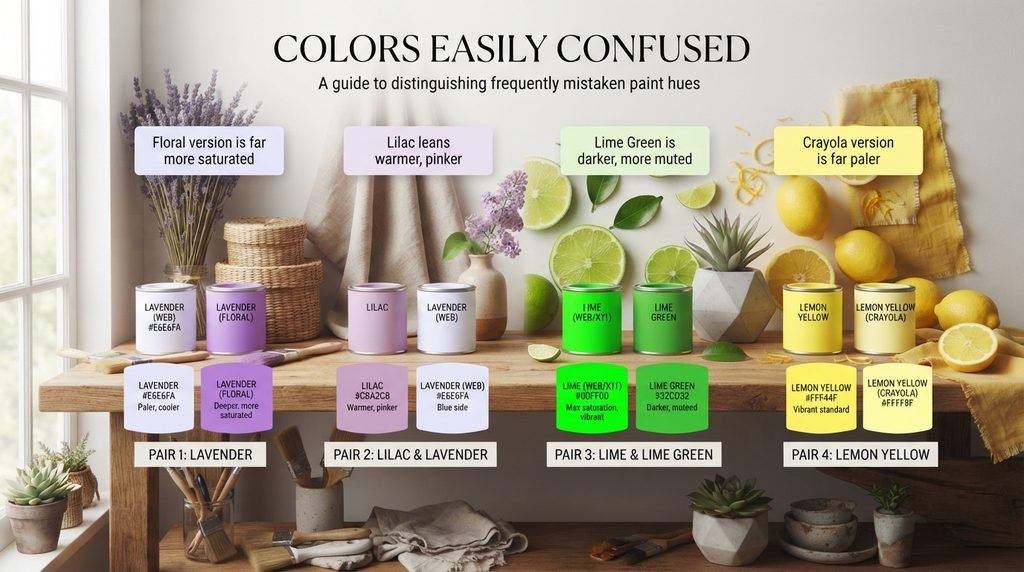
Lime (Web/X11 Green) and Lime Green get mixed up constantly too, since both share the word “lime,” but the web standard is a pure, maximum-saturation green while Lime Green runs slightly darker and more muted. The two Lemon Yellow variants cause similar confusion, since Crayola’s version runs noticeably paler than the standard Lemon Yellow.
| Color A | Hex A | Color B | Hex B | Key Difference |
| Lavender (Web) | #E6E6FA | Lavender (Floral) | #B57EDC | Floral version is far more saturated |
| Lilac | #C8A2C8 | Lavender (Web) | #E6E6FA | Lilac leans warmer, pinker |
| Lime (Web/X11) | #00FF00 | Lime Green | #32CD32 | Lime Green is darker, more muted |
| Lemon Yellow | #FFF44F | Lemon Yellow (Crayola) | #FFFF9F | Crayola version is far paler |
Lavender (Web) versus Lavender (Floral) is the pair most likely to confuse someone shopping for paint or fabric, since both share the exact same name despite reading quite differently side by side. Lime versus Lime Green matters most for anyone doing brand or web design, since choosing the wrong standard can shift an intended fresh green into something noticeably more electric or muted.
Master Alphabetical List of L Colors
This list includes standard CSS/X11 names, Crayola-official names, and long-documented traditional names. Standard CSS/X11 names are marked with an asterisk, since those carry a single, universally agreed hex code. Every other name below is still verified against its cited source, though minor variation can exist across informal color-naming sites.

- La Salle Green — #087830
- Languid Lavender — #D6CADD
- Lanzones — #E0BC5B
- Lapis Lazuli — #26619C
- Laser Lemon — #FFFF66
- Latte — #A67B5B
- Laurel Green — #A9BA9D
- Lava — #CF1020
- Lavender (Floral) — #B57EDC
- Lavender (Web)* — #E6E6FA
- Lavender Blue — #CCCCFF
- Lavender Blush* — #FFF0F5
- Lavender Gray — #C4C3D0
- Lavender Indigo — #9457EB
- Lavender Magenta — #EE82EE
- Lavender Pink — #FBAED2
- Lavender Purple — #967BB6
- Lavender Rose — #FBA0E3
- Lawn Green* — #7CFC00
- Lemon — #FFF700
- Lemon Chiffon* — #FFFACD
- Lemon Curry — #CCA01D
- Lemon Glacier — #FDFF00
- Lemon Lime — #E3FF00
- Lemon Meringue — #F6EABE
- Lemon Yellow — #FFF44F
- Lemon Yellow (Crayola) — #FFFF9F
- Licorice — #1A1110
- LightBlue* — #ADD8E6
- LightCoral* — #F08080
- LightCyan* — #E0FFFF
- LightGoldenrodYellow* — #FAFAD2
- LightGray* — #D3D3D3
- LightGreen* — #90EE90
- LightLavender — #C9A0DC
- LightOrange — #FED8B1
- LightPink* — #FFB6C1
- LightSalmon* — #FFA07A
- LightSeaGreen* — #20B2AA
- LightSkyBlue* — #87CEFA
- LightSlateGray* — #778899
- LightSteelBlue* — #B0C4DE
- LightYellow* — #FFFFE0
- Lilac — #C8A2C8
- Lilac Luster — #AE98AA
- Lime (Color Wheel) — #BFFF00
- Lime (Web/X11 Green)* — #00FF00
- Lime Green* — #32CD32
- Limerick — #9DC209
- Lincoln Green — #195905
- Linen* — #FAF0E6
- Lion — #C19A6B
- Liseran Purple — #DE6FA1
- Little Boy Blue — #6CA0DC
- Little Girl Pink — #F8B9D4
- Liver — #674C47
- Liver (Dogs) — #B86D29
- Liver (Organ) — #6C2E1F
- Liver Chestnut — #987456
- Livid — #6699CC
- Lotion — #FEFDFA
Notice how many entries carry “Lavender” or “Lemon” as a root word, together making up nearly a third of this entire letter group. That concentration happens because both names have been calibrated independently by multiple color-naming traditions over more than a century.
Hex/RGB Crosswalk: Why Exact Codes Matter
A color name alone isn’t enough for real design work. Two designers using “lavender” without a hex code might land on two noticeably different shades of purple. That’s why any serious project needs the exact hex or RGB value locked in before production starts.
Hex codes matter most for web and app design, since browsers read hex values directly. RGB values matter more for video, screen graphics, and design software that calculates color mathematically. The table below gives both formats for five of the most frequently searched colors that start with L, so you can copy whichever your tool requires.
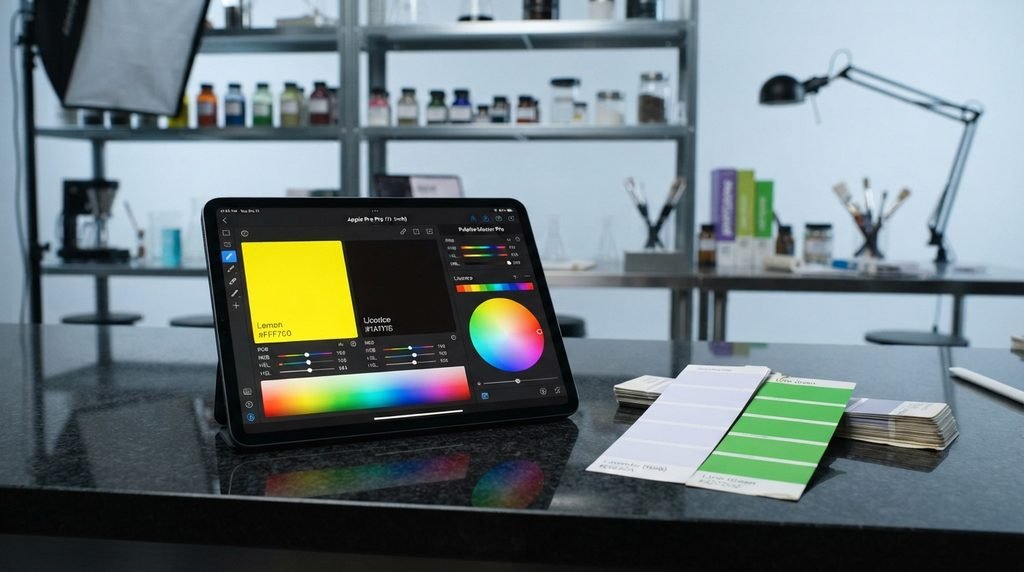
| Color | Hex | RGB |
| Lavender (Web) | #E6E6FA | 230, 230, 250 |
| Lime Green | #32CD32 | 50, 205, 50 |
| Lemon | #FFF700 | 255, 247, 0 |
| Lapis Lazuli | #26619C | 38, 97, 156 |
| Licorice | #1A1110 | 26, 17, 16 |
Lemon’s RGB values show a maxed-out red and green channel paired with zero blue, which is exactly what gives it that bright, saturated yellow quality. Licorice, by contrast, keeps all three channels extremely low and close together, producing its flat, near-black appearance rather than anything bold or colorful.
Full Comparison Table: All 61 L Colors
This table brings every color from the alphabetical list together with hex, RGB, color family, and common use. Use the family column to quickly find colors that will sit well together in a single palette, and use the common use column to match a color to your actual project type.
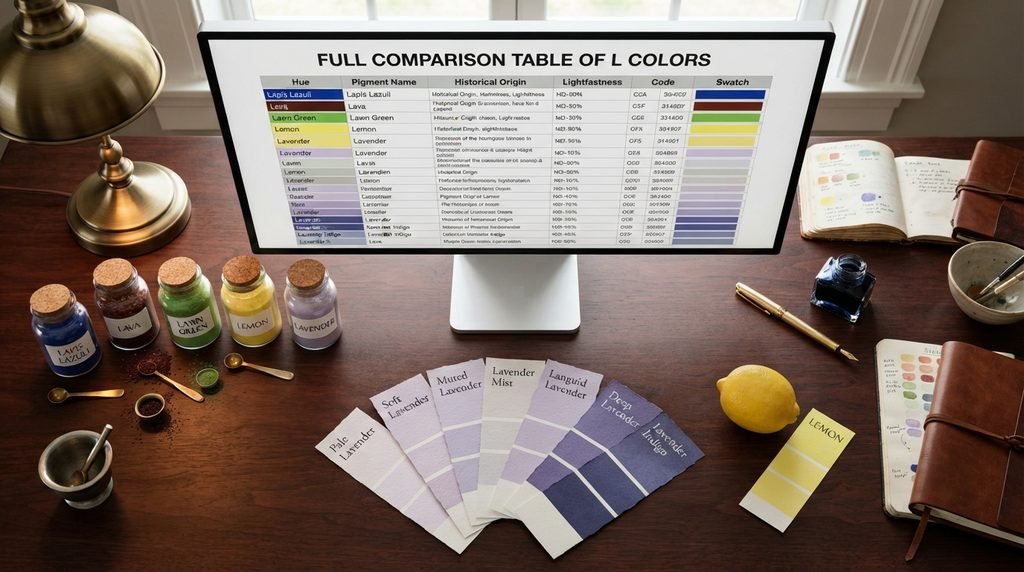
| Color | Hex | RGB | Family | Common Use |
| La Salle Green | #087830 | 8, 120, 48 | Green | Broad formal green accent |
| Languid Lavender | #D6CADD | 214, 202, 221 | Purple | Soft pastel branding |
| Lanzones | #E0BC5B | 224, 188, 91 | Yellow/Brown | Warm tropical accent |
| Lapis Lazuli | #26619C | 38, 97, 156 | Blue | Historic pigment, art reference |
| Laser Lemon | #FFFF66 | 255, 255, 102 | Yellow | Bright energetic accent |
| Latte | #A67B5B | 166, 123, 91 | Brown | Café, warm neutral branding |
| Laurel Green | #A9BA9D | 169, 186, 157 | Green | Calm, muted natural accent |
| Lava | #CF1020 | 207, 16, 32 | Red | Bold dramatic accent |
| Lavender (Floral) | #B57EDC | 181, 126, 220 | Purple | Wellness, floral branding |
| Lavender (Web) | #E6E6FA | 230, 230, 250 | Purple | Calm, soft background tone |
| Lavender Blue | #CCCCFF | 204, 204, 255 | Blue/Purple | Soft pastel accent |
| Lavender Blush | #FFF0F5 | 255, 240, 245 | Pink | Bridal, formalwear lining |
| Lavender Gray | #C4C3D0 | 196, 195, 208 | Purple/Gray | Sophisticated muted accent |
| Lavender Indigo | #9457EB | 148, 87, 235 | Purple | Bold creative accent |
| Lavender Magenta | #EE82EE | 238, 130, 238 | Pink/Purple | Bold fashion accent |
| Lavender Pink | #FBAED2 | 251, 174, 210 | Pink | Soft feminine branding |
| Lavender Purple | #967BB6 | 150, 123, 182 | Purple | Muted formal accent |
| Lavender Rose | #FBA0E3 | 251, 160, 227 | Pink | Playful cosmetics accent |
| Lawn Green | #7CFC00 | 124, 252, 0 | Green | Fresh, energetic branding |
| Lemon | #FFF700 | 255, 247, 0 | Yellow | Bold citrus-inspired branding |
| Lemon Chiffon | #FFFACD | 255, 250, 205 | Yellow | Pale soft background |
| Lemon Curry | #CCA01D | 204, 160, 29 | Yellow/Brown | Warm food-inspired accent |
| Lemon Glacier | #FDFF00 | 253, 255, 0 | Yellow | High-visibility accent |
| Lemon Lime | #E3FF00 | 227, 255, 0 | Green/Yellow | Bold energetic branding |
| Lemon Meringue | #F6EABE | 246, 234, 190 | Yellow | Soft food-inspired accent |
| Lemon Yellow | #FFF44F | 255, 244, 79 | Yellow | Bright cheerful branding |
| Lemon Yellow (Crayola) | #FFFF9F | 255, 255, 159 | Yellow | Pale playful accent |
| Licorice | #1A1110 | 26, 17, 16 | Neutral | Near-black formal alternative |
| LightBlue | #ADD8E6 | 173, 216, 230 | Blue | Soft calming background |
| LightCoral | #F08080 | 240, 128, 128 | Red/Pink | Gentle warm accent |
| LightCyan | #E0FFFF | 224, 255, 255 | Blue/Cyan | Pale cool background |
| LightGoldenrodYellow | #FAFAD2 | 250, 250, 210 | Yellow | Soft pastel background |
| LightGray | #D3D3D3 | 211, 211, 211 | Neutral | Universal soft neutral |
| LightGreen | #90EE90 | 144, 238, 144 | Green | Fresh, gentle accent |
| Light Lavender | #C9A0DC | 201, 160, 220 | Purple | Soft calming accent |
| Light Orange | #FED8B1 | 254, 216, 177 | Orange | Warm gentle accent |
| LightPink | #FFB6C1 | 255, 182, 193 | Pink | Soft feminine branding |
| LightSalmon | #FFA07A | 255, 160, 122 | Orange/Pink | Warm gentle accent |
| LightSeaGreen | #20B2AA | 32, 178, 170 | Green/Teal | Calm, professional branding |
| LightSkyBlue | #87CEFA | 135, 206, 250 | Blue | Soft, airy background |
| LightSlateGray | #778899 | 119, 136, 153 | Gray | Professional minimalist design |
| LightSteelBlue | #B0C4DE | 176, 196, 222 | Blue/Gray | Muted professional accent |
| LightYellow | #FFFFE0 | 255, 255, 224 | Yellow | Pale soft background |
| Lilac | #C8A2C8 | 200, 162, 200 | Purple | Spring fashion, nursery design |
| Lilac Luster | #AE98AA | 174, 152, 170 | Purple | Muted sophisticated accent |
| Lime (Color Wheel) | #BFFF00 | 191, 255, 0 | Green/Yellow | Bold high-energy accent |
| Lime (Web/X11 Green) | #00FF00 | 0, 255, 0 | Green | Maximum-saturation web green |
| Lime Green | #32CD32 | 50, 205, 50 | Green | Sports, eco branding |
| Limerick | #9DC209 | 157, 194, 9 | Green/Yellow | Bold natural accent |
| Lincoln Green | #195905 | 25, 89, 5 | Green | Deep traditional green |
| Linen | #FAF0E6 | 250, 240, 230 | Neutral | Soft warm background |
| Lion | #C19A6B | 193, 154, 107 | Brown | Warm neutral accent |
| Liseran Purple | #DE6FA1 | 222, 111, 161 | Pink/Purple | Traditional fashion accent |
| Little Boy Blue | #6CA0DC | 108, 160, 220 | Blue | Gentle, friendly branding |
| Little Girl Pink | #F8B9D4 | 248, 185, 212 | Pink | Soft playful branding |
| Liver | #674C47 | 103, 76, 71 | Brown | Muted formal neutral |
| Liver (Dogs) | #B86D29 | 184, 109, 41 | Brown | Veterinary coat-color reference |
| Liver (Organ) | #6C2E1F | 108, 46, 31 | Brown/Red | Deep dramatic accent |
| Liver Chestnut | #987456 | 152, 116, 86 | Brown | Warm muted accent |
| Livid | #6699CC | 102, 153, 204 | Blue | Calm professional accent |
| Lotion | #FEFDFA | 254, 253, 250 | Neutral | Near-white soft background |
A few rows deserve a second look. The ten Lavender-family variants together make up the largest single cluster on this entire table, spanning from the pale Web standard to the far bolder Lavender Indigo. Lemon’s RGB values stand out as one of the purest, most saturated entries here, maxing out two channels while zeroing the third. The three Liver variants prove that even a clinically descriptive name can carry a precisely documented, checkable hex code.
Decision-Flow Table: Picking the Right L Color
Choosing between sixty-one similar-sounding names gets easier with a clear project goal in mind. The table below matches common use cases to a recommended color that starts with L, so you can skip the guesswork and go straight to a shade that fits the job.
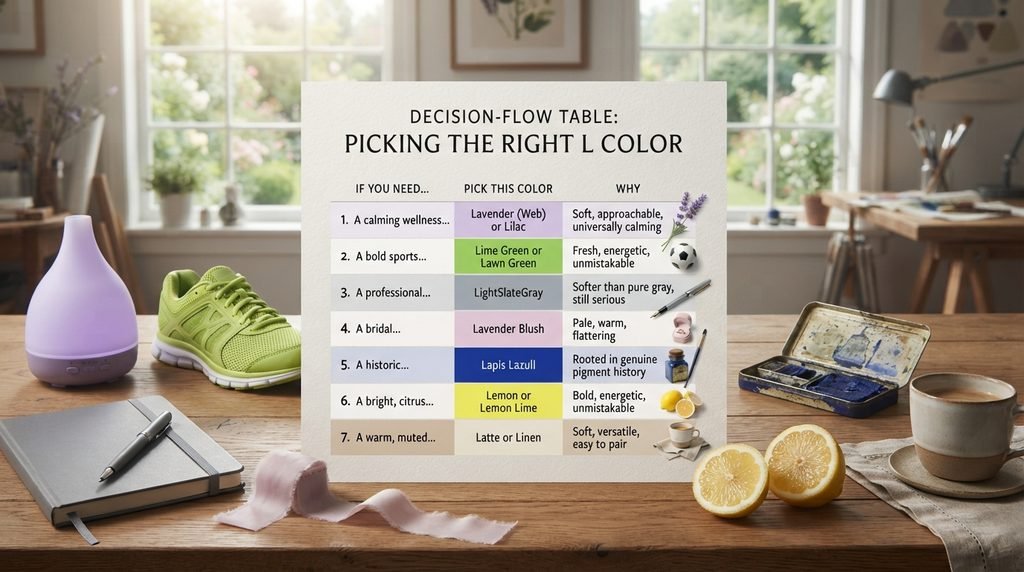
| If you need… | Pick this color | Why |
| A calming wellness or beauty brand | Lavender (Web) or Lilac | Soft, approachable, universally calming |
| A bold sports or eco-focused brand | Lime Green or Lawn Green | Fresh, energetic, unmistakable |
| A professional, minimalist design | LightSlateGray | Softer than pure gray, still serious |
| A bridal or soft formalwear palette | Lavender Blush | Pale, warm, flattering |
| A historic or art-inspired project | Lapis Lazuli | Rooted in genuine pigment history |
| A bright, citrus-inspired accent | Lemon or Lemon Lime | Bold, energetic, unmistakable |
| A warm, muted neutral for interiors | Latte or Linen | Soft, versatile, easy to pair |
Use this table as a starting point rather than a final answer. A palette built entirely around Lime Green, for instance, often benefits from a neutral like Linen or Lotion alongside it to keep the overall design from feeling too intense. Pair the recommended color with a calmer neutral from the comparison table above for a balanced result.
Conclusion
Colors that start with L stretch from the calm softness of Lavender to the bold energy of Lime Green. This list sticks to 61 verified names with real hex and RGB codes, so nothing here is guesswork or padding. Whether you’re building a brand, mixing paint, or just curious, these colors that start with L give you a solid, checkable starting point.
Frequently Asked Questions
How many colors actually start with the letter L?
This guide covers 61 verified colors that start with L, drawn from CSS/X11 standards, Crayola’s official naming, and long-documented traditional names. That number includes thirteen official CSS “Light” colors alone, such as LightBlue and LightSeaGreen.
What are some common colors that start with L?
Lavender, Lime, Lemon, Lilac, and Lapis Lazuli are among the most recognized. Each has a fixed hex code and shows up regularly in design, fashion, and branding.
What’s the difference between Lavender (Web) and Lavender (Floral)?
Lavender (Web), hex #E6E6FA, is the paler CSS standard, while Lavender (Floral), hex #B57EDC, matches the more saturated color of the actual flower’s petals.
Is Lilac the same as Lavender?
They’re closely related but not identical. Lilac (#C8A2C8) leans warmer and pinker, while Lavender stays firmly on the blue side of pale purple.
Why are there so many official “Light” colors starting with L?
CSS and X11 standards include thirteen colors prefixed with “Light,” from LightBlue to LightYellow, each providing a paler, softer version of a more saturated base color for web design use.
What color is Lapis Lazuli exactly?
Lapis Lazuli is a deep, historic blue with the hex code #26619C, named after the gemstone once ground into ultramarine pigment for Renaissance paintings.
What’s the difference between Lime and Lime Green?
Lime (Web/X11 Green), hex #00FF00, is a maximum-saturation pure green, while Lime Green, hex #32CD32, runs noticeably darker and more muted.
Is Licorice a real, standardized color?
Licorice doesn’t appear in the official CSS/X11 named color list, but it’s a widely documented traditional color with a consistently cited hex code of #1A1110 across major color-name databases.