
Colors That Start With I: Popular, Rare & Unique Shades

Colors that start with I cover a surprisingly formal range. Indigo and Ivory are the household names. International Orange and Imperial Red follow close behind, both tied to real institutions rather than casual naming. Few letters lean this heavily on official, documented sources.
This list of colors that start with I only includes names with a real, checkable source. That means CSS/X11 web standards, documented engineering and government color specifications, or long-established traditional names. Every hex code here was cross-checked against at least two sources before it made the list.
That cross-checking mattered here. Some names showed up on only one informal site, with no second source to confirm them. Those got left out. What remains is 23 real colors that start with I, each backed by a source that agrees with at least one other reference.
The list below groups colors that start with I by family, then by real-world use. Designers will find bold institutional colors here. Historians will find genuine dye and pigment names. Anyone curious about where a color like Isabelline comes from can browse freely, since every entry is backed by a source you can check yourself.
Quick Answer: Standout I Colors
Short on time? Here are eight colors that start with I worth knowing first. Indigo (#4B0082) is a deep blue-purple long tied to natural dye and Isaac Newton’s original color spectrum. Ivory (#FFFFF0) offers a soft, warm off-white drawn from elephant tusks. International Orange (#FF4F00) delivers a bold, high-visibility orange used on the Golden Gate Bridge.

Iris (#5A4FCF) provides a soft purple-blue named after the flower. Imperial Red (#ED2939) carries a bold, formal red used in flags and heraldry. India Green (#138808) ties directly to the green stripe on India’s national flag. Isabelline (#F4F0EC) gives a pale, warm cream tone used to describe bird plumage. Islamic Green (#009000) holds deep cultural and religious significance. Each of these earns its spot through genuine, documented use.
What I Colors Mean and Evoke
Color names carry emotional weight, and colors that start with I lean toward formality, national identity, and historical depth more than most letters. Indigo suggests depth and mystery, tied to centuries of dye trade and its brief status as one of Isaac Newton’s seven named spectrum colors. Ivory suggests quiet luxury, borrowed directly from a material once considered precious and rare.

International Orange and Imperial Red both carry a sense of urgency and formality, chosen specifically by institutions that needed a color impossible to miss or misread. India Green and Islamic Green both carry deep cultural weight, tied respectively to a national flag and a color with religious significance in Islamic tradition.
Iris and Isabelline both lean softer and more contemplative. Iris borrows a dreamy, romantic quality from the flower itself, while Isabelline carries a quiet, historical strangeness, tied to obscure legends about its origin that scholars still debate today.
Color Families: Where I Colors Belong

Blues and Purples
Iceberg, Imperial Blue, Indigo, Indigo Dye, International Klein Blue, Iris, and Italian Sky Blue anchor this large family. Indigo and Indigo Dye share a name root but differ noticeably, since the CSS “Indigo” runs darker and more purple than the historical dye color. International Klein Blue stands apart as an artist-created color, while Iceberg and Italian Sky Blue both stay pale and soft by comparison.
Greens
Illuminating Emerald, India Green, and Islamic Green make up this smaller but distinct family. Illuminating Emerald reads bright and jewel-toned, while India Green and Islamic Green both carry deep national and cultural symbolism rather than purely aesthetic value.
Reds and Oranges
Imperial Red, Indian Red, Irresistible, and the three International Orange variants anchor this warm family. Imperial Red stays bold and formal, while Indian Red leans more muted and earthy. The three International Orange colors, tied to aerospace, engineering, and the Golden Gate Bridge respectively, all differ slightly despite sharing one name.
Yellows
Icterine and Indian Yellow cover this smaller family. Icterine leans bright and lemon-like, while Indian Yellow pulls warmer and more golden, historically tied to a controversial and since-discontinued pigment production method.
Purples
Imperial and Iris both represent this family, though each in a different way. Imperial carries a deep, formal richness tied to its name, while Iris stays lighter and more floral, closer to the flower’s actual petal color.
Neutrals
Isabelline and Ivory round out this group. Isabelline leans slightly gray and yellow, while Ivory stays warmer and creamier, both useful as softer alternatives to stark white.
Gray-Blue
Independence stands alone in this family, a muted, dusty blue-gray with a name that suggests calm resolve rather than anything decorative.
Design & Branding Favorites
Certain colors that start with I show up constantly in institutional and safety-focused branding. International Orange dominates aviation, aerospace, and infrastructure design, chosen specifically for maximum visibility against sky and water. Indigo and Iris both appear in wellness and creative branding, valued for a calm, slightly mysterious read. Ivory remains a steady choice in luxury and bridal branding, prized for its soft warmth.
Below is a quick reference for how four of these colors typically get used in real design work. Notice how the high-visibility entries lean toward safety and infrastructure, while the softer entries lean toward luxury and calm branding.

| Color | Hex | Typical Use |
| International Orange (Aerospace) | #FF4F00 | Aviation, high-visibility design |
| Indigo | #4B0082 | Wellness, creative branding |
| Ivory | #FFFFF0 | Luxury, bridal branding |
| Iris | #5A4FCF | Calm, creative accent branding |
International Orange and Ivory rarely appear in the same palette, since one is built for maximum attention and the other for quiet elegance. Indigo and Iris pair naturally together, since both sit in a similar part of the color wheel while carrying slightly different moods.
Fashion & Beauty Shades
Fashion draws on a focused set of colors that start with I. Ivory remains one of the most requested colors in bridal and formalwear, valued for reading as elegant without the starkness of pure white. Indigo shows up constantly in denim and casualwear, tied directly to centuries of dye tradition long before synthetic alternatives existed.

Iris crosses over into beauty branding fairly often, since its soft purple-blue pairs naturally with fragrance and cosmetics lines aiming for a dreamy, romantic feel. Its softness sets it apart from a bolder entry like Imperial Red, which almost never appears in the same delicate product category.
Nature-Inspired Names
Several colors that start with I borrow directly from the natural world. Iris takes its name and tone from the flower, one of the more literal nature-to-color connections in this letter group. Indigo and Indigo Dye both trace back to a plant-based dye extracted from the indigo plant, used for centuries before synthetic versions took over.
Ivory references elephant tusks directly, a material once so valued that entire trade networks formed around it. Isabelline closes out this group with a stranger nature connection, since the term was first formally used in ornithology to describe a specific pale plumage color seen in birds across Northern Africa.
Rare or Unusual I Color Names
Some colors that start with I rarely surface outside specialist circles, but each has a real story behind it. Isabelline carries one of the odder etymological legends in the entire color dictionary. One popular but unproven story claims the name comes from a Spanish infanta who vowed not to change her undergarments until a military siege ended, though historians generally treat this as folklore rather than fact.

Indian Yellow holds a genuinely strange production history, historically linked to a pigment made from the urine of cattle fed exclusively on mango leaves, a practice long since discontinued. International Klein Blue stands apart as one of the only colors on this list created and patented by a single artist, French painter Yves Klein, rather than emerging from tradition or industry standards. Each of these names shows that “obscure” in the “I” family usually means “historically strange,” not “made up.”
- Isabelline (#F4F0EC) — pale cream tone with disputed, legend-heavy origin
- Indian Yellow (#E3A857) — historically tied to a discontinued, unusual pigment process
- International Klein Blue (#002FA7) — artist-created and patented color
- Illuminating Emerald (#319177) — a bright, modern jewel-toned green
These four sit at the edge of common knowledge, but each one has a stable, checkable source. That’s what separates a genuinely rare color name from a vague one that different sites define inconsistently.
Colors Easily Confused With Each Other
A few “I” pairs trip people up constantly. Indigo and Indigo Dye share a name root but read quite differently, since the CSS standard Indigo runs darker and more purple than the true historical dye color. The three International Orange variants cause even more confusion, since Aerospace, Engineering, and Golden Gate Bridge versions all carry the same base name but were calibrated by three completely different organizations.

Iris and Imperial can also blur together in the purple family, though Iris stays lighter and more blue-leaning, while Imperial reads deeper and more formal. Isabelline and Ivory get mixed up occasionally too, since both are pale, warm neutrals, though Isabelline carries a subtle gray undertone that Ivory lacks.
The table below lines up the clearest pairs directly so the difference is easy to see at a glance. Pay attention to the RGB numbers, not just the names, since two colors can look nearly identical in a small swatch but read very differently once scaled up.
| Color A | Hex A | Color B | Hex B | Key Difference |
| Indigo | #4B0082 | Indigo Dye | #00416A | Indigo Dye is more blue, less purple |
| International Orange (Aerospace) | #FF4F00 | International Orange (Engineering) | #BA160C | Engineering version is deeper, more red |
| Iris | #5A4FCF | Imperial | #602F6B | Imperial is darker, more formal |
| Isabelline | #F4F0EC | Ivory | #FFFFF0 | Ivory is warmer, less gray |
Indigo versus Indigo Dye is the pair most likely to confuse someone researching historical color, since one is a modern web standard and the other reflects the actual plant-based dye color used for centuries. The three International Orange variants matter most for anyone doing safety or infrastructure design, since the wrong standard could mean a noticeably less visible result.
Master Alphabetical List of I Colors
This list includes standard CSS/X11 names, documented engineering and government color specifications, and long-established traditional names. Standard CSS/X11 names are marked with an asterisk, since those carry a single, universally agreed hex code. Every other name below is still verified against its cited source, though minor variation can exist across informal color-naming sites.

- Iceberg — #71A6D2
- Icterine — #FCF75E
- Illuminating Emerald — #319177
- Imperial — #602F6B
- Imperial Blue — #002395
- Imperial Red — #ED2939
- Inchworm — #B2EC5D
- Independence — #4C516D
- India Green — #138808
- Indian Red* — #CD5C5C
- Indian Yellow — #E3A857
- Indigo* — #4B0082
- Indigo Dye — #00416A
- International Klein Blue — #002FA7
- International Orange (Aerospace) — #FF4F00
- International Orange (Engineering) — #BA160C
- International Orange (Golden Gate Bridge) — #C0362C
- Iris — #5A4FCF
- Irresistible — #B3446C
- Isabelline — #F4F0EC
- Islamic Green — #009000
- Italian Sky Blue — #B2FFFF
- Ivory* — #FFFFF0
Notice how many of these colors that start with I are tied to a specific institution, country, or historical event rather than a purely descriptive name. That pattern is stronger here than in most other letters, likely because so few purely visual color words happen to start with I.
Hex/RGB Crosswalk: Why Exact Codes Matter
A color name alone isn’t enough for real design work. Two designers using “indigo” without a hex code might land on two noticeably different shades of blue-purple. That’s why any serious project needs the exact hex or RGB value locked in before production starts.
Hex codes matter most for web and app design, since browsers read hex values directly. RGB values matter more for video, screen graphics, and design software that calculates color mathematically. The table below gives both formats for five of the most frequently searched colors that start with I, so you can copy whichever your tool requires.

| Color | Hex | RGB |
| Indigo | #4B0082 | 75, 0, 130 |
| Ivory | #FFFFF0 | 255, 255, 240 |
| International Orange (Aerospace) | #FF4F00 | 255, 79, 0 |
| Iris | #5A4FCF | 90, 79, 207 |
| India Green | #138808 | 19, 136, 8 |
Indigo’s RGB values show a low green channel paired with a moderate red and high blue, which is exactly what gives it that deep, mysterious purple-blue quality. Ivory, by contrast, keeps all three channels extremely high and close together, producing its soft, warm near-white appearance instead of anything bold or saturated.
Full Comparison Table: All 23 I Colors
This table brings every color from the alphabetical list together with hex, RGB, color family, and common use. Use the family column to quickly find colors that will sit well together in a single palette, and use the common use column to match a color to your actual project type.

| Color | Hex | RGB | Family | Common Use |
| Iceberg | #71A6D2 | 113, 166, 210 | Blue | Cool, calm accent branding |
| Icterine | #FCF75E | 252, 247, 94 | Yellow | Bright cheerful accent |
| Illuminating Emerald | #319177 | 49, 145, 119 | Green | Modern jewel-toned branding |
| Imperial | #602F6B | 96, 47, 107 | Purple | Formal, regal accent |
| Imperial Blue | #002395 | 0, 35, 149 | Blue | Bold formal branding |
| Imperial Red | #ED2939 | 237, 41, 57 | Red | Flags, heraldry, bold branding |
| Inchworm | #B2EC5D | 178, 236, 93 | Green | Playful nature-inspired accent |
| Independence | #4C516D | 76, 81, 109 | Blue/Gray | Muted professional accent |
| India Green | #138808 | 19, 136, 8 | Green | National, cultural branding |
| Indian Red | #CD5C5C | 205, 92, 92 | Red | Earthy, muted accent |
| Indian Yellow | #E3A857 | 227, 168, 87 | Yellow | Historic pigment accent |
| Indigo | #4B0082 | 75, 0, 130 | Purple/Blue | Wellness, creative branding |
| Indigo Dye | #00416A | 0, 65, 106 | Blue | Denim, traditional dye reference |
| International Klein Blue | #002FA7 | 0, 47, 167 | Blue | Art, creative branding |
| International Orange (Aerospace) | #FF4F00 | 255, 79, 0 | Orange | Aviation, high-visibility design |
| International Orange (Engineering) | #BA160C | 186, 22, 12 | Red/Orange | Industrial safety design |
| International Orange (Golden Gate Bridge) | #C0362C | 192, 54, 44 | Red/Orange | Architectural, landmark branding |
| Iris | #5A4FCF | 90, 79, 207 | Purple/Blue | Calm creative accent |
| Irresistible | #B3446C | 179, 68, 108 | Pink/Red | Bold cosmetics branding |
| Isabelline | #F4F0EC | 244, 240, 236 | Neutral | Soft historic neutral |
| Islamic Green | #009000 | 0, 144, 0 | Green | Cultural, religious branding |
| Italian Sky Blue | #B2FFFF | 178, 255, 255 | Blue | Pale, airy accent branding |
| Ivory | #FFFFF0 | 255, 255, 240 | Neutral | Luxury, bridal branding |
A few rows deserve a second look. The three International Orange variants together show how much a single name can shift depending on which organization defines it, ranging from a bright red-orange to a deeper, more muted brick tone. Indigo and Indigo Dye sit close enough in name to cause confusion, but their RGB values reveal a meaningfully different balance of blue and red. Isabelline stands out as the only entry with a genuinely disputed origin story, unlike the more clearly documented history behind most other colors that start with I.
Decision-Flow Table: Picking the Right I Color
Choosing between twenty-three distinct names gets easier with a clear project goal in mind. The table below matches common use cases to a recommended color that starts with I, so you can skip the guesswork and go straight to a shade that fits the job.
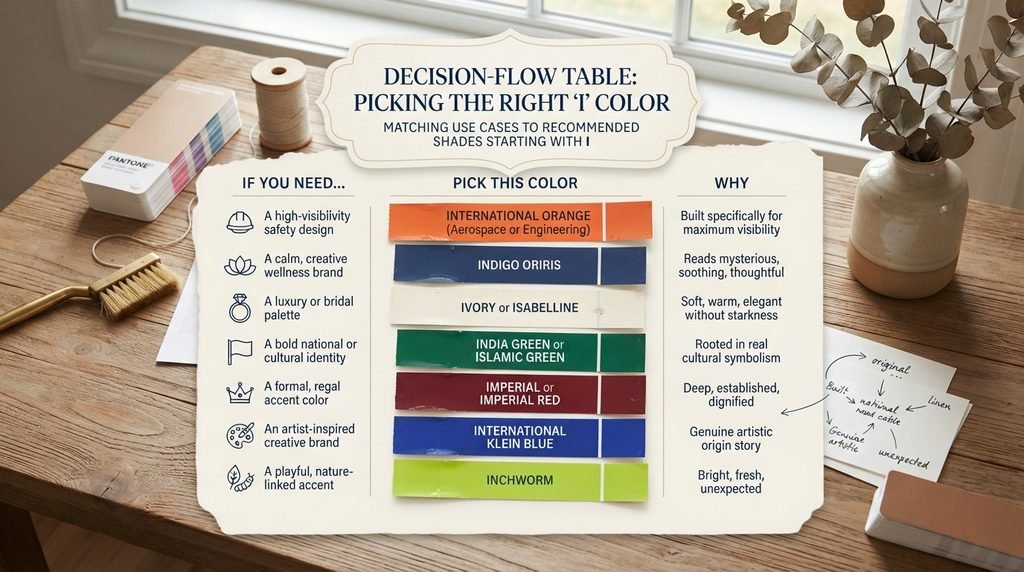
| If you need… | Pick this color | Why |
| A high-visibility safety design | International Orange (Aerospace or Engineering) | Built specifically for maximum visibility |
| A calm, creative wellness brand | Indigo or Iris | Reads mysterious, soothing, thoughtful |
| A luxury or bridal palette | Ivory or Isabelline | Soft, warm, elegant without starkness |
| A bold national or cultural identity | India Green or Islamic Green | Rooted in real cultural symbolism |
| A formal, regal accent color | Imperial or Imperial Red | Deep, established, dignified |
| An artist-inspired creative brand | International Klein Blue | Genuine artistic origin story |
| A playful, nature-linked accent | Inchworm | Bright, fresh, unexpected |
Use this table as a starting point rather than a final answer. A brand built entirely around International Orange, for instance, often benefits from a neutral like Ivory or Isabelline alongside it to keep the palette from feeling overwhelming. Pair the recommended color with a calmer neutral from the comparison table above for a balanced result.
Conclusion
Colors that start with I stretch from the bold visibility of International Orange to the quiet warmth of Ivory. This list sticks to 23 verified names with real hex and RGB codes, so nothing here is guesswork or padding. Whether you’re building a brand, exploring color history, or just curious, these colors that start with I give you a solid, checkable starting point.
Frequently Asked Questions
How many colors actually start with the letter I?
This guide covers 23 verified colors that start with I, each with confirmed hex and RGB codes drawn from CSS/X11 standards, documented institutional specifications, and long-established traditional names.
What are some common colors that start with I?
Indigo, Ivory, Iris, International Orange, and India Green are among the most recognized. Each has a documented hex code and shows up regularly in design, culture, and branding.
Is Indigo a real CSS color?
Yes. Indigo is a standard CSS/X11 color with the hex code #4B0082, though it runs noticeably darker and more purple than the historical indigo dye color.
What’s the difference between Indigo and Indigo Dye?
Indigo (#4B0082) is the modern web standard, while Indigo Dye (#00416A) reflects the traditional plant-based dye color used for centuries before synthetic alternatives existed. Indigo Dye reads more blue and less purple.
Why are there three different International Orange colors?
International Orange (Aerospace), (Engineering), and (Golden Gate Bridge) were each calibrated independently by different organizations for different purposes. All three share a name but carry distinct hex codes.
Where does the name Isabelline come from?
Isabelline’s exact origin is disputed. One popular legend ties it to a Spanish infanta’s wartime vow, though historians generally treat this as folklore rather than confirmed fact.
What color is Ivory exactly?
Ivory is a warm, soft off-white with the hex code #FFFFF0, named directly after elephant tusks, historically a valued material in trade and craftsmanship.