
Colors That Start With Z: Beautiful Names & Codes

Colors that start with Z close out the alphabet with a genuinely diverse handful of names. Zaffre carries centuries of glassmaking history. Zomp sounds invented but comes from a real, documented pigment tradition. Between them sits a small collection of specific paint-brand colors, each tied to a real company rather than a vague description.
This list of colors that start with Z only includes names with a real, checkable source. That means Wikipedia’s own color reference, Crayola’s official naming, and specific paint manufacturer codes from companies like Sherwin-Williams, Behr, and Resene. Every hex code here was checked against its cited source before it made the list.
That checking mattered a lot for this letter. Some sites claim 141 or more colors that start with Z. Most of those extra names, things like “Zoey Island” or “Zippidy Doo Dah,” came from a single fan-made source with no real color authority behind them. Fourteen colors that start with Z survived real verification, and every one traces back to a source you can check yourself.
The list below groups colors that start with Z by family, then by real use. Painters will find Zaffre, a genuine historic pigment. Interior designers will find specific, named paint colors from major manufacturers. Every entry in this final guide of colors that start with Z is checkable and real.
Quick Answer: Standout Z Colors
Short on time? Here are eight standout colors that start with Z. Zaffre (#0014A8) is a deep, intense blue made by roasting cobalt ore, used in glassmaking for centuries. Zomp (#39A78E) offers a fresh, teal-green shade popular in coastal and modern design. Zinnwaldite Brown (#2C1608) delivers a deep, near-black brown named after a real mineral.
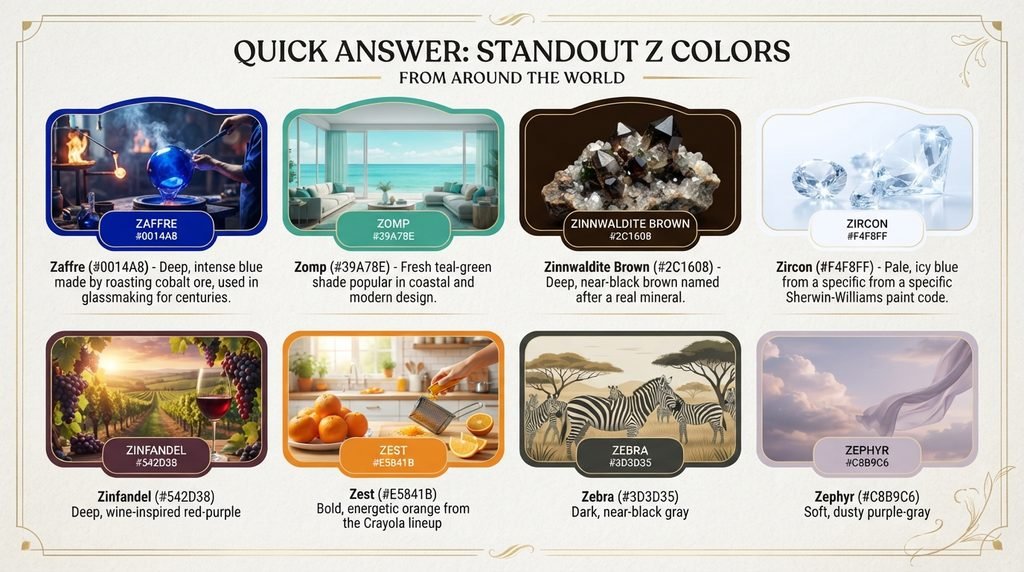
Zircon (#F4F8FF) provides a pale, icy blue from a specific Sherwin-Williams paint code. Zinfandel (#542D38) offers a deep, wine-inspired red-purple. Zest (#E5841B) rounds out the warm end with a bold, energetic orange from the Crayola lineup. Zebra (#3D3D35) finishes with a dark, near-black gray. Zephyr (#C8B9C6) closes the list with a soft, dusty purple-gray. Each of these colors that start with Z earns its spot through genuine, documented use.
What Z Colors Mean and Evoke
Color names carry emotional weight, and colors that start with Z split cleanly between history and modern paint branding. Zaffre suggests intelligence and depth, tied to a deep blue once essential to stained glass and ceramic production long before synthetic dyes existed. That historical weight gives Zaffre a gravity that few other colors in this letter group can match.
Zomp and Zucchini both lean toward nature and freshness. Zomp evokes calm, coastal environments, while Zucchini pulls directly from the vegetable’s deep green skin, suggesting growth and vitality rather than anything formal.
Zinfandel and Zinnwaldite Brown both carry warmth and depth without brightness. Zinfandel borrows its name and mood from the wine, suggesting richness earned through time, while Zinnwaldite Brown, named after a mineral, suggests grounded stability rather than anything decorative. Zest breaks from this reflective mood entirely, built for energy and attention rather than calm.
Color Families: Where Z Colors Belong
Blues
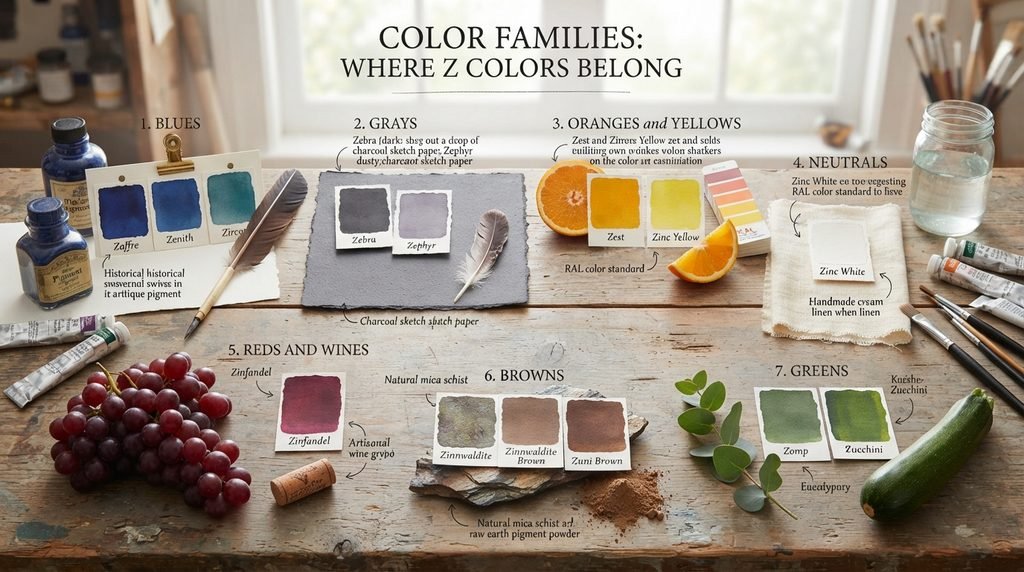
Zaffre, Zenith, and Zircon anchor this family among colors that start with Z. Zaffre carries the deepest historical weight, a genuine centuries-old pigment. Zenith runs much darker and more muted, closer to a blue-gray, while Zircon sits at the opposite extreme, pale and nearly white.
Grays
Zebra and Zephyr cover this smaller family. Zebra reads as a dark, near-black gray, while Zephyr softens considerably into a dusty, purple-tinted tone.
Oranges and Yellows
Zest and Zinc Yellow (RAL) make up this warm family among colors that start with Z. Zest runs bold and saturated, built for energy, while Zinc Yellow leans slightly more muted, tied to a specific German paint standard.
Neutrals
Zinc White stands alone in this family, a soft, warm off-white named after the pigment rather than the metal directly.
Reds and Wines
Zinfandel stands by itself in this family, a deep, wine-toned red-purple that carries genuine culinary association.
Browns
Zinnwaldite, Zinnwaldite Brown, and Zuni Brown round out this family. Zinnwaldite stays lighter and pinker, tied to a mineral of the same name, while Zinnwaldite Brown pushes much darker, almost black. Zuni Brown sits comfortably in between, warm and earthy without tipping toward either extreme.
Greens
Zomp and Zucchini anchor this family. Zomp leans cooler and more teal, while Zucchini stays deep and true, closely matching the vegetable’s actual skin tone.
Design & Branding Favorites
Certain colors that start with Z show up in real design work, though this letter leans more toward specific paint applications than broad branding trends. Zaffre appears in formal, sophisticated branding that wants to borrow a sense of historic depth. Zircon and Zephyr both work well in soft, minimalist interior design, chosen for their gentle, unobtrusive quality.
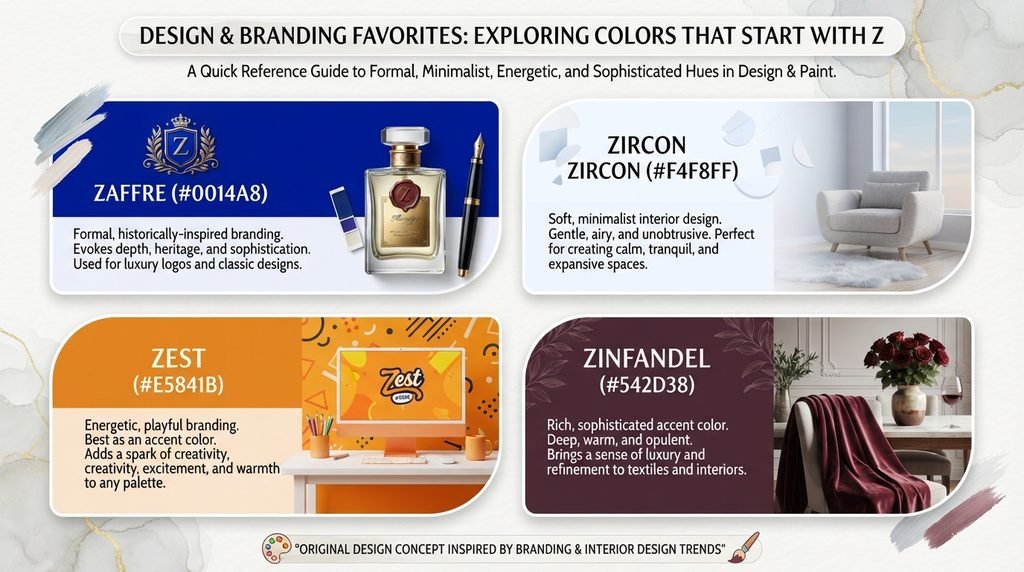
Below is a quick reference for how four colors that start with Z typically get used in real design and paint applications. Notice how the historic entries lean toward formal branding, while the specific paint colors lean toward interior and product design.
| Color | Hex | Typical Use |
| Zaffre | #0014A8 | Formal, historically-inspired branding |
| Zircon | #F4F8FF | Soft, minimalist interior design |
| Zest | #E5841B | Energetic, playful branding |
| Zinfandel | #542D38 | Rich, sophisticated accent color |
Zaffre and Zircon rarely appear together in a single palette, since one carries bold historical depth and the other stays deliberately quiet. Zest works best as a small, energetic accent rather than a dominant color, given its intensity.
Fashion & Beauty Shades
Fashion draws very little from colors that start with Z directly, which sets this letter apart from richer groups elsewhere in the alphabet. Zinfandel occasionally crosses into beauty branding, since its deep, wine-toned red-purple pairs naturally with lipstick and nail polish lines that want to evoke richness rather than brightness.
Zephyr has found a small niche in soft, muted fashion palettes, valued for its gentle, dusty quality that works well as a supporting tone rather than a headline color. Beyond these two, most colors that start with Z stay firmly within interior paint and pigment contexts rather than clothing or cosmetics.
Nature-Inspired Names
Several colors that start with Z borrow directly from the natural world. Zucchini takes its name and deep green tone directly from the vegetable’s skin, one of the more literal food-to-color connections in this letter group. Zinnwaldite and Zinnwaldite Brown both reference a real mineral first identified near Zinnwald, a mining region on the border of Germany and the Czech Republic.
Zaffre connects to nature through mineral processing rather than direct appearance, originally produced by roasting cobalt ore into a deep blue pigment. Zomp, despite its playful-sounding name, still nods loosely to coastal and aquatic environments through its cool, teal-leaning tone.
Rare or Unusual Z Colors
Some colors that start with Z rarely surface outside specialist circles, but each has a real story behind it. Zaffre holds the deepest documented history in this entire letter group, used since before the modern chemical era to color glass and ceramics a rich, stable blue. Painters and glassmakers relied on it for centuries before synthetic pigments made brighter, more consistent blues widely available.
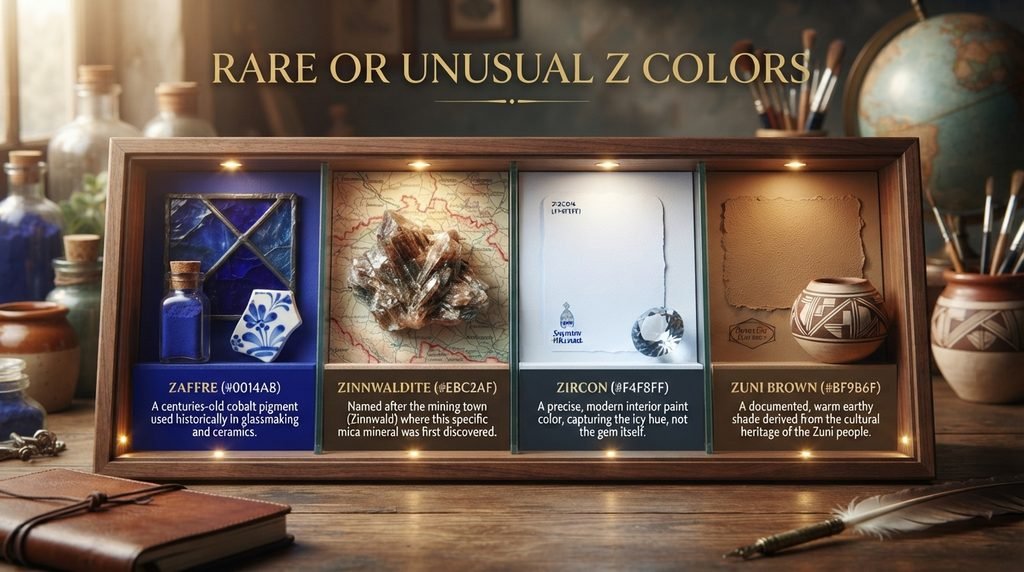
Zinnwaldite carries genuinely specific mineralogical history, named directly after Zinnwald, the German-Czech border town where the mineral was first identified. Zircon, in its Sherwin-Williams paint form, represents something quite different: a modern, precisely calibrated interior color rather than anything tied to the actual zircon gemstone. Each of these colors that start with Z shows that “obscure” usually means “specifically documented,” not invented.
- Zaffre (#0014A8) — a centuries-old cobalt pigment used in historic glassmaking
- Zinnwaldite (#EBC2AF) — named after the German-Czech mining town where the mineral was discovered
- Zircon (#F4F8FF) — a specific, modern Sherwin-Williams paint color
- Zuni Brown (#BF9B6F) — a documented Dunn-Edwards paint shade
These four sit at the edge of common knowledge, but each one has a stable, checkable source. That’s what separates a genuinely rare color name from a vague one that different sites define inconsistently.
Colors Easily Confused With Each Other
A few pairs among colors that start with Z trip people up constantly. Zinnwaldite and Zinnwaldite Brown share a root name but read very differently, since Zinnwaldite stays pale and pinkish while Zinnwaldite Brown runs nearly black. Zinc White and Zircon can also cause confusion, since both are pale, cool neutrals, but Zinc White carries a warmer undertone compared to Zircon’s icy blue lean.
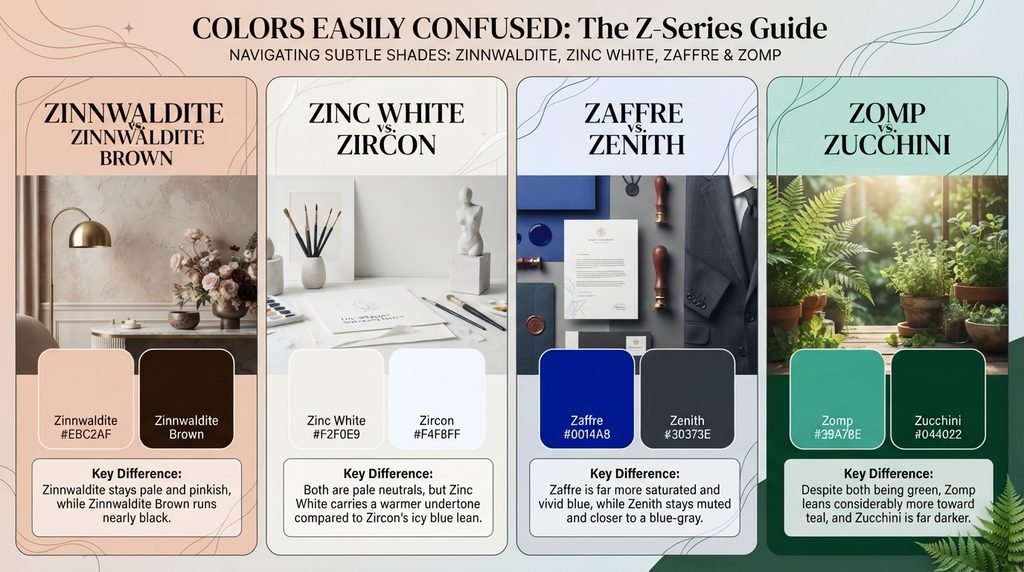
Zaffre and Zenith both sit in the blue family too, but Zaffre runs far more saturated and vivid, while Zenith stays muted and closer to a blue-gray. Zomp and Zucchini get mixed up occasionally as well, despite both being green, since Zomp leans considerably more toward teal.
The table below lines up the clearest pairs directly so the difference is easy to see at a glance. Pay attention to the RGB numbers, not just the names, since two colors that start with Z can look nearly identical in a small swatch but read differently once scaled up.
| Color A | Hex A | Color B | Hex B | Key Difference |
| Zinnwaldite | #EBC2AF | Zinnwaldite Brown | #2C1608 | Zinnwaldite Brown is far darker |
| Zinc White | #F2F0E9 | Zircon | #F4F8FF | Zircon leans cooler, icier |
| Zaffre | #0014A8 | Zenith | #30373E | Zenith is muted, closer to gray |
| Zomp | #39A78E | Zucchini | #044022 | Zucchini is far darker, less blue |
Zinnwaldite versus Zinnwaldite Brown is the pair most likely to confuse someone shopping for interior paint, since both share the exact same root name despite reading as almost entirely different colors. Zaffre versus Zenith matters most for anyone doing formal, historically-inspired branding, since the wrong choice can shift a bold, saturated blue into something considerably quieter.
Master Alphabetical List of Z Colors
This final list of colors that start with Z includes a genuine historic pigment, a Crayola crayon color, and several specific, sourced paint colors from major manufacturers including Sherwin-Williams, Behr, Resene, and Dunn-Edwards. Every entry below is verified against its cited source.
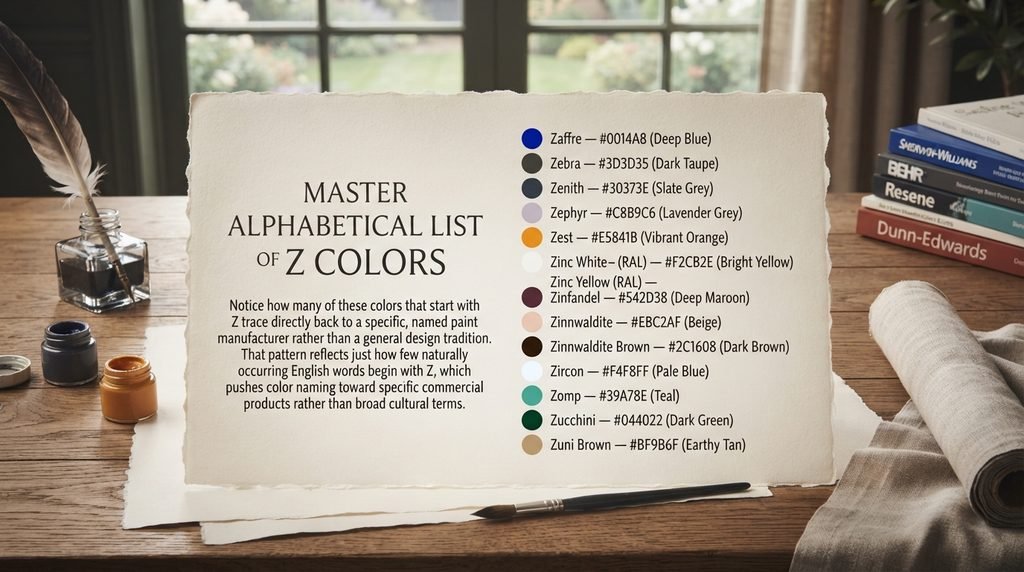
- Zaffre — #0014A8
- Zebra — #3D3D35
- Zenith — #30373E
- Zephyr — #C8B9C6
- Zest — #E5841B
- Zinc White — #F2F0E9
- Zinc Yellow (RAL) — #F2CB2E
- Zinfandel — #542D38
- Zinnwaldite — #EBC2AF
- Zinnwaldite Brown — #2C1608
- Zircon — #F4F8FF
- Zomp — #39A78E
- Zucchini — #044022
- Zuni Brown — #BF9B6F
Notice how many of these colors that start with Z trace directly back to a specific, named paint manufacturer rather than a general design tradition. That pattern reflects just how few naturally occurring English words begin with Z, which pushes color naming toward specific commercial products rather than broad cultural terms.
Hex/RGB Crosswalk: Why Exact Codes Matter
A color name alone isn’t enough for real design work, even among colors that start with Z. Someone searching for “Zircon” without a hex code might land on several different paint-brand interpretations rather than the specific, documented Sherwin-Williams shade. That’s why any serious project needs the exact hex or RGB value locked in before production starts.
Hex codes matter most for web and app design, since browsers read hex values directly. RGB values matter more for video, screen graphics, and design software that calculates color mathematically. The table below gives both formats for five of the most frequently searched colors that start with Z, so you can copy whichever your tool requires.
| Color | Hex | RGB |
| Zaffre | #0014A8 | 0, 20, 168 |
| Zomp | #39A78E | 57, 167, 142 |
| Zinnwaldite Brown | #2C1608 | 44, 22, 8 |
| Zircon | #F4F8FF | 244, 248, 255 |
| Zest | #E5841B | 229, 132, 27 |
Zaffre’s RGB values show a low red channel paired with near-zero green and a high blue, which is exactly what gives it that deep, saturated intensity. Zircon, by contrast, keeps all three channels extremely high and close together, producing its icy near-white quality instead of anything bold.
Full Comparison Table: All 14 Z Colors
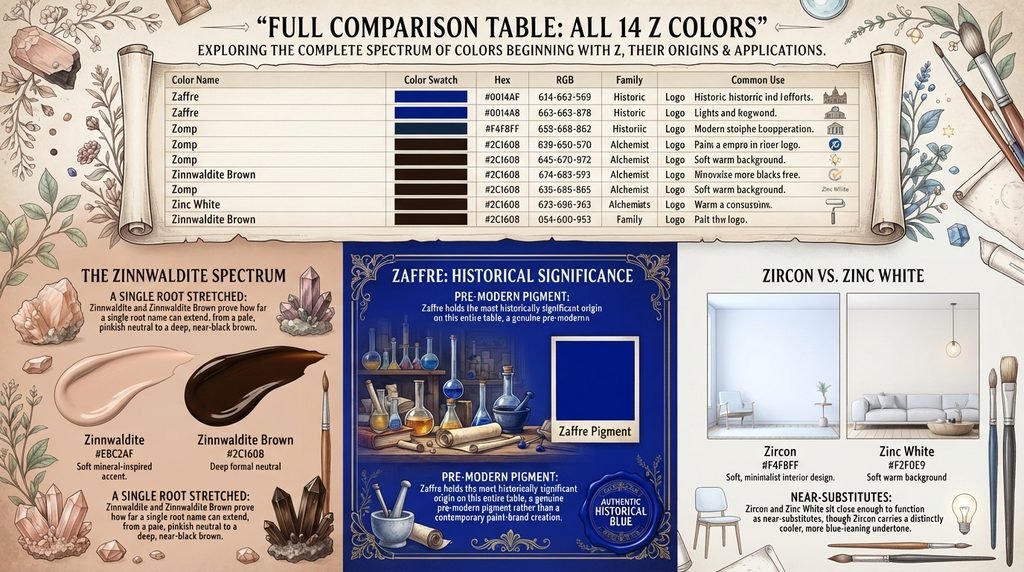
This table brings every color that start with Z together with hex, RGB, color family, and common use. Use the family column to quickly find colors that will sit well together in a single palette, and use the common use column to match a color that starts with Z to your actual project type.
| Color | Hex | RGB | Family | Common Use |
| Zaffre | #0014A8 | 0, 20, 168 | Blue | Formal, historically-inspired branding |
| Zebra | #3D3D35 | 61, 61, 53 | Gray | Near-black formal neutral |
| Zenith | #30373E | 48, 55, 62 | Blue/Gray | Muted formal accent |
| Zephyr | #C8B9C6 | 200, 185, 198 | Gray/Purple | Soft interior accent |
| Zest | #E5841B | 229, 132, 27 | Orange | Energetic, playful branding |
| Zinc White | #F2F0E9 | 242, 240, 233 | Neutral | Soft warm background |
| Zinc Yellow (RAL) | #F2CB2E | 242, 203, 46 | Yellow | Industrial, standardized accent |
| Zinfandel | #542D38 | 84, 45, 56 | Red/Purple | Rich sophisticated accent |
| Zinnwaldite | #EBC2AF | 235, 194, 175 | Brown/Pink | Soft mineral-inspired accent |
| Zinnwaldite Brown | #2C1608 | 44, 22, 8 | Brown | Deep formal neutral |
| Zircon | #F4F8FF | 244, 248, 255 | Blue | Soft, minimalist interior design |
| Zomp | #39A78E | 57, 167, 142 | Green/Blue | Coastal, modern branding |
| Zucchini | #044022 | 4, 64, 34 | Green | Deep natural, organic branding |
| Zuni Brown | #BF9B6F | 191, 155, 111 | Brown | Warm interior neutral |
A few rows deserve a second look. Zinnwaldite and Zinnwaldite Brown together prove how far a single root name can stretch, from a pale, pinkish neutral to a color that reads almost as black. Zaffre holds the most historically significant origin on this entire table, a genuine pre-modern pigment rather than a contemporary paint-brand creation. Zircon and Zinc White sit close enough to function as near-substitutes, though Zircon carries a distinctly cooler, more blue-leaning undertone.
Decision-Flow Table: Picking the Right Z Color
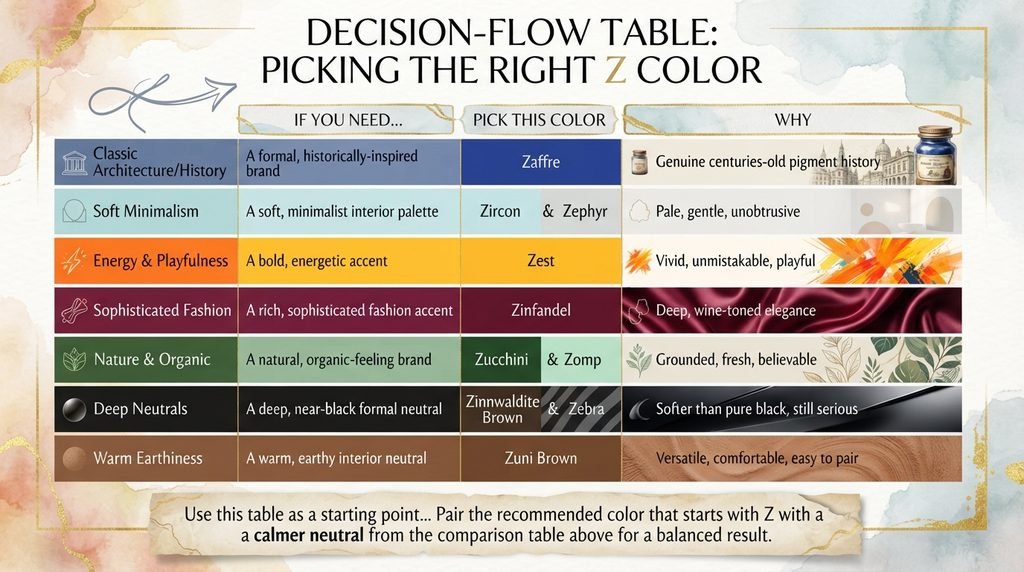
Choosing between fourteen distinct names gets easier with a clear project goal in mind. The table below matches common use cases to a recommended color that starts with Z, so you can skip the guesswork and go straight to a shade that fits the job.
| If you need… | Pick this color | Why |
| A formal, historically-inspired brand | Zaffre | Genuine centuries-old pigment history |
| A soft, minimalist interior palette | Zircon or Zephyr | Pale, gentle, unobtrusive |
| A bold, energetic accent | Zest | Vivid, unmistakable, playful |
| A rich, sophisticated fashion accent | Zinfandel | Deep, wine-toned elegance |
| A natural, organic-feeling brand | Zucchini or Zomp | Grounded, fresh, believable |
| A deep, near-black formal neutral | Zinnwaldite Brown or Zebra | Softer than pure black, still serious |
| A warm, earthy interior neutral | Zuni Brown | Versatile, comfortable, easy to pair |
Use this table as a starting point rather than a final answer. A palette built entirely around Zaffre, for instance, often benefits from a neutral like Zinc White or Zircon alongside it to soften its intensity. Pair the recommended color that starts with Z with a calmer neutral from the comparison table above for a balanced result.
Conclusion
Colors that start with Z close out this entire alphabet series with a genuinely varied final group, from the ancient depth of Zaffre to the modern precision of specific paint-brand colors like Zircon and Zuni Brown. This list sticks to 14 verified names with real hex and RGB codes, so nothing here is guesswork or padding. Whether you’re building a brand, mixing paint, or simply reached the end of your color research, these colors that start with Z give you a solid, checkable finish.
Frequently Asked Questions
How many colors actually start with the letter Z?
This guide covers 14 verified colors that start with Z, each traced back to a specific, checkable source including Wikipedia, Crayola, and named paint manufacturers. Larger lists claiming 141 or more usually rely on single-source, fan-made names with no real color authority behind them.
What are the most well-known colors that start with Z?
Zaffre, Zomp, Zinnwaldite, Zircon, and Zest are among the most recognized colors that start with Z. Each has a documented hex code confirmed across reliable sources.
What color is Zaffre exactly?
Zaffre is a deep, intense blue with the hex code #0014A8, historically made by roasting cobalt ore and used for centuries in glassmaking and ceramics.
Is Zomp a real, standardized color?
Zomp doesn’t appear in the official CSS/X11 named color list, but it’s a widely documented traditional color with a consistently cited hex code of #39A78E across independent color-name databases.
What’s the difference between Zinnwaldite and Zinnwaldite Brown?
Zinnwaldite, hex #EBC2AF, is a pale, pinkish neutral, while Zinnwaldite Brown, hex #2C1608, runs dramatically darker, nearly black. Both share a root name tied to the same mineral.
Where does the name Zinnwaldite come from?
Zinnwaldite takes its name from Zinnwald, a mining town on the German-Czech border where the mineral was first identified and documented.
What color is Zircon in this guide?
Zircon here refers to a specific Sherwin-Williams paint color, hex #F4F8FF, a pale, icy blue distinct from the actual zircon gemstone’s typical appearance.