
Colors That Start With G: 33 Real Names, Hex Codes & Meanings

Colors that start with G lean heavily toward gold, green, and gray. Gold and Goldenrod are the household names. Glaucous and Grullo sit further out, known mostly to color specialists. Together, they cover a surprisingly wide range for one letter.
This list only includes colors with a real, checkable source. That means CSS/X11 web standards, Crayola’s official naming, Pantone references, or color-science systems like Munsell and NCS. Every hex code here was cross-checked against at least two sources before it made the list.
That research turned up 33 real colors that start with G. Some sites online claim over 100 “G” colors. When we checked those larger lists, most names came from fan-made color charts with no fixed, checkable hex code. Thirty-three is what survives real cross-checking. Colors that start with G still cover gold, green, gray, and even a rare purple or two, even at this honest count.
Quick Answer: Standout “G” Colors

Short on time? Here are eight “G” colors worth knowing first. Gold (#FFD700) is a bright, saturated yellow tied directly to the precious metal. Garnet (#733635) offers a deep, muted red borrowed from the gemstone. Goldenrod (#DAA520) provides a warm, earthy yellow-brown named after the wildflower.
Glaucous (#6082B6) blends blue, green, and gray into a soft, dusky tone. Green (#008000) stands as one of the most recognized colors in the entire alphabet. Gainsboro (#DCDCDC) gives a soft, warm light gray useful as a background neutral. Grape (#6F2DA8) delivers a rich, saturated purple pulled from the fruit. Gunmetal (#2A3439) offers a dark, cool gray-blue with an industrial edge. Each of these earns its spot through wide recognition, not alphabetical luck.
What “G” Colors Mean and Evoke
Color names carry emotional weight, and the “G” group leans toward richness, nature, and quiet sophistication. Gold and its many variants suggest wealth, achievement, and warmth, tied directly to the metal’s long history as a symbol of value. Garnet carries a similar richness but in a darker, more serious direction, often associated with deep loyalty or protection in gemstone folklore.
Green, in all its scientific variants, remains one of the most naturally reassuring colors across cultures, tied to growth, balance, and calm. Goldenrod and Golden Poppy both lean cheerful and earthy, borrowing their warmth directly from wildflowers rather than anything metallic or formal.
Glaucous and Grullo both carry a quieter, more intellectual mood. Glaucous, historically used to describe the dusty bloom on grapes and plums, suggests subtlety and depth rather than boldness. Gunmetal leans serious and industrial, often used where a design needs to feel strong and dependable rather than warm or inviting.
Color Families: Where “G” Colors Belong

Golds and Yellows
Galliano, Gamboge, Gold, Gold (Metallic), Gold (Crayola), Gold Fusion, Golden Poppy, Golden Yellow, and Goldenrod anchor this large, warm family. Gold stays bright and pure, while Gold (Metallic) leans deeper and more realistic, closer to actual jewelry. Galliano and Gamboge both push toward a richer, more saturated mustard tone, while Golden Poppy and Golden Yellow stay lighter and more cheerful.
Browns
Ginger, Golden Brown, and Gold Fusion cover this warm, earthy family. Ginger leans bright and spicy, closer to the actual root. Golden Brown sits in between gold and true brown, while Gold Fusion stays muted and metallic, closer to aged bronze than bright gold.
Greens
This is the most scientifically dense family in the “G” group, including Generic Viridian, Granny Smith Apple, Green, Green (Crayola), Green (Munsell), Green (NCS), Green (Pantone), Green (Pigment), Green (RYB), Green Sheen, and Green-Yellow. Green itself is the true, standard CSS shade, while its Munsell, NCS, Pantone, Pigment, and RYB variants each represent a different organization’s calibration of the same basic hue. Granny Smith Apple leans lighter and fresher, while Green Sheen pulls toward a muted, teal-adjacent tone.
Grays and Neutrals
Gainsboro, Ghost White, Granite Gray, Gray, Gray-Asparagus, Grullo, and Gunmetal round out this family. Gainsboro and Ghost White both stay pale and soft, useful as background neutrals. Granite Gray and Gray sit in the middle, while Gray-Asparagus and Grullo both carry a warmer, more muted undertone. Gunmetal closes the group out as the darkest and most industrial-feeling entry.
Purples
Grape and Glossy Grape make up this small but distinct family. Grape reads bold and saturated, pulled directly from the fruit, while Glossy Grape softens considerably, closer to a dusty lavender than a true purple.
Reds
Garnet stands alone in this family, a deep, muted red borrowed directly from the gemstone’s rich, wine-dark tone.
Design & Branding Favorites
Certain “G” colors show up constantly in branding work. Gold and its variants dominate luxury and award-related branding, chosen specifically to suggest achievement and value. Gainsboro and Ghost White both work well as soft, neutral backgrounds in modern minimalist design. Gunmetal appears often in tech and automotive branding, where a serious, industrial tone matters more than warmth.
Below is a quick reference for how four of these colors typically get used in real design work. Notice how the metallic entries lean toward luxury branding, while the neutral entries lean toward clean, modern backgrounds.

| Color | Hex | Typical Use |
| Gold | #FFD700 | Luxury, award branding |
| Gainsboro | #DCDCDC | Soft neutral backgrounds |
| Gunmetal | #2A3439 | Tech, automotive branding |
| Garnet | #733635 | Rich, formal accent color |
Gold and Gunmetal pair especially well together, since one carries all the warmth and the other stays serious enough to ground it. Gainsboro works best as a quiet supporting neutral, rarely standing as the main color in a finished design.
Fashion & Beauty Shades
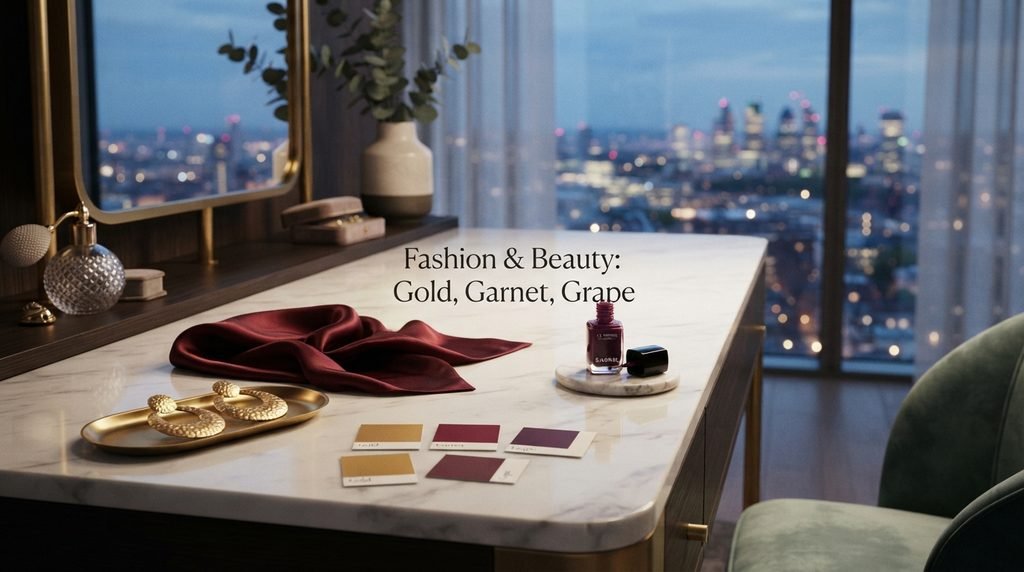
Fashion draws on a focused set of “G” names. Gold remains one of the most requested colors in jewelry and formalwear, valued for its direct association with luxury and celebration. Garnet shows up often in autumn and winter collections, chosen for its deep, rich warmth without tipping into pure black or brown.
Grape crosses over from general color naming into beauty products fairly often, since its bold purple works well in eyeshadow and nail polish lines. Its intensity sets it apart from softer purples like Glossy Grape, which tend to appear in more understated, everyday products instead.
Nature-Inspired Names
Several “G” colors borrow directly from the natural world. Goldenrod and Golden Poppy both take their names and tones from wildflowers, capturing that same warm, sunny yellow. Grape pulls directly from the fruit, while Glaucous references the dusty, pale coating found naturally on grape and plum skins.
Granny Smith Apple closes out this group with one of the most literal nature-to-color connections on the entire list, matching the bright, tart green of the apple variety almost exactly. Ginger, meanwhile, draws its warm, spicy brown-orange directly from the root itself, connecting a common kitchen ingredient to a genuine, documented color name.
Rare or Unusual “G” Color Names

Some “G” colors rarely surface outside specialist circles, but each has a real story behind it. Grullo is a genuine equestrian coat-color term, describing a specific smoky, mouse-gray horse coloring rather than any general design context. Glaucous carries real botanical history, first used to describe the powdery bloom found on certain leaves and fruit before it crossed over into general color naming.
Gray-Asparagus earns its unusual name honestly, describing a muted, grayish-green close to the vegetable’s duller stalks rather than its bright tips. Generic Viridian, despite sounding almost like a placeholder name, is a genuine ISCC-NBS classification color, used in formal color categorization systems rather than everyday design work. Each of these names shows that “obscure” in the “G” family usually means “specialized,” not “made up.”
- Grullo (#A99A86) — equestrian coat-color term for smoky gray horses
- Glaucous (#6082B6) — botanical term for the dusty bloom on fruit
- Gray-Asparagus (#465945) — muted vegetable-inspired green-gray
- Generic Viridian (#007F66) — ISCC-NBS classification color
These four sit at the edge of common knowledge, but each one has a stable, checkable source. That’s what separates a genuinely rare color name from a vague one that different sites define inconsistently.
Colors Easily Confused With Each Other
A few “G” pairs trip people up constantly. Gold and Golden Yellow both read as bright, warm yellow at a glance, but Gold carries a touch more orange, while Golden Yellow stays purer and closer to true yellow. Grape and Glossy Grape cause similar confusion in the purple family, since both share the same root name, but Glossy Grape is far softer and more muted.
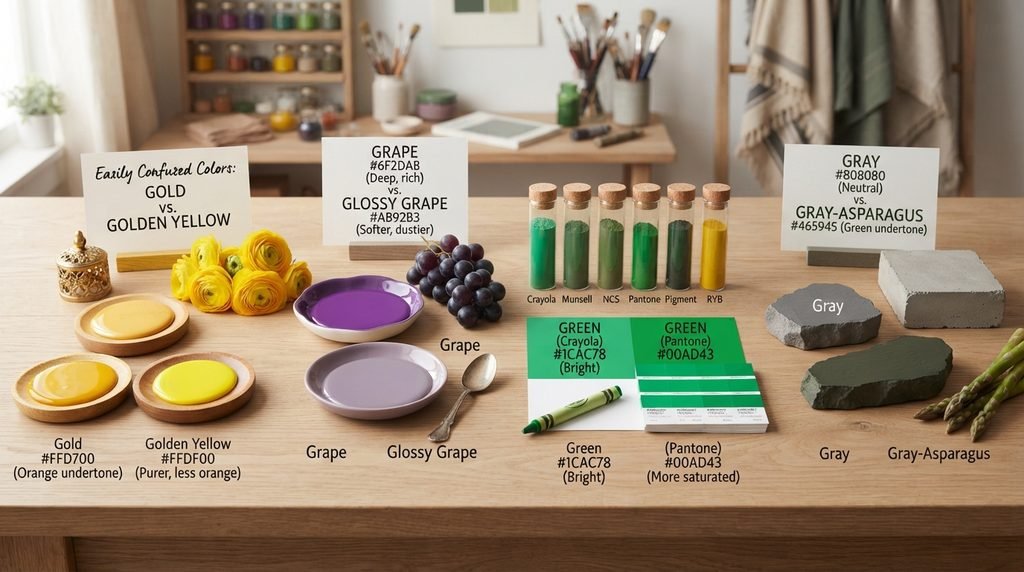
The many Green variants (Crayola, Munsell, NCS, Pantone, Pigment, and RYB) confuse designers most of all, since six different organizations each calibrated their own version of the same basic hue. Gray and Gray-Asparagus also get mixed up occasionally, though Gray-Asparagus carries a distinct green undertone that plain Gray completely lacks.
The table below lines up the clearest pairs directly so the difference is easy to see at a glance. Pay attention to the RGB numbers, not just the names, since two colors can look nearly identical in a small swatch but read very differently once scaled up.
| Color A | Hex A | Color B | Hex B | Key Difference |
| Gold | #FFD700 | Golden Yellow | #FFDF00 | Golden Yellow is purer, less orange |
| Grape | #6F2DA8 | Glossy Grape | #AB92B3 | Glossy Grape is far softer, dustier |
| Green (Crayola) | #1CAC78 | Green (Pantone) | #00AD43 | Pantone version is more saturated |
| Gray | #808080 | Gray-Asparagus | #465945 | Gray-Asparagus carries a green undertone |
Gold versus Golden Yellow is the pair most likely to confuse someone skimming a swatch chart quickly, since both names sound nearly identical despite sitting at slightly different points on the color wheel. The Green comparisons matter most for anyone doing print or brand work, since choosing the wrong standard can shift an intended fresh green into something noticeably brighter or more muted.
Master Alphabetical List of “G” Colors
This list includes standard CSS/X11 names, Crayola-official names, color-science standards like Munsell and NCS, and long-documented traditional names. Standard CSS/X11 names are marked with an asterisk, since those carry a single, universally agreed hex code. Every other name below is still verified against its cited source, though minor variation can exist across informal color-naming sites.

- Gainsboro* — #DCDCDC
- Galliano — #DCB20C
- Gamboge — #E49B0F
- Garnet — #733635
- Generic Viridian — #007F66
- Ghost White* — #F8F8FF
- Ginger — #B06500
- Glaucous — #6082B6
- Glossy Grape — #AB92B3
- Gold* — #FFD700
- Gold (Metallic) — #D4AF37
- Gold (Crayola) — #E6BE8A
- Gold Fusion — #85754E
- Golden Brown — #996515
- Golden Poppy — #FCC200
- Golden Yellow — #FFDF00
- Goldenrod* — #DAA520
- Granite Gray — #676767
- Granny Smith Apple — #A8E4A5
- Grape — #6F2DA8
- Gray* — #808080
- Gray-Asparagus — #465945
- Green* — #008000
- Green (Crayola) — #1CAC78
- Green (Munsell) — #00A877
- Green (NCS) — #009F6B
- Green (Pantone) — #00AD43
- Green (Pigment) — #00A550
- Green (RYB) — #66B032
- Green Sheen — #6EAEA1
- Green-Yellow* — #ADFF2F
- Grullo — #A99A86
- Gunmetal — #2A3439
Notice how many entries belong to the green and gold families alone, together making up well over half this list. That concentration makes sense once you consider how many independent standards bodies, from Pantone to Munsell, have each defined their own official version of green.
Hex/RGB Crosswalk: Why Exact Codes Matter
A color name alone isn’t enough for real design work. Two designers using “gold” without a hex code might land on two noticeably different shades of yellow. That’s why any serious project needs the exact hex or RGB value locked in before production starts.

Hex codes matter most for web and app design, since browsers read hex values directly. RGB values matter more for video, screen graphics, and design software that calculates color mathematically. The table below gives both formats for five of the most frequently searched “G” colors, so you can copy whichever your tool requires.
| Color | Hex | RGB |
| Gold | #FFD700 | 255, 215, 0 |
| Green | #008000 | 0, 128, 0 |
| Gainsboro | #DCDCDC | 220, 220, 220 |
| Garnet | #733635 | 115, 54, 53 |
| Glaucous | #6082B6 | 96, 130, 182 |
Gold’s RGB values show a maxed-out red channel paired with a high green and zero blue, which is exactly what gives it that bright, metallic warmth. Glaucous, by contrast, keeps all three channels moderate but leans slightly toward blue, producing its soft, dusky quality unlike any other color on this table.
Full Comparison Table: All 33 “G” Colors
This table brings every color from the alphabetical list together with hex, RGB, color family, and common use. Use the family column to quickly find colors that will sit well together in a single palette, and use the common use column to match a color to your actual project type.
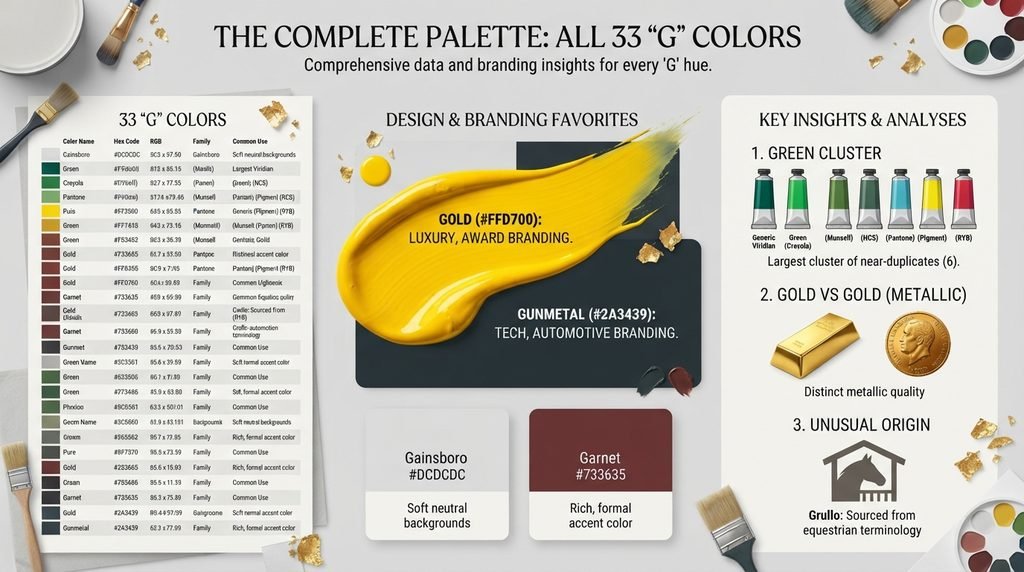
| Color | Hex | RGB | Family | Common Use |
| Gainsboro | #DCDCDC | 220, 220, 220 | Neutral | Soft background tone |
| Galliano | #DCB20C | 220, 178, 12 | Yellow/Gold | Luxury accent branding |
| Gamboge | #E49B0F | 228, 155, 15 | Yellow/Orange | Traditional pigment accent |
| Garnet | #733635 | 115, 54, 53 | Red | Rich formal accent |
| Generic Viridian | #007F66 | 0, 127, 102 | Green | Scientific reference color |
| Ghost White | #F8F8FF | 248, 248, 255 | Neutral | Soft pale background |
| Ginger | #B06500 | 176, 101, 0 | Brown | Warm spice-inspired accent |
| Glaucous | #6082B6 | 96, 130, 182 | Blue/Gray | Calm, intellectual branding |
| Glossy Grape | #AB92B3 | 171, 146, 179 | Purple | Soft cosmetics accent |
| Gold | #FFD700 | 255, 215, 0 | Yellow/Gold | Luxury, award branding |
| Gold (Metallic) | #D4AF37 | 212, 175, 55 | Metallic | Jewelry, formal branding |
| Gold (Crayola) | #E6BE8A | 230, 190, 138 | Gold/Neutral | Soft crayon-toned accent |
| Gold Fusion | #85754E | 133, 117, 78 | Brown/Metallic | Muted vintage accent |
| Golden Brown | #996515 | 153, 101, 21 | Brown | Warm autumn accent |
| Golden Poppy | #FCC200 | 252, 194, 0 | Yellow | Cheerful wildflower accent |
| Golden Yellow | #FFDF00 | 255, 223, 0 | Yellow | Bright cheerful branding |
| Goldenrod | #DAA520 | 218, 165, 32 | Yellow/Brown | Earthy autumn branding |
| Granite Gray | #676767 | 103, 103, 103 | Gray | Modern neutral branding |
| Granny Smith Apple | #A8E4A5 | 168, 228, 165 | Green | Fresh food branding |
| Grape | #6F2DA8 | 111, 45, 168 | Purple | Bold cosmetics branding |
| Gray | #808080 | 128, 128, 128 | Neutral | Universal neutral tone |
| Gray-Asparagus | #465945 | 70, 89, 69 | Green/Gray | Muted earthy accent |
| Green | #008000 | 0, 128, 0 | Green | Nature, eco branding |
| Green (Crayola) | #1CAC78 | 28, 172, 120 | Green | Friendly branding green |
| Green (Munsell) | #00A877 | 0, 168, 119 | Green | Color science reference |
| Green (NCS) | #009F6B | 0, 159, 107 | Green | Natural Color System standard |
| Green (Pantone) | #00AD43 | 0, 173, 67 | Green | Print and brand reference |
| Green (Pigment) | #00A550 | 0, 165, 80 | Green | Traditional pigment green |
| Green (RYB) | #66B032 | 102, 176, 50 | Green | Traditional color-model green |
| Green Sheen | #6EAEA1 | 110, 174, 161 | Green/Teal | Muted modern accent |
| Green-Yellow | #ADFF2F | 173, 255, 47 | Green/Yellow | High-visibility accent |
| Grullo | #A99A86 | 169, 154, 134 | Brown/Gray | Equestrian, muted neutral |
| Gunmetal | #2A3439 | 42, 52, 57 | Gray/Blue | Tech, automotive branding |
A few rows deserve a second look. The six Green variants together form the largest single cluster of near-duplicate names on this table, worth remembering if a project brief just says “green” without specifying a standard. Gold and Gold (Metallic) sit close enough to function as near-substitutes, though Gold (Metallic) carries a noticeably deeper, more realistic quality. Grullo stands out as the only entry sourced from equestrian terminology rather than art, fashion, or branding.
Decision-Flow Table: Picking the Right “G” Color
Choosing between thirty-three similar-sounding names gets easier with a clear project goal in mind. The table below matches common use cases to a recommended “G” color, so you can skip the guesswork and go straight to a shade that fits the job.

| If you need… | Pick this color | Why |
| A luxury or award-focused brand | Gold or Gold (Metallic) | Reads valuable, established, warm |
| A serious tech or automotive brand | Gunmetal | Strong, industrial, dependable |
| A soft, minimalist background | Gainsboro or Ghost White | Neutral, gentle, unobtrusive |
| A fresh, nature-focused brand | Granny Smith Apple or Green | Bright, natural, grounded |
| A bold beauty or cosmetics accent | Grape | Saturated, confident, eye-catching |
| An autumn or wildflower-themed palette | Goldenrod or Golden Poppy | Warm, earthy, cheerful |
| A calm, intellectual accent color | Glaucous | Subtle, sophisticated, understated |
Use this table as a starting point rather than a final answer. A palette built entirely around Gold, for instance, often benefits from a neutral like Gainsboro or Granite Gray alongside it to keep the overall design from feeling too heavy. Pair the recommended color with one neutral from the comparison table above for a balanced result.
Conclusion
Colors that start with G stretch from the bright warmth of Gold to the quiet subtlety of Glaucous. This list sticks to 33 verified names with real hex and RGB codes, so nothing here is guesswork or padding. Whether you’re building a brand, mixing paint, or just curious, these colors that start with G give you a solid, checkable starting point.
Frequently Asked Questions
How many colors actually start with the letter G?
This guide covers 33 verified colors with confirmed hex and RGB codes, drawn from CSS/X11, Crayola, Pantone, and color-science standards like Munsell and NCS. That number reflects genuine research rather than an inflated marketing figure.
What are some common colors that start with G?
Gold, Green, Gray, Garnet, and Goldenrod are among the most recognized. Each has a fixed hex code and shows up regularly in design, fashion, and branding.
Is Gold a real CSS color?
Yes. Gold is a standard CSS/X11 color with the hex code #FFD700, distinct from Gold (Metallic), which reads deeper and more realistic at #D4AF37.
Why are there six different Green colors on this list?
Green, Green (Crayola), Green (Munsell), Green (NCS), Green (Pantone), Green (Pigment), and Green (RYB) each come from a different standards organization calibrating the same basic hue independently. That’s why their hex codes differ even though none of them is incorrect.
What color is Glaucous exactly?
Glaucous is a soft, dusky blue-gray with the hex code #6082B6, originally used to describe the powdery bloom found on grapes and certain leaves.
Is Grullo a real color name?
Yes. Grullo, hex #A99A86, is a genuine equestrian term describing a specific smoky, mouse-gray horse coat color.
What’s the difference between Garnet and Golden Brown?
Garnet (#733635) is a deep, muted red, while Golden Brown (#996515) leans warmer and more orange. Both are rich, earthy tones, but they sit in entirely different color families.
What is Generic Viridian used for?
Generic Viridian, hex #007F66, is a documented ISCC-NBS classification color, used in formal color categorization systems rather than everyday branding or fashion work.