
50+ Colors That Start With E: Popular, Rare & Unique Shades

Anyone searching for colors that start with E quickly notices something the other letters don’t reveal: E is genuinely one of the shorter letters for color names. There’s no standard CSS or X11 keyword that begins with E at all, which means every entry on this list comes from documented traditional pigments, well-known paint-brand names, or the “electric” family of vivid, saturated shades. That scarcity is actually useful. It means fewer duplicates, fewer near-identical filler entries, and a list you can actually learn from.
This guide covers 50-plus real, verified colors that start with E. Every entry includes a hex code, an RGB value, and a note on where it’s typically used or where its name came from. Rather than padding the list with vague or invented names just to hit a round number, this guide sticks to shades that show up consistently across more than one color-name reference — because a color name with no fixed value isn’t useful to a designer, painter, or anyone else relying on it.
The list is built for practical use, not just alphabetical browsing. It starts with what these colors tend to symbolize, then groups them into families — greens, blues, browns, and the distinct “electric” cluster unique to this letter. From there, it breaks into categories: branding favorites, fashion shades, nature-inspired names, and colors people mix up often. Two full tables at the end let you scan every hex code in one place.
Quick Answer: Standout Colors That Start With E

If you only need a few names, start here. Emerald (#50C878) is the best-known E color by far, a rich green tied to luxury, nature, and precious stones. Egyptian Blue (#1034A6) holds the distinction of being one of the oldest synthetic pigments in human history, dating back thousands of years. Electric Blue (#7DF9FF) brings a jolt of neon energy, common in tech and gaming branding. Eggplant (#614051) offers a deep, muted purple favored in moody interior palettes.
Ecru (#C2B280) is the classic soft beige used constantly in packaging and textiles. Eton Blue (#96C8A2) is a soft sage-blue tied historically to Eton College’s sporting colors. English Lavender (#B48395) leans dusty and muted, a favorite in cottage-style decor. Electric Indigo (#6F00FF) rounds things out as one of the boldest, most saturated purples on any color list. Together, these eight show just how far colors that start with E can range, from ancient pigments to modern neons.
What Colors That Start With E Symbolize
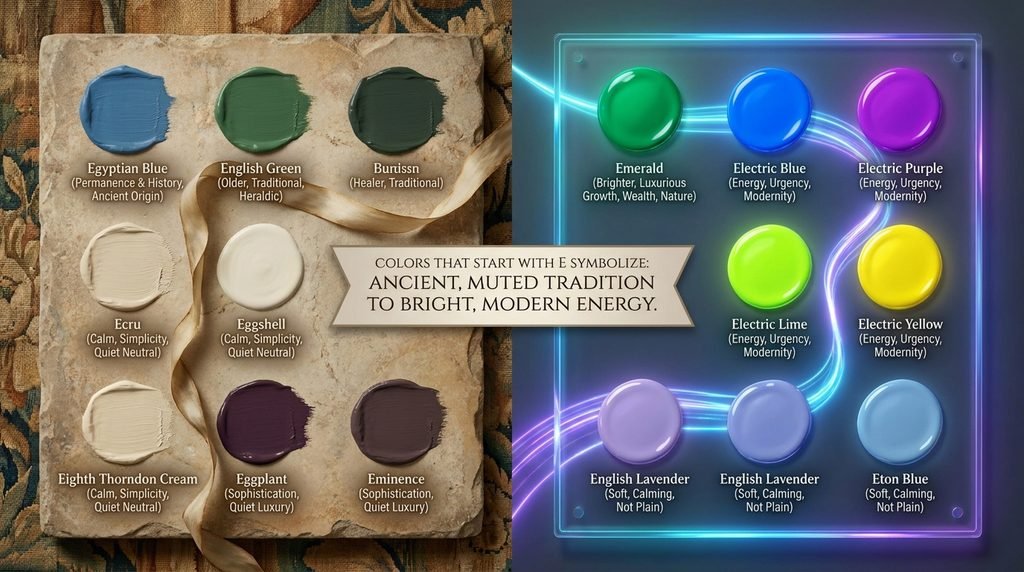
Meaning varies enormously across this letter, more so than in most others. Emerald and English Green both signal growth, wealth, and nature, but Emerald carries a brighter, more luxurious feel while English Green reads as older and more traditional, almost heraldic. Egyptian Blue, given its ancient origin, tends to symbolize permanence and history whenever it’s used in design, a nod to its use in tomb paintings and sculpture thousands of years ago.
The “electric” family communicates something entirely different. Electric Blue, Electric Purple, Electric Lime, and Electric Yellow all signal energy, urgency, and modernity. These shades rarely appear in nature at full saturation, which is exactly why they grab attention in gaming, sports, and youth-oriented branding. Eggplant and Eminence, both deep purples, move in the opposite direction, suggesting sophistication and quiet luxury rather than excitement.
Softer, muted E colors carry their own tone. Ecru, Eggshell, and Eighth Thorndon Cream all suggest calm and simplicity, the kind of quiet neutral that lets other design elements stand out. English Lavender and Eton Blue sit somewhere in between — soft enough to feel calming, but with just enough color to avoid reading as plain. Across the board, colors that start with E swing between two extremes: ancient, muted tradition on one end, and bright, modern energy on the other.
Color Families Among E Shades
Grouping colors that start with E by family highlights just how unevenly this letter’s colors are distributed. Greens form one of the strongest clusters. Emerald, English Green, Elf Green, Electric Green, and Electric Lettuce span everything from deep forest tones to nearly fluorescent shades, giving this family unusual range for a single letter.

Blues make up a second solid group. Egyptian Blue, Eastern Blue, Electric Blue, Eton Blue, and Elephant cover a wide spectrum, from the ancient, mineral-based Egyptian Blue to the icy brightness of Electric Blue. Purples follow closely behind, with Eggplant, Eminence, English Violet, Electric Indigo, Electric Purple, and Electric Violet ranging from deep, muted tones to some of the most saturated purples found anywhere on a standard color list.
Browns, neutrals, and the “electric” bright family fill out the rest. Ecru, Eggshell, Earth Yellow, Ebi Brown, and English Oak handle the warm neutral side, while Electric Black, Eerie Black, and Eternity cover near-black tones with subtle variation. The electric bright cluster itself — Electric Crimson, Electric Yellow, Energy Yellow, and Ecstasy — stands apart from every other letter’s color families, since almost no other letter has this concentration of high-saturation, modern-coined names.
Design & Branding Favorites Among E Colors
A small set of colors that start with E dominate logos, apps, and packaging, and each has a distinct reason for its popularity. Emerald signals luxury and growth at once, which is why it appears constantly in finance, wellness, and eco-conscious branding. Electric Blue delivers energy and modernity, a natural fit for gaming, tech startups, and youth brands that want to stand out immediately. Eggplant offers a deep, moody alternative to standard purple, often chosen by beauty and wellness brands aiming for sophistication rather than boldness. Eton Blue, softer and more muted, tends to show up in brands that want blue’s calm without its corporate stiffness.

| Color Name | Hex Code | Typical Use |
| Emerald | #50C878 | Luxury, finance, eco branding |
| Electric Blue | #7DF9FF | Gaming, tech, youth brands |
| Eggplant | #614051 | Beauty, wellness, moody interiors |
| Eton Blue | #96C8A2 | Soft, calming branding |
| Egyptian Blue | #1034A6 | Heritage, museum, cultural branding |
Emerald and Eton Blue both fall in cool-to-mid tones, but they send very different signals — Emerald feels rich and confident, while Eton Blue feels quiet and approachable. Egyptian Blue stands apart from the rest of this table entirely, since its main appeal lies in the historical weight it carries rather than trend-driven appeal. Any of these five colors that start with E can anchor a brand identity without needing much support from secondary shades.
Fashion & Beauty Shades That Start With E

Fashion draws from a narrower, more muted slice of the E color spectrum than branding does. Eggplant remains a fall and winter staple, valued for pairing easily with both neutrals and jewel tones. English Lavender, softer and dustier than standard lavender, shows up often in cottage-core and vintage-inspired collections. Ecru functions as the fashion world’s default neutral, appearing in everything from linen shirts to bridal accents. Electric Purple, by contrast, sits at the opposite end of the intensity scale, reserved for bold statement pieces rather than everyday wear.
- Eggplant (#614051) — deep purple staple for fall and winter fashion
- English Lavender (#B48395) — dusty, muted purple-pink for vintage styling
- Ecru (#C2B280) — classic neutral beige for linens and bridal wear
- Electric Purple (#BF00FF) — bold, saturated purple for statement pieces
- Eucalyptus (#44D7A8) — soft green popular in bridesmaid palettes
Eggplant and English Lavender often get paired together in the same collection because they share enough warmth to complement each other without clashing. Eucalyptus, meanwhile, has become a near-default choice for wedding color schemes over the past decade, prized for photographing well in both bright and overcast light. Together, these five colors that start with E show fashion’s general preference for muted, wearable tones over the letter’s brighter electric shades.
Nature-Inspired E Color Names
Several colors that start with E take their names straight from animals, plants, or natural materials. Eagle and Eagle White both draw from the tawny brown and pale head feathers of the bird, with Eagle White specifically referencing the coloring found on a Bald Eagle’s head. Echidna, a muted grayish-brown, borrows its name from the spiny mammal’s coat color. Elf Green and Eucalyptus both name themselves after plant life, one evoking a fantastical forest tone and the other drawing directly from the eucalyptus tree’s cool, dusty leaves.
Earls Green stands out for its slightly ambiguous origin — sitting between yellow and green, it’s often linked to aristocratic garden hedgerows in older color-naming traditions, though the exact etymology isn’t as tightly documented as some other nature names. Ebi Brown, meanwhile, comes from the Japanese word for shrimp, referencing the reddish-brown shade of cooked shrimp shells. These nature ties give several E colors built-in stories that a plain hex code alone can’t provide.
Rare or Unusual Colors That Start With E
A handful of E colors rarely surface outside specialized color-naming databases, which makes them appealing for anyone chasing a name nobody else is using. Eigengrau is a genuine standout — a German scientific term meaning “intrinsic gray,” describing the dark gray your eyes perceive in total darkness rather than true black. Eighth Thorndon Cream, a pale warm off-white, comes from Resene’s New Zealand paint range and is named after a Wellington suburb rather than anything visual. El Paso, a near-black brown, borrows its name from the Texas city without any documented visual connection to the place itself.
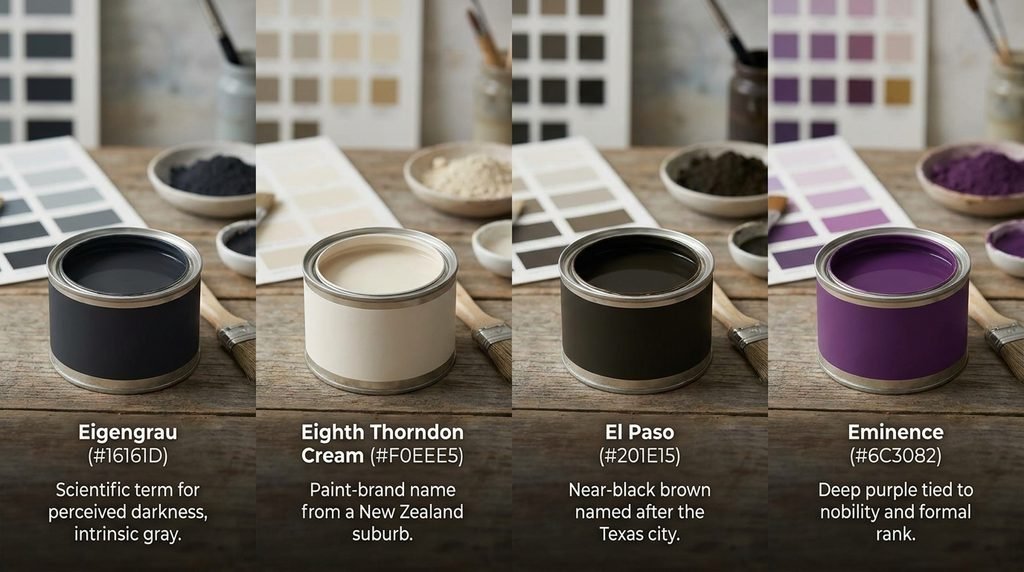
- Eigengrau (#16161D) — scientific term for perceived darkness, not true black
- Eighth Thorndon Cream (#F0EEE5) — paint-brand name from a New Zealand suburb
- El Paso (#201E15) — near-black brown named after the Texas city
- Eminence (#6C3082) — deep purple tied to nobility and formal rank
Eminence rounds out this group nicely, since its name directly references a title of high ecclesiastical or social rank, giving the deep purple shade an air of formality that matches its visual weight. Each of these four names combines genuine rarity with a documented, traceable hex code, making them solid picks for niche branding or naming projects that want something distinctive rather than generic.
Colors That Start With E Easily Confused With Each Other
Because the “electric” family packs so many similar bright shades into one letter, mix-ups happen constantly among colors that start with E. Electric Blue and Electric Cyan look nearly identical at a glance, but Electric Blue carries a touch more white brightness while Electric Cyan sits closer to pure turquoise. Electric Purple and Electric Violet cause similar confusion — both are intensely saturated, but Electric Violet leans slightly more blue while Electric Purple pushes further toward magenta.
Eggplant and Eminence get mixed up too, despite serving different purposes. Eggplant is darker and more brownish-purple, while Eminence is brighter and more clearly violet. English Green and Emerald suffer from the same overlap in casual use, though English Green is noticeably darker and more muted compared to Emerald’s brighter, more saturated tone.
| Color A | Hex A | Color B | Hex B | Key Difference |
| Electric Blue | #7DF9FF | Electric Cyan | #00FFFF | Electric Blue is slightly whiter |
| Electric Purple | #BF00FF | Electric Violet | #8F00FF | Violet leans more blue |
| Eggplant | #614051 | Eminence | #6C3082 | Eminence is brighter/more violet |
| English Green | #1B4D3E | Emerald | #50C878 | Emerald is far more saturated |
When two colors that start with E sit this close together, checking the exact hex value before finalizing a design saves real trouble later, especially with the electric family where the difference between two shades can be a handful of RGB points. Relying on the name or a small thumbnail alone is exactly how these near-identical shades get swapped by mistake.
Master Alphabetical List of Colors That Start With E
The list below runs alphabetically and combines documented traditional pigment names, historic references, and established paint-brand shades, noting origin where it matters. It includes every color discussed above, giving a full reference in one place.

- Eagle
- Eagle White
- Eagles Midnight Green
- Early Bird
- Earls Green
- Earth Yellow
- Eastern Blue
- Ebi Brown
- Ebony
- Ebony Clay
- Ecru
- Echidna
- Ecstasy
- Edward
- Eerie Black
- Eggplant
- Eggshell
- Egyptian Blue
- Egyptian Teal
- Eigengrau
- Eighth Thorndon Cream
- El Paso
- Elephant
- Elf Green
- Electric Black
- Electric Blue
- Electric Crimson
- Electric Cyan
- Electric Green
- Electric Indigo
- Electric Lettuce
- Electric Lime
- Electric Purple
- Electric Ultramarine
- Electric Violet
- Electric Yellow
- Eminence
- Energy Yellow
- English Green
- English Lavender
- English Oak
- English Red
- English Vermillion
- English Violet
- Emerald
- Eternity
- Eton Blue
- Eucalyptus
- Evergreen
Notice how many entries begin with “Electric” — twelve in total, more than any other prefix on this list. That single cluster accounts for almost a quarter of all colors that start with E, which is a pattern unique to this letter and worth remembering when browsing for a bright, modern shade specifically.
Hex & RGB Crosswalk for Colors That Start With E
Exact hex and RGB values matter because a name alone can’t guarantee consistency across screens, software, or print runs. Two people typing “Emerald” into different tools might land on slightly different greens unless they reference the same numeric code. The crosswalk below gives precise values ready to copy directly into design software or code.
| Color Name | Hex | RGB |
| Emerald | #50C878 | 80, 200, 120 |
| Egyptian Blue | #1034A6 | 16, 52, 166 |
| Electric Blue | #7DF9FF | 125, 249, 255 |
| Eggplant | #614051 | 97, 64, 81 |
| Ecru | #C2B280 | 194, 178, 128 |
| Eton Blue | #96C8A2 | 150, 200, 162 |
| Electric Indigo | #6F00FF | 111, 0, 255 |
| English Lavender | #B48395 | 180, 131, 149 |
Emerald and Eton Blue may sound related by association with nature and green tones, but their RGB values show just how far apart they actually sit — Emerald carries far more saturation and less red than the soft, muted Eton Blue. That gap illustrates why pulling the exact numeric code matters far more than trusting a name’s general impression.
Full Comparison Table of Colors That Start With E
This table shows the main colors in this guide. It includes the color name, hex code, RGB value, color family, and common use. Use it to compare shades quickly.
| Name | Hex | RGB | Family | Common Use |
|---|---|---|---|---|
| Eagle | #B6BAA4 | 182, 186, 164 | Brown-Green | Natural designs |
| Eagle White | #F0E1CC | 240, 225, 204 | Neutral | Soft interiors |
| Eagles Midnight Green | #004953 | 0, 73, 83 | Blue-Green | Sports branding |
| Early Bird | #CEA2FD | 206, 162, 253 | Purple | Modern designs |
| Earls Green | #B8A722 | 184, 167, 34 | Yellow-Green | Garden themes |
| Earth Yellow | #E1A95F | 225, 169, 95 | Yellow-Brown | Rustic designs |
| Eastern Blue | #1E9AB0 | 30, 154, 176 | Blue | Coastal designs |
| Ebi Brown | #773C30 | 119, 60, 48 | Red-Brown | Food branding |
| Ebony | #555D50 | 85, 93, 80 | Near-Black | Elegant designs |
| Ebony Clay | #253C42 | 37, 60, 66 | Blue-Gray | Modern interiors |
| Ecru | #C2B280 | 194, 178, 128 | Neutral | Textiles |
| Echidna | #745F52 | 116, 95, 82 | Brown-Gray | Earthy designs |
| Ecstasy | #FA7814 | 250, 120, 20 | Orange | Bright branding |
| Edward | #A2A58D | 162, 165, 141 | Green-Gray | Interior design |
Decision-Flow Table: Picking the Right E Color for Your Project
With over 50 colors that start with E to sort through, matching a shade to your actual project is far more efficient than scanning the entire list. Find your project type in the left column below, then choose from the suggested shades, each selected for both recognizability and reliable documentation.
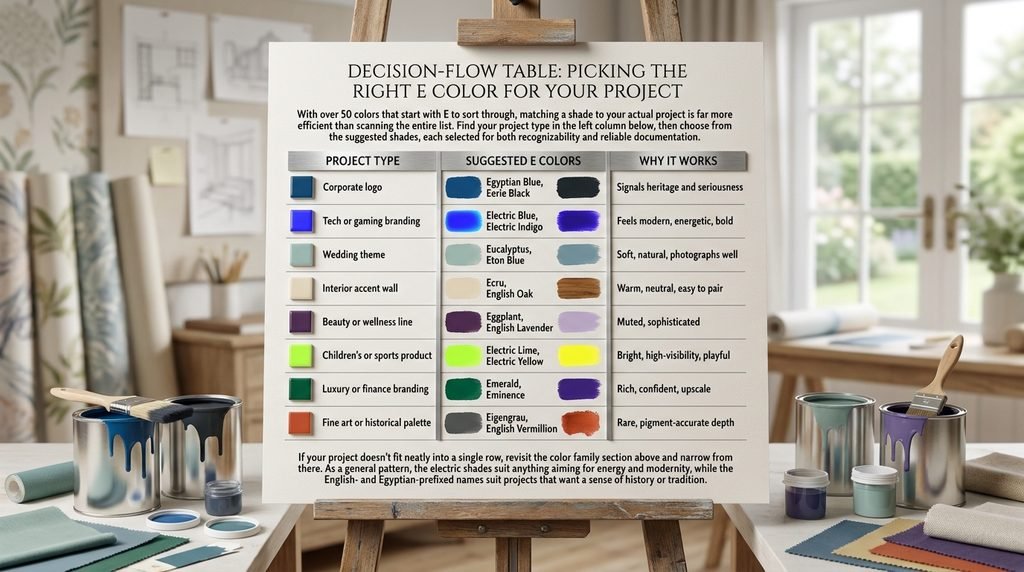
| Project Type | Suggested E Colors | Why It Works |
| Corporate logo | Egyptian Blue, Eerie Black | Signals heritage and seriousness |
| Tech or gaming branding | Electric Blue, Electric Indigo | Feels modern, energetic, bold |
| Wedding theme | Eucalyptus, Eton Blue | Soft, natural, photographs well |
| Interior accent wall | Ecru, English Oak | Warm, neutral, easy to pair |
| Beauty or wellness line | Eggplant, English Lavender | Muted, sophisticated |
| Children’s or sports product | Electric Lime, Electric Yellow | Bright, high-visibility, playful |
| Luxury or finance branding | Emerald, Eminence | Rich, confident, upscale |
| Fine art or historical palette | Eigengrau, English Vermillion | Rare, pigment-accurate depth |
If your project doesn’t fit neatly into a single row, revisit the color family section above and narrow from there. As a general pattern, the electric shades suit anything aiming for energy and modernity, while the English- and Egyptian-prefixed names suit projects that want a sense of history or tradition.
Conclusion
Colors that start with E cover a wide range of shades. For example, Egyptian Blue has a rich, historic look, while Electric Purple brings a bright and modern feel. In contrast, Ecru offers a soft and warm neutral tone.
Since the letter E has fewer named colors than many other letters, this list focuses on real and verified shades. It avoids vague names and repeated entries. For easy comparison, keep the hex and RGB values nearby when you need to match a color across screens or in print.
Overall, this guide includes more than 50 documented colors that start with E. From bold and bright shades to soft and natural tones, you may find the right color for your next project here.
Frequently Asked Questions
What are some popular colors that start with E?
Emerald, Eggplant, Electric Blue, Ecru, and Egyptian Blue are among the most recognized. Each has a well-documented hex code that stays consistent across most design tools.
How many colors start with the letter E?
This guide documents more than 50 verified colors that start with E. Other sources sometimes list well over 100 by including many near-duplicate “electric” variations or unverified brand names, which is why this list focuses on clearly distinct, well-sourced entries instead.
Why are there fewer colors that start with E compared to other letters?
There’s no standard CSS or X11 keyword beginning with E, unlike letters such as C or D. Most documented E colors instead come from historic pigments, cultural references, or paint-brand naming systems.
What color is Emerald? Emerald is a rich, saturated green with the hex code #50C878. It’s strongly associated with luxury, wealth, and nature-based branding.
Is Electric Blue the same as Electric Cyan?
They’re close but not identical. Electric Blue (#7DF9FF) carries a touch more white brightness, while Electric Cyan (#00FFFF) sits closer to pure turquoise.
What does Egyptian Blue symbolize?
Egyptian Blue is often linked to permanence, history, and craftsmanship, largely because it’s considered one of the oldest known synthetic pigments, used in ancient Egyptian art thousands of years ago.
What is the rarest color that starts with E?
Eigengrau is among the rarest, since it describes a scientific concept — the gray your eyes perceive in total darkness — rather than a typical design color. Eighth Thorndon Cream is similarly obscure, tied to a specific New Zealand paint range.